

























































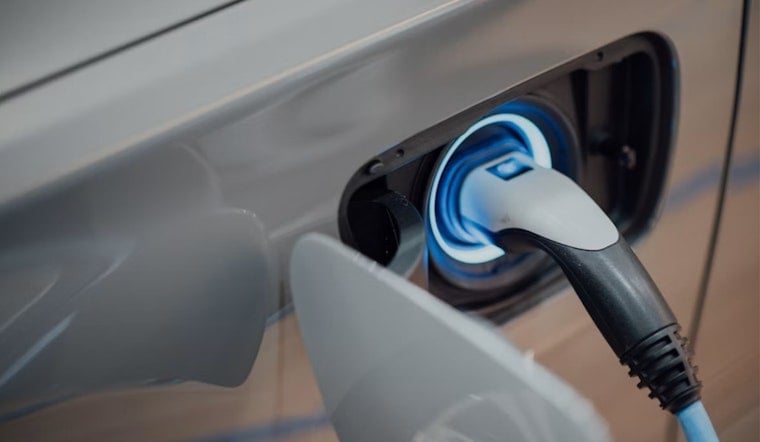
Free electric vehicle charging at Adams County government buildings is officially a thing of the past. As of August 3, the county began charging drivers $0.15 per kilowatt-hour to plug in at its public stations, ending a policy that had let EV owners charge for free since 2014.
The change, confirmed by a county spokesperson, applies to charging stations that had offered free power at seven locations for the past 12 years, according to The Denver Post. For a typical 2026 electric car, which requires roughly 50 to 110 kWh to fully charge its battery, the new rate translates to somewhere between $7.50 and $17.50 per full charge, before any additional fees kick in. Adams County operates 29 total charging ports across its facilities, including 22 publicly accessible Level 2 chargers at sites like the Adams County Government Center in Brighton, the Human Services Center in Westminster, and the Riverdale Animal Shelter.
Drivers who linger too long after their vehicle finishes charging will also feel it in their wallet. Under the county's charging policy, vehicles that remain plugged in more than one hour after charging completes are hit with a $0.25-per-minute idle fee, a mechanism aimed at freeing up stations for the next driver rather than letting cars sit parked in charging spots.
Pricing Lines Up With What Drivers Already Pay at Home
The $0.15 per kWh rate isn't far off from what many Adams County residents already pay for electricity at home. Xcel Energy's flat residential rates run between $0.10 and $0.15 per kWh, though the utility's summer on-peak Time-of-Use rates can climb to 21.3 cents per kWh, according to REenergizeCO. That positions the county's new fee closer to cost recovery than a revenue grab, since the rate roughly mirrors what the county itself likely pays for the electricity flowing through its chargers.
The timing also lines up with new statewide oversight. Effective July 1, the Colorado Division of Oil and Public Safety enacted regulations requiring any operator that charges fees at EV stations to register their equipment and meet metering accuracy standards similar to those used at retail gas pumps, per the Colorado Department of Labor and Employment. State inspections are set to begin later this year, with formal enforcement taking effect in July 2027.
A Charging Network Straining Under Rapid EV Growth
The shift away from free charging comes as Colorado's EV market has exploded. The state led the nation in EV sales share during the third quarter of 2025, with electric vehicles accounting for 32.4% of all new car sales and total registered EVs topping 210,000, according to the Colorado Energy Office. A rush to claim expiring federal tax credits helped fuel that surge, adding pressure to public charging infrastructure that wasn't originally built for this level of demand.
That growth traces back to county planning that predates the current crunch. Adams County adopted an Electric Vehicle Readiness Plan in December 2023 that set goals of converting half of eligible county fleet vehicles to electric and pushing countywide EV ownership to 5% of all registered vehicles by 2030, with Drive Clean Colorado providing technical assistance on charger deployment.
Other Incentives Remain for Adams County EV Owners
Even with the new fees, Adams County drivers still have other avenues to offset EV costs. Xcel Energy offers home wiring rebates up to $1,300 and commercial charger rebates as high as $14,170 per port, while United Power provides members a Level 2 home charger program for $19 a month, according to county government resources. Income-qualified residents can also tap the state's Vehicle Exchange Colorado program for up to $9,000 toward a new EV or $6,000 toward a used one when trading in a gas car at least 12 years old or one that failed emissions testing, per ChargerPro.
EV owners also skip a recurring cost gas drivers face. Gasoline-powered vehicles registered in Adams County must undergo $25 Air Care Colorado emissions testing every two years, while electric vehicles are entirely exempt, according to Emich Volkswagen. That inspection requirement applies across nine Front Range counties.
Under state laws HB 23-1233 and HB 24-1173, local governments and homeowners associations are barred from banning EV chargers outright, and counties with populations over 20,000 must adopt streamlined permitting processes for charger installation, according to the Colorado General Assembly. Those protections don't prevent counties like Adams from charging for the electricity itself, which is exactly the lever officials pulled here.
The move also lands against a broader backdrop of Colorado's climate goals falling behind schedule. Governor Jared Polis has set a target of 900,000 registered EVs statewide by 2030, but a state climate report released last month acknowledged Colorado is behind on its near-term 2025 emissions reduction benchmarks, as Hoodline previously reported. State modeling now suggests key emissions goals won't be fully met until the early 2030s.
Whether other metro-Denver municipalities follow Adams County's lead by monetizing their own free public chargers remains an open question, as does whether the new idle fees will actually stop drivers from hogging high-demand stations at county facilities. For now, Adams County's 12-year experiment with free EV charging has come to a close, and drivers pulling into its lots will need to plan for a bill.





