

























































Absentee ballot requests in Wisconsin were nearly 18% lower in early October than at the same point in the 2022 midterm cycle. The decline is larger in Madison and Milwaukee than in several other counties, but requests alone do not show how many voters will ultimately cast ballots by mail or in person. The figures come as David Crowley and Tom Tiffany compete for governor, and as campaign operatives offer competing interpretations of the numbers.
Wisconsin Elections Commission figures reported by WisPolitics show that voters had requested 329,449 absentee ballots by mail as of early October, compared with 400,780 at the same point in the 2022 midterm cycle. This was the first update this cycle comparable to the figures the commission posted four years ago, with the 2026 election four weeks away. Madison's requests were down 29.3% from 2022, and Milwaukee's were down 19.7%.
The county figures also show variation in the size of the declines. Dane County, home to Madison, had 15,159 fewer requests, a 23.9% decrease from four years ago. Milwaukee County was down 14,822 requests, or 21.6%. Waukesha County's requests fell 9.4%, a decline of 3,045, while Washington County's dropped 15.2%, or 1,293.
What Request Totals Can—and Cannot—Show
Milwaukee Election Commission Executive Director Paulina Gutiérrez said her office had also seen more cancellations among absentee requests on file. Some voters who canceled their mail requests told the office they planned to vote in person, either early or on Election Day. That means a lower request count may reflect a change in voting method, not necessarily a decision to skip the election.
In-person absentee voting can begin as soon as October 20, depending on the jurisdiction, and can run through November 1, with exact hours set by local municipal clerks. Gutiérrez told WisPolitics that the early-voting period will help clarify how voters are choosing to cast ballots. State election rules require a mail-in ballot to be physically received by a municipal clerk or polling site by 8 p.m. on Election Day to count, according to Votebeat; a postmark alone does not meet that deadline.
Requests Are Not the Same as Votes
The current count concerns absentee ballots requested, not completed votes. A request may later be canceled, and the request figure should not be read as a tally of ballots returned. The Wisconsin Elections Commission’s November 2020 Election Data Report recorded nearly 3.3 million voters in that general election, while also noting more than 52,000 canceled absentee requests. The commission described reports that some voters switched to in-person voting as anecdotal. Past elections show that in-person absentee voting can account for a substantial share of early ballots, but those figures do not establish how voters will shift in 2026. The Associated Press, in a report published by PBS Wisconsin, reported that 97,436 people voted in person on the first day of absentee voting before the November 2024 election. Wisconsin Public Radio reported that nearly 950,000 of the more than 1.5 million absentee ballots cast ahead of that separate presidential election were cast in person. These statewide past-election totals do not show how early voting will vary among municipalities or offset lower mail requests this year.
Parties Offer Competing Readings of the Decline
State GOP spokesperson Anika Rickard said the figures point to a lack of enthusiasm among Democratic voters in Madison and Milwaukee, while arguing that Republicans are urging their voters to cast ballots early. The comments come amid a late push from President Donald Trump. His efforts to restrict mail-in voting faced a high-profile battle over the past month, even as he posted a video, per a Truth Social post, encouraging Republicans to use every appropriate tool, including mail-in voting, to win the midterms. That stance has coincided with broader concerns about the U.S. Postal Service's ability to deliver ballots on time.
WisDems spokesperson Rachel La Due said the party was not concerned about the lower request count, attributing it to a return to pre-COVID-19 pandemic voting behavior. Wisconsin's absentee voting had already fallen nearly 23% in 2024 compared with the pandemic-era 2020 election. La Due said the party's internal data team believes Democratic voters are returning absentee ballots at a higher rate than Republicans this cycle, and that WisDems plans to increase its early-voting efforts later in October, focusing on in-person absentee voting. “Wisconsinites will bring in the blue wave on November 3rd by defeating Republicans up and down the ballot,” she said.
A Tight Race Adds Pressure to Turnout
The absentee numbers arrive alongside a tightening governor's race. A Marquette Law School poll published September 30 found Crowley leading Tiffany 49% to 46% among likely voters, as Hoodline previously reported. Spending has kept pace with the stakes: post-primary campaign spending in the race has topped $50 million, with Tiffany and supporting PACs spending $29.8 million compared to $20.9 million from Crowley and allied groups, according to The Daily Cardinal.
Historical turnout offers context, but it measures ballots cast rather than current requests; mail-in absentee voting accounted for 39.2% of votes in the pandemic-era 2020 election.
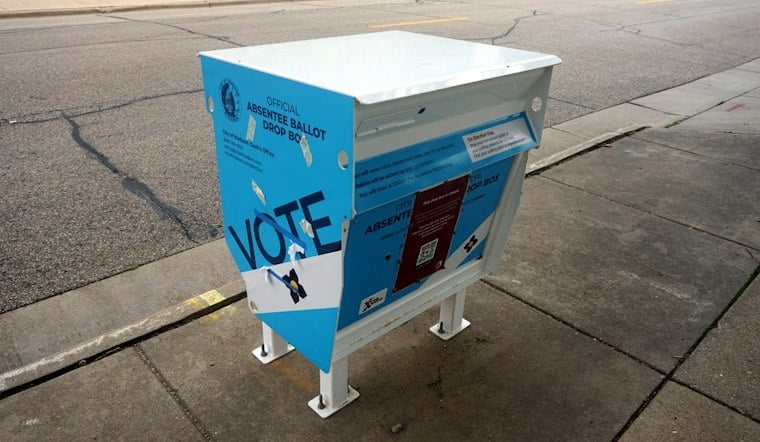
Wisconsin voters also have more flexibility in how they return ballots than they did a few years ago. A 2024 state Supreme Court ruling reauthorized local municipal clerks to deploy secure ballot drop boxes across their communities, reversing a prior restriction limiting drop boxes to clerks' primary offices, according to Democracy Docket. Mail-in absentee voters must still submit a copy of an acceptable photo ID with their ballot request and return their ballot in a sealed, witness-signed envelope, per Vote.org, though military and indefinitely confined voters are exempt from the photo ID requirement.
Voters who miss the October 14 registration deadline for online and mail registration are not out of options. They can still register in person at their municipal clerk's office through October 30, or at their polling site on Election Day itself, according to the City of Rhinelander, though proof of residence is required for any in-person registration.



