

























































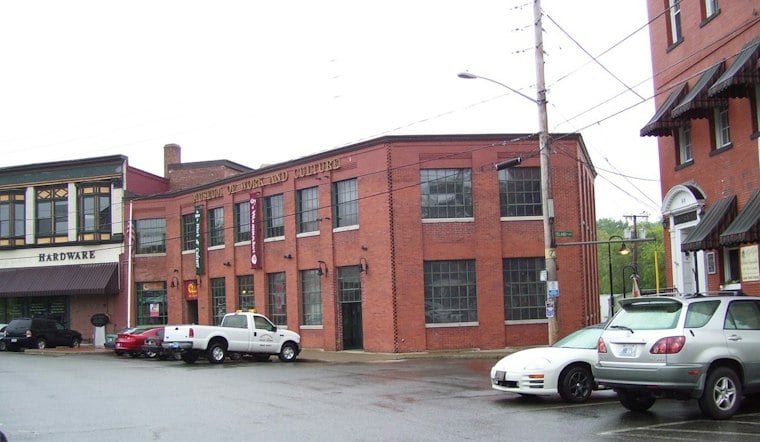
Guests rolled up to the Museum of Work & Culture in bell bottoms and polyester, stepping past vintage cars parked out front for a party that turned back the clock to 1976. The occasion was the grand opening of Welcome to the Neighborhood, a new permanent interactive exhibit exploring the diverse people and cultures who settled in Woonsocket during the 1970s. Even the ribbon-cutting ceremony got into the retro spirit when the scissors jammed mid-snip.
The Museum of Work & Culture Preservation Foundation had scheduled the 1976-themed grand-opening party for Saturday, October 24, promising an exhibit ribbon-cutting ceremony along with period food, music and dance, according to govern1.com. Partygoers were asked to wear 1970s attire for the occasion, and many obliged, including Chris and Paul Ouellette of Greenville, who showed up dressed for the decade, per The Valley Breeze. Woonsocket resident Denise Bourget was among those who took in the 1970s-themed music at the party, the outlet reports.
Scissors Stall as Officials Cut the Ribbon
The ribbon-cutting itself brought together Mayor Chris Beauchamp, museum director Anne Conway and other local participants, but the ceremonial scissors malfunctioned partway through the cut, according to the same account. The Good Living Band supplied the era-appropriate soundtrack for the celebration, with members Simon Silvia, Elizabeth Silvia-Landry, Spencer Soucy and Emily Harrison providing live 1970s music throughout the evening.
The museum is housed inside the former Barnai Worsted Company mill on South Main Street in Woonsocket, a building that has long anchored the city's telling of its industrial past, as reported by turnto10.com. The Rhode Island Historical Society lists the museum's address as 42 South Main Street and describes it as a venue that presents the story of immigrants who came to find a better life in the mill towns along the Blackstone River.
A Museum Built on Mill-Town Immigration
That mission traces back generations. The Woonsocket Historical Society notes that the first French Canadian families were recruited from Quebec to work in the city's mills in the 1840s, and by 1900 French Canadians made up 60 percent of Woonsocket's population. The group's growth continued for decades, with French Canadians representing 70 percent, or 35,000, of the city's 50,000 residents in 1930, per the historical society.
Turnto10.com reports that at one point nearly 70 percent of Woonsocket's population was French or French-Canadian, a legacy that still shapes how the museum frames its exhibits on Rhode Island's industrial rise. The Woonsocket Historical Society also notes that as cultural ties among the city's French Canadian descendants have loosened over time, use of the French language in the city has diminished as well.
More Immigrant Stories Planned for the Future
Welcome to the Neighborhood is billed as a permanent exhibit celebrating the stories, cultures and community spirit of the many groups who made Woonsocket home in the 20th century, according to the museum's announcement on govern1.com. Museum leadership has signaled that the storytelling will not stop with the 1970s theme. Turnto10.com reports that future exhibits will also recognize other immigrant groups that shaped the city, including Irish, Italian, Polish and Ukrainian communities, continuing the museum's focus on the people who built Woonsocket's neighborhoods one generation at a time.





