

























































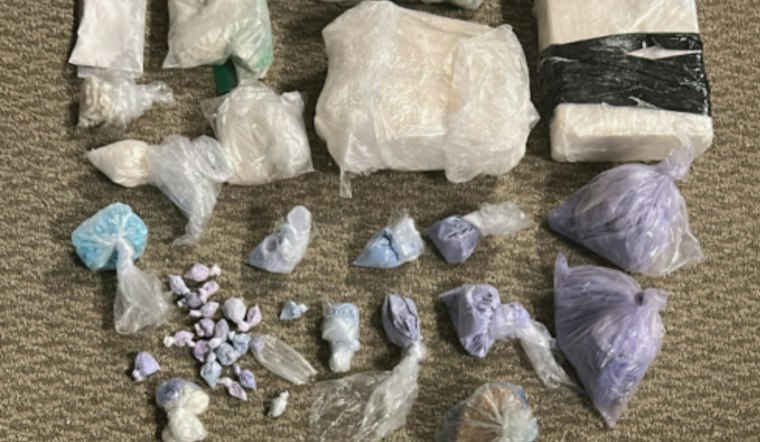
A 28-year-old Worcester man is facing a federal drug charge after investigators say they recovered more than three kilograms of fentanyl from his one-bedroom apartment, along with a suitcase of gear allegedly used to cut and package the drug for sale. Junior Tejada Hernandez now faces one count of possession with intent to distribute controlled substances, a charge that carries the possibility of decades behind bars.
According to This Week in Worcester, investigators found more than three kilograms of fentanyl inside Hernandez's apartment. Tucked inside a suitcase in the bedroom closet, the outlet reports, were cutting agents, baggies, a sifting device, scissors, and a blender allegedly used to mix the drug with dilutants before it hit the street. The U.S. Drug Enforcement Administration considers just two milligrams of fentanyl a potentially lethal dose, a scale that underscores why federal prosecutors treat kilogram-level seizures so seriously.
The dates surrounding Hernandez's arrest are not entirely consistent across reporting. This Week in Worcester states that authorities arrested him on October 21 and that he was scheduled for an initial appearance in federal court the following day. The Fall River Reporter, meanwhile, reported that Hernandez was arrested on October 24 and would appear in federal court in Worcester the next day. Hoodline could not independently resolve which timeline is accurate.
What Was Allegedly Found Inside
The Fall River Reporter's headline framed the seizure in stark terms, stating that authorities found enough fentanyl to kill 1.5 million people. The Department of Justice, in a statement cited by This Week in Worcester, said Hernandez's immigration status is unknown at this time. The charging documents reflect allegations only, and the claims within may be challenged by the accused in court, per the same outlet's reporting.
If convicted, Hernandez would face up to 20 years in prison, at least three years of supervised release, and a fine of as much as $1 million, This Week in Worcester reports. Any eventual sentence would be determined by a federal judge applying U.S. sentencing guidelines and the governing statute.
A Pattern of Large Seizures Around Massachusetts
This case is not an isolated one in the region. The same outlet noted that on October 15, a man living at a Revere hotel pleaded guilty to possessing more than 4.5 kilograms of fentanyl along with an assault rifle. Separately, federal prosecutors in Massachusetts announced the indictment of 27-year-old Omar Ramos-Jimenez on two counts of distribution of and possession with intent to distribute 40 grams or more of fentanyl, according to the U.S. Attorney's Office for the District of Massachusetts.
Those cases arrive against a backdrop of shifting overdose numbers statewide. For the first time in more than a decade, total annual opioid-related overdose deaths in Massachusetts fell below 1,000, according to preliminary data cited by the Massachusetts Executive Office of Health and Human Services. The state's Department of Public Health tracks overdose and substance-use data to identify service gaps and target interventions, per the same state source.
Immigration Status Remains Unresolved
Federal immigration authorities lodge detainers only after officers or agents establish probable cause that a person is removable, typically after a conviction and when the individual is considered a public-safety or national-security threat, according to U.S. Immigration and Customs Enforcement. In Hernandez's case, the Justice Department has stated only that his immigration status is unknown at this time, and that detail has not been further resolved in available reporting.
As with any federal case, Hernandez is presumed innocent unless and until proven guilty beyond a reasonable doubt in court. The charging-document details made public so far remain allegations, and Hernandez retains the right to challenge them before a judge.



