

























































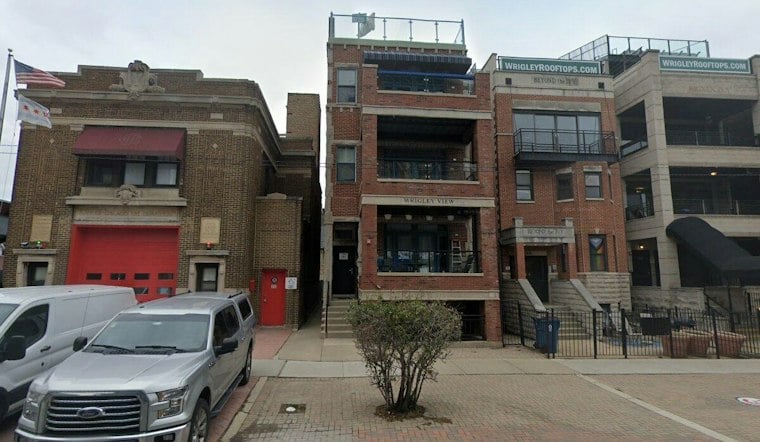
A federal judge has barred Wrigley View Rooftop and its owner, Aidan Dunican, from selling seats to watch games or events at Wrigley Field without the Cubs’ authorization. Dunican’s business had sold rooftop seats on Waveland Avenue for about three decades.
U.S. District Judge Sharon Johnson Coleman granted summary judgment on September 30 and issued a permanent injunction against Wrigley View Rooftop and Dunican, 64, according to VitalLaw. The Cubs sued Dunican and his business, Rooftop by the Firehouse, Inc., on June 18, 2024, alleging misappropriation, unjust enrichment and trademark infringement after the venue continued selling tickets after its contract with the team expired, according to FindLaw.
Per ABC7 Chicago, Dunican bought the four-story Waveland Avenue building for $400,000 in the late 1990s and built two rooftop decks on it, later investing more than $2 million in renovations in 2010. He lives on the building's third floor, rents out another unit on Airbnb, and hosts rooftop guests across the top three floors — all while holding a city license to operate during Cubs games, the outlet reports.
A Business Built on Views, Beer, and Ballpark Nostalgia
ABC7 Chicago reported that Wrigley View Rooftop charges $100 to $300 per seat, with food and an open bar included, and can host about 200 people. Dunican told the outlet the business brings in roughly $1 million a year before expenses; he generally opens for a game when at least 50 tickets sell.
Dunican moved to Chicago in 1981, and Wrigleyville rooftop seating has drawn fans since the 1990s, back when the arrangement was still informal. The city didn't formalize the practice until 1998, when it created a Special Club License framework that turned residential rooftops into regulated commercial hospitality venues, per WTTW News. After the city's 2006 ordinance amendments, rooftop operators collectively spent more than $50 million on structural, safety, and fire-code renovations to stay compliant, the same outlet notes.
From Revenue-Sharing Deal to Courtroom Defeat
The legal framework that let Dunican operate for two decades came from a January 27, 2004 settlement between the Cubs' former owner, Tribune Co., and several surrounding rooftop businesses, requiring operators to pay 17% of profits plus 11% of billboard advertising revenues, a 2004-era document cited in federal court filings shows. That agreement expired after the 2023 season, and according to ABC7 Chicago, Dunican offered the Cubs 20% of gross revenue to renew it — while the team countered by asking for 30% of regular-season revenue and 40% of postseason revenue.
After negotiations failed, the Cubs installed translucent screens and raffle lettering that ABC7 Chicago reports obstruct views from Dunican’s rooftop. The team has said businesses cannot commercially profit from Cubs games or use Cubs intellectual property without authorization, the outlet reported.
In explaining the ruling, Judge Coleman relied on the principle that unfairly benefiting from another party’s labor and expenses can offend justice, equity and good conscience, according to ABC7 Chicago. The decision also drew on Pittsburgh Athletic Co. v. KQV Broadcasting Co., a 1938 case concerning a sports team’s right to prevent unauthorized commercial exploitation of the live-game experience, as described by FindLaw.
Still, the Cubs didn't win on every front. Judge Coleman rejected the team's Lanham Act false advertising claim, finding the Cubs failed to show that Wrigley View's description of itself as an “Official Partner” actually influenced customer purchasing decisions, per the VitalLaw report. After the lawsuit was filed in 2024, Wrigley View had directed employees to remove Cubs logos and reworded event listings to read “Chicago vs. [opposing team]” on its ticketing channels in an attempt to limit trademark liability, the same filing indicates.
A Decade of Friction Between Rooftops and Ownership
Rooftop operators have previously challenged the Cubs in court over changes to the ballpark. In 2015, independent rooftop owners sued the team, alleging breach of contract and antitrust violations after planned outfield video scoreboards threatened their sightlines, according to DNAinfo. The Ricketts family, which owns the Cubs, owned 10 rooftops by January 2016, the outlet reported.
How the Earlier Rooftop Case Was Different
A separate Chicago case began in January 2015, when Right Field Rooftops and related entities sued over the Cubs’ planned right-field video board and billboard signage. The federal court denied the operators’ request for a preliminary injunction, finding they had no likelihood of success on the merits, according to the U.S. District Court for the Northern District of Illinois. That case concerned planned stadium construction; Dunican’s case concerns ticket sales after his agreement with the Cubs expired.
The Cubs have also expanded their presence around the ballpark, including by opening a merchandise store in a former CVS across from Wrigley Field, according to ABC7 Chicago.
What's Next for Dunican
Dunican intends to keep fighting to keep the business operating. “People are still coming,” he said.
Dunican is weighing his options for an appeal, ABC7 Chicago reported, and plans to continue fighting to keep the business operating next season. If he appeals, the appeal will determine whether the injunction remains in place.



