

























































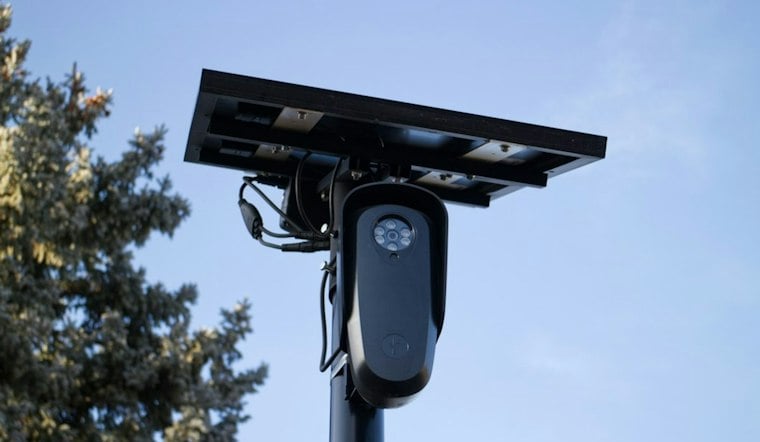
U.S. Sen. Ron Wyden stood near Clackamas Town Center and called a Flock camera a weapon of mass inspection, throwing his support behind a statewide effort to outlaw the automated license-plate readers across Oregon. Two state lawmakers, Portland Democrat Willy Chotzen and Douglas County Republican Alek Skarlatos, plan to introduce a bill banning Flock devices and similar cameras during the 2027 legislative session, which begins in mid-January.
Wyden said the cameras, which law enforcement uses to scan and track license-plate data, expose everyone in America to the weaponization of surveillance. His backing adds a prominent federal voice to a fight that has already drawn support from the Oregon chapter of the American Civil Liberties Union, which notes that the cameras record not just plates but a vehicle's make, model, color and even scratches and dents. Flock operates cameras in all 50 states, and Oregon alone has roughly 400 of them, including 58 in Eugene and 49 in Portland, according to The Oregonian/OregonLive.
Backlash Builds Even As Police Defend the Tool
Flock cameras have sparked data-privacy concerns and bipartisan backlash across the country, and Oregon is no exception. Chotzen told the outlet he is quite confident the bill will pass next session, while Skarlatos is co-sponsoring the measure alongside him.
Law enforcement officials have defended the devices, pointing to their role in locating stolen cars and wanted criminals — including, officials say, the man suspected of killing five people in Forest Grove, who was located with help from Flock devices. That tension between investigative value and privacy risk has defined the debate statewide, with the technology's backers and critics both pointing to real-world cases to make their case.
False Accusations and Immigration Fears Fuel Distrust
Policymakers and civil rights groups have also raised concerns about law-enforcement abuse of the technology and false accusations tied to it. Denver police reportedly relied on Flock camera data in 2025 when they wrongfully accused a woman of stealing an Amazon package, a case that has become a cautionary example for critics nationwide. Flock data, opponents note, can be collected about all people regardless of whether there is any evidence or suspicion of wrongdoing.
Officials have also expressed concern that the technology could aid federal immigration enforcement without Oregonians' awareness. Those fears aren't hypothetical in this state: an audit confirmed that federal agencies tapped into Woodburn's camera network, with Homeland Security Investigations conducting 175 searches between March and May 2025 and U.S. Border Patrol logging 209 more between May and June of that year, according to reporting on Woodburn's decision to remove its cameras entirely. Bend Police reported a similar pattern, with federal immigration officials making 279 queries into its Flock database in just the first three weeks of a June 2025 pilot, according to the Bend Source. Bend's City Council later voted to shut off its cameras immediately and let the contract expire.
A Wave of Cancellations Across Oregon
Eugene, Springfield, Bend, Talent, Winston and Woodburn have all signed contracts with Flock only to cancel or suspend them in recent months, citing safety and privacy concerns, per the Lookout Eugene-Springfield's reporting on how left and right have found common ground in opposing the cameras. At least six Oregon cities and two counties have now canceled or curtailed Flock contracts over privacy and data-leak worries, the outlet reports. Eugene's City Council set an early marker when it voted unanimously on October 8, 2025, to turn off the city's cameras until further notice.
The pushback isn't limited to Oregon. State legislatures in Washington, Kentucky and Oregon all enacted statewide restrictions on the technology in 2026, according to The Marshall Project. Texas Gov. Greg Abbott barred state agencies from spending money on Flock cameras last month, and Florida's ban on local police installing the readers on state roads took effect October 1. Flock itself has responded to the pressure by shortening its standard data-retention period from 30 days to seven.
What the Research Shows
The debate isn't purely about privacy versus safety in the abstract — there's data on both sides. A study comparing 216 police agencies that adopted Flock with thousands that didn't found an 11% decline in vehicle theft and a 16% increase in theft-clearance rates after installation, per the same Marshall Project investigation. Flock maintains that the license-plate data its system gathers is owned by its customers, who decide whether to share it with other agencies under applicable laws and policies.
Flock spokesperson Andrew Smith has pushed back on the idea of an outright ban, telling OPB that a blanket ban would take a proven investigative tool away from communities and officers who rely on it. OPB also reports that Chotzen serves as vice chair of the House Judiciary Committee, a position that could shape how the bill moves through the chamber. The Portland Police Bureau, for its part, operates five automated license-plate readers made by Motorola Solutions and has used the technology for more than a decade — a reminder that Flock's cameras aren't the only plate-reading systems in play as lawmakers weigh how broad any new ban should be.





