

























































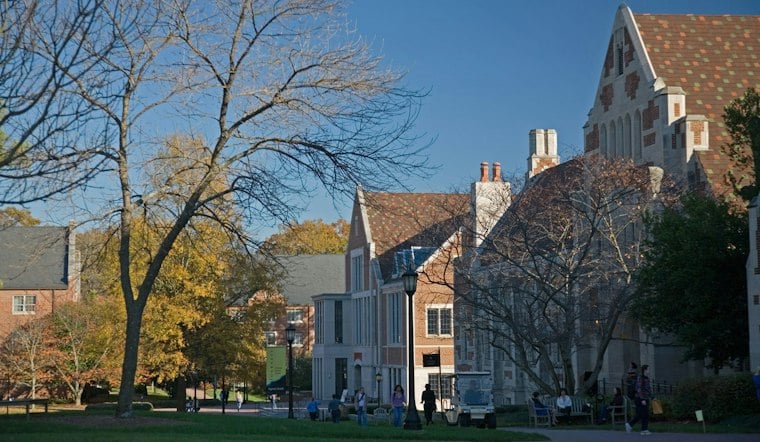
A permanent art installation called “Let Us Meet on the Land” is being crafted for Agnes Scott College in Decatur, honoring the Muscogee (Creek) people through an interactive artwork placed near Presser Hall. The piece is the latest project from Beacon Hill Black Alliance for Human Rights’ Art for the People initiative, and it brings together an Afro-Indigenous artist from Portland and a Chicago-based Afro-Indigenous visual artist to tell a story organizers say reclaims ancestral space.
The monument is a collaboration among Beacon Hill Black Alliance for Human Rights, Decatur Makers and Agnes Scott College, according to Decaturish. Per the news release the outlet cited, Art for the People aims to reclaim ancestral space and honor shared Black and Indigenous histories. A ceremonial land blessing and artist reception are scheduled next to Presser Hall from 5:30 to 7:30 p.m. Tuesday, and public kickoff events are set to introduce the artists and the vision behind the monument.
Leading the design are Amber Starks, an Afro-Indigenous artist and enrolled citizen of the Muscogee Nation based in Portland, Oregon, and Monica Rickert-Bolter, who is crafting the artwork alongside her. The same report describes Rickert-Bolter as a Chicago-based Afro-Indigenous artist, visual artist and journalist, while the National Museum of the American Indian notes she is of Black and German descent and a citizen of the Prairie Band Potawatomi Nation. Both Starks and Rickert-Bolter are expected to attend a reception following the ceremony.
A Community Conversation on Design and History
Decatur Makers will host an art-focused community conversation featuring Starks alongside Rhonda Grayson, a descendant of the Muscogee Black Freedmen, the Decatur-based outlet reports. That conversation is set to cover the artwork’s design, fabrication plans, historical context and opportunities for community participation — details that, as of now, remain otherwise unspecified.
Fonta High, co-chair of Beacon Hill Black Alliance for Human Rights, said the Art for the People initiative holds significant meaning for the Decatur community and opens conversations about accountability and reparations. High also said the initiative serves as a vehicle for uncomfortable conversations and history-telling that cannot be trusted to be told in the American classroom, according to the same account.
Roots in a 2020 Proposal
The project traces back to a 2020 proposal in which Beacon Hill told the City of Decatur it was working with Decatur Makers to construct public artwork meant to educate residents about the history of white supremacy and colonialism in Georgia, according to a City of Decatur civic document. That proposal described artwork exploring the intertwined histories of Indigenous people violently forced off land that Africans were then brought to work on.
The 2020 filing set a tentative $40,000 fundraising goal, including $10,000 for an artist commission and $25,000 for fabrication, and said Beacon Hill was requesting $15,000 from the city’s Anti-Racism Education Fund. Those figures reflect the original proposal rather than the project’s current budget. Separately, The Atlanta Journal-Constitution reported that Decatur planned to contribute $5,000 to the Art for the People project, at a time when the format and location were still unsettled and plans called for installing the work in the Beacon Hill community just southwest of Decatur’s square.
Part of a Broader Pattern of Public Art
Art for the People describes itself as a project of Beacon Hill Black Alliance for Human Rights in partnership with Decatur Arts Alliance and Decatur Makers, according to the group’s own site, which frames its mission around lifting up the artistic expression of the Black and Indigenous community and reflecting voices of people of color. Beacon Hill has previously explained its broader approach to public art in similar terms, telling the Atlanta History Center’s UnderCurrent that after a divisive symbol comes down, there does need to be something in its place that speaks to, but from a different perspective of, what was there before, centering the stories of the people that the symbol wished to oppress.
That philosophy has shaped earlier work. After the Decatur Confederate Obelisk was removed, Beacon Hill commissioned a community-led piece called “What Sonia Said,” per the same UnderCurrent account. More recently, WABE reported that DeKalb County installed a marker on Decatur Square honoring the Muscogee (Creek) people and acknowledging their forced removal from ancestral lands, a marker that also recognizes the October 2021 removal of what activists called the genocide cannon.
The Agnes Scott installation follows that same throughline, placing a new Afro-Indigenous artwork at a campus that, as recently as August 2024, was the site of a very different kind of public gathering — move-in day, captured in a photo credited to Dean Hesse. Tuesday’s land blessing marks the next chapter for a campus community preparing to live alongside a monument meant to hold centuries of history in public view.





