

























































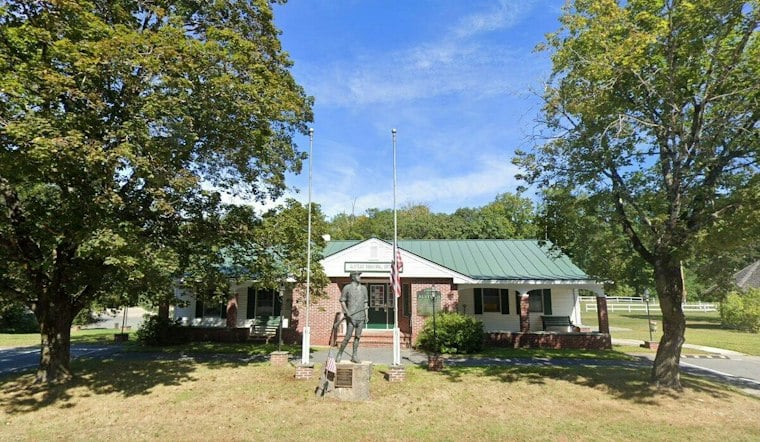
Alstead’s police department is down to a single full-time officer, and the part-time administrative assistant who keeps the office running is retiring. Facing that reality, a town committee met at the Alstead Town Fire Station on Tuesday and recommended two paths forward that would both keep local policing intact, rather than handing the job to an outside agency.
About 30 residents turned out for the meeting, where the Alstead Police Services Committee laid out its findings after months of studying what the town’s roughly 2,000 residents, spread across 40 square miles, might do without a local department, according to The Keene Sentinel. The committee told residents that neighboring Walpole, the Cheshire County Sheriff’s Office and New Hampshire State Police could not take on everyday or consistent full-time policing duties in Alstead, leaving the town with few alternatives to maintaining its own force. The Alstead Police Services Committee was formed by the town to present options after the retirement of longtime Chief Murrell, according to the Alstead Police Department.
Outside Agencies All Said No
The department has been operating with just one officer since the longtime chief retired and another officer departed for a different area department, leaving Cpl. Wendy Underwood staffing the office 40 hours a week. Committee chair and selectboard member David Hogan said the Cheshire County Sheriff’s Office told the committee it wouldn’t be able to staff consistent coverage either, and New Hampshire State Police Troop C said it couldn’t staff full-time patrol coverage in Alstead. Troop C already covers nearly 40 towns across two counties, and any coverage it did provide would be billed to Alstead as overtime, per Hogan.
Walpole Police, meanwhile, made clear they weren’t interested in taking on another town and instead wanted Alstead to retain its own service, Hogan said. If Alstead’s department were to disband entirely, the town would fall back on Troop C’s emergency response rather than any dedicated local patrol. The committee’s report acknowledged that recruitment realities across the county and state could constrain Alstead’s options no matter which service model residents prefer, since those agencies are themselves struggling to hire and keep staff.
Two Options, Two Price Tags
After weighing choices that ranged from contracting out coverage to disbanding, shrinking, growing or simply maintaining current funding, the committee settled on two recommendations to send to the selectboard, both designed to preserve local service. The first option would keep one full-time officer, one part-time administrative assistant and the possibility of adding a part-time officer, at an estimated cost of $135,692 to $156,791 for the coming year — a figure that excludes health insurance, benefits and related costs. The second option would fund two full-time officer positions along with a part-time administrative assistant and potential part-time officer, running an estimated $223,039 to $258,115. For comparison, the department’s current annual budget is $225,889, also excluding benefits.
Seven of the committee’s nine members voted to recommend keeping the department in some form. Gordon Kemp voted to recommend discontinuing it, while Officer Wendy Underwood abstained from the vote.
Why Residents Say Local Policing Matters
Hogan argued that community policing carries intangible value that’s hard to capture in a budget line — officers who know neighborhoods and families can sometimes intervene before a situation becomes an emergency, he said, and local control gives the town more accountability and transparency over its own police force. He also warned that reestablishing a disbanded department later would be very difficult and expensive, and that the cost of doing so would most likely be untenable for Alstead.
Resident Gail Rowe, in a letter to the selectboard, said having nearby police who know the community is imperative, describing past responses from Alstead officers as prompt, supportive and professional. The department has provided school event coverage, downtown walk coverage and school-zone traffic control, and it helped local schools obtain an emergency alarm system to rapidly notify police.
Kevin Hicks told the committee that Officer Underwood remains a resource even when she’s off duty, often answering his calls directly, and said police involvement helps students understand health and safety concerns. “Early intervention is going to create a better human being in the long run,” Hicks said. He noted that while state police respond to emergencies at Langdon and Acworth schools, they lack the intimacy of knowing the children that comes with community policing.
Penny Gendron, the department’s administrative assistant, said much of the department’s actual work is social work rather than crime fighting — a role she said state police would not be able to fill. Emily Sherwood, an Alstead firefighter and committee member, said preserving the police department matters beyond Alstead’s borders because the region’s fire, police and EMS services all depend on mutual aid between towns.
A Regional Staffing Crunch
Alstead’s predicament reflects a broader strain across New Hampshire law enforcement. As of August, departments throughout the Monadnock Region were short roughly 25 officers, including five vacancies apiece in Keene and Swanzey, according to The Keene Sentinel. Nearby Chesterfield has been left with Chief Lance Rouse as its only officer in what would be a six-person department at full staffing, while Rindge ended 24/7 police service in April because of staffing challenges. Not every town has gone the same direction, though — Nelson residents narrowly voted in March to keep their town’s one-officer department rather than contract with the Cheshire County Sheriff’s Office, and towns including Gilsum, Roxbury, Stoddard, Sullivan and Westmoreland already rely on the sheriff’s office or state police for coverage.
The shortage extends well beyond the Monadnock Region. New Hampshire police departments are seeing a significant decline in applicants statewide, making vacancies harder to fill, according to WMUR. Nashua has lost 40 officers with one to 17 years on the job over the past five years and sits 22 officers below its capacity of 182; Manchester is short 24 of 271 positions, and Rochester is down 11 of 65. New Hampshire State Police need 64 more officers to reach full staffing of 360. Nashua Police Chief Kevin Rourke told the station the shortages make the job harder on remaining officers because they must cover more ground. A separate Union Leader report similarly described New Hampshire departments statewide as facing fluctuating, worrisome officer shortages.



