

























































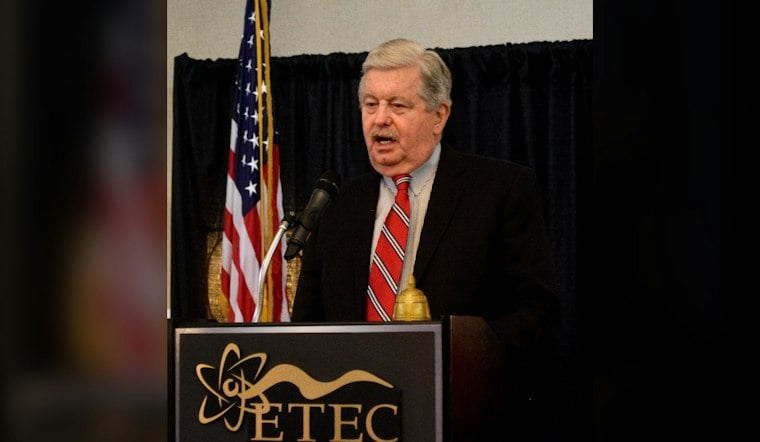
Tennessee State Senate District 5 is getting its first new face in decades, as Republican Jimmy Matlock and Democrat David Miller compete to succeed Randy McNally, who is retiring at the end of his current term. The district stretches across all of Anderson and Loudon counties and into part of Knox County, and the two candidates have staked out sharply different approaches to affordability, taxes and the role of government heading into the race.
McNally's departure closes out a tenure that different outlets have measured differently. WATE 6 On Your Side reports he has held the seat for 40 years, while Tennessee Lookout describes him as retiring after 39 years in the seat. Either way, his exit opens a rare vacancy in a district that, per Knox News, covers all of Anderson and Loudon counties and extends into west Knox County.
A Tire Shop Owner Running on Fiscal Caution
Matlock, a former state representative and businessman, served in the Tennessee House from his 2006 election through 2018, according to Tennessee Lookout, and operates Matlock Tire, a family business with five locations across East Tennessee. He has described himself as a fiscal conservative and compares government service to serving a customer at his business.
On the economy, Matlock has said the government cannot fix the economy on its own and that people must make harder decisions about spending and possible luxuries. He's also said he believes voters are anxious and are looking for someone they can trust. When it comes to housing affordability specifically, Matlock told Yahoo, “I'm not for the government jumping too far in because we tend to overmanage. ... I think the free market probably is the answer,” a framing also captured in the Knox News voter guide.
A School Board Member Pointing to Grocery Bills
Miller, the Democrat in the race, serves on the Anderson County School Board. His exact current occupation is described inconsistently across sources: Tennessee Lookout identifies him as a public school teacher and Anderson County School Board member, while a separate Knox News voter guide profile lists him as a retired educator and Anderson County school board member.
Miller has said Tennessee is not doing enough for working people, and has connected that concern to his own life, saying his father died when he was five years old. He told Yahoo that sales taxes on food, combined with spending on school vouchers, leave less money available for housing affordability programs, saying, “it doesn't allow there to be money available to create programs for people to afford their rent.” Miller has also said the sales tax applied to purchases at Kroger is an important issue for people's lives, and that he supports keeping Tennessee's primaries open, telling Yahoo, “I think there should be open primaries.”
Affordability Versus Culture-War Framing
Miller has drawn a contrast between his affordability-focused campaign and what he describes as Republicans' emphasis on culture-war issues, and has said his election would signal to Republicans in office that they should address people's needs rather than focusing only on corporate interests. Knox News notes that Miller did not participate in the outlet's voter guide online questionnaire, even though the newspaper invited the Democratic and Republican Senate nominees to its office for in-person interviews and to complete the questionnaire.
The grocery tax that Miller has criticized sits at the center of a broader statewide debate. Tennessee charges a 4% tax on groceries, which Think Tennessee ranks as the sixth-highest grocery tax rate in the nation, generating a revenue picture that remains central to state budget debates. WKRN reports that tax brings in more than $800 million a year, and that lawmakers have floated options ranging from eliminating the tax altogether to a partial reduction or a cut limited to produce.
Sources differ on just how many states still tax groceries at all. Think Tennessee has put the number at 13 states, while WKRN describes Tennessee as one of about 10 states that still implements such a tax. Think Tennessee has also reported that sales taxes made up 58% of Tennessee's tax revenues in 2021, compared with 42% across the Southeast and 33% nationally, underscoring how heavily the state leans on consumption taxes like the one Miller has highlighted on the campaign trail.





