

























































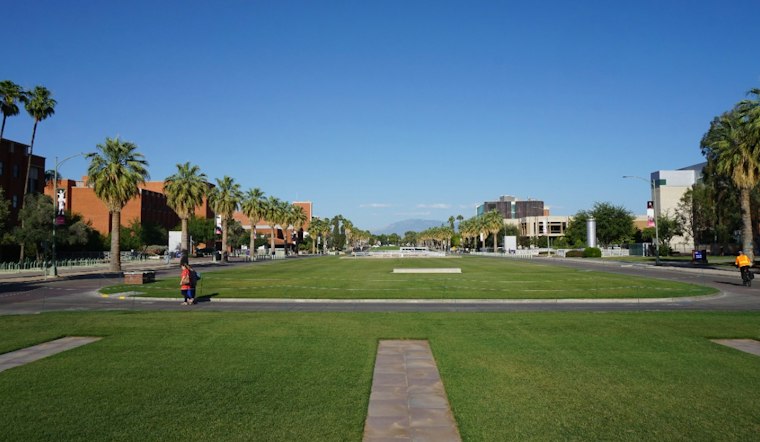
Arizona's three public universities are enrolling far fewer international students this fall, with university leaders and higher education groups pointing to visa delays and shifting federal immigration policy as the driving force behind the decline. The University of Arizona, Arizona State University and Northern Arizona University all reported drops steeper than last year's, according to ABC15 Arizona.
At the University of Arizona, international enrollment fell about 18% to 2,721 students this fall, according to Arizona Luminaria. Northern Arizona University's international enrollment reportedly declined 32%, per ABC15, the steepest drop among the three schools. Arizona State University's numbers vary depending on the source: ABC15 cited a 21% decline, which matches a separate report from The Arizona State Press putting ASU's fall 2026 headcount at 11,500 international students from 174 countries, down from the prior year. AZFamily, however, reported ASU welcomed 11,000 international students this fall, down from 14,000 the year before — a 20% drop.
Visa Delays Named as the Core Problem
ASU Vice President of Academic Enrollment Matt López told the State Press the decrease is due entirely to delays and visa denials affecting students who had already been admitted. ASU President Michael Crow addressed the enrollment decline before a state committee with the Arizona Board of Regents last Thursday, saying two principal factors were driving the disruption. Crow said more than 80% of the enrollment variability stemmed from non-American admitted students' difficulty obtaining visa appointments and visa approval, according to ABC15.
Arizona Luminaria's report on the same appearance noted Crow said most of the disruption came from visa delays for admitted international students, along with changes to federal financial aid rules for part-time online students. The university is now offering alternatives for students who can't get to campus, including starting classes online, studying through a partner university, or enrolling at ASU London — a new option this year, per the State Press.
A National Pattern, Not Just an Arizona Problem
The American Council on Education has said the decline is part of a national pattern, according to ABC15. Sarah Spreitzer of the council said a historic drop in international student enrollment began last year, and that uncertainty and concern about changes to legal immigration and visa policies are contributing to the slide.
National figures back that up. New international students studying in the U.S. fell 17% in fall 2025 compared with the previous year, according to a U.S. Department of State and Institute of International Education snapshot cited by CNBC. Common App data showed international undergraduate applicants fell 10% for the 2026–27 academic year — the steepest decline on record, per the same CNBC report, which also noted IIE's Spring 2026 Snapshot had already estimated another drop in overall international enrollment for the upcoming fall.
U.S. student visa issuances fell 23% in 2025 compared with 2024, according to Department of State figures reported by Inside Higher Ed. F-1 visas, the category most international students use, declined 33.4%, compared with drops of 9.9% for J-1 visas and 6.7% for M-1 visas. Visa issuances for applicants from China and India fell 28% and 56.6%, respectively, from 2024 to 2025, the outlet reported — and NAFSA, an association for international education professionals, has projected the decline in international students for the 2026–27 academic year will cost the U.S. economy $3.4 billion.
The Dollars and Jobs at Stake for Arizona
The stakes for Arizona's economy are considerable. ASU research found that international students have an economic impact of nearly $700 million in the state, according to ABC15. A more detailed estimate from ASU News put the total annual impact of international students' tuition and non-tuition spending at $679 million in Arizona GDP, supporting 5,954 Arizona jobs. ASU had hosted 18,400 international students during the 2023–24 academic year, more than 10% of its total enrollment, according to Inside Higher Ed.
Not every data point points downward uniformly — in September, Arizona Board of Regents executive director Chad Sampson told KJZZ that Arizona's public universities have done better than other universities nationally in being able to maintain their students and recruit students. Still, the overall trend across the state is downward: Arizona Luminaria reported combined enrollment across the three public universities slipped 0.2% this fall, which it described as the state's first statewide decline in 10 years. The University of Arizona's total enrollment, international and domestic combined, fell from 54,384 students in fall 2025 to 49,104 this fall, per the same Luminaria report.
Students React to the Shrinking Pipeline
For students on campus, the decline is personal. Aarnav, a student quoted by ABC15, said qualified students should be able to come to the United States and that many international students come for a better education. Zach, another student interviewed by the outlet, said he considers the decline unfortunate and said he appreciates international students and their contributions.
Universities are responding by offering options such as online classes in hopes of bringing international students back once visa processing eases, according to ABC15. But Common App researchers told CNBC that fewer students outside the U.S. are even creating accounts to apply, warning that the pipeline for future international enrollment is likely to shrink further — a sign that Arizona's universities may be contending with this trend well beyond the current academic year.




