

























































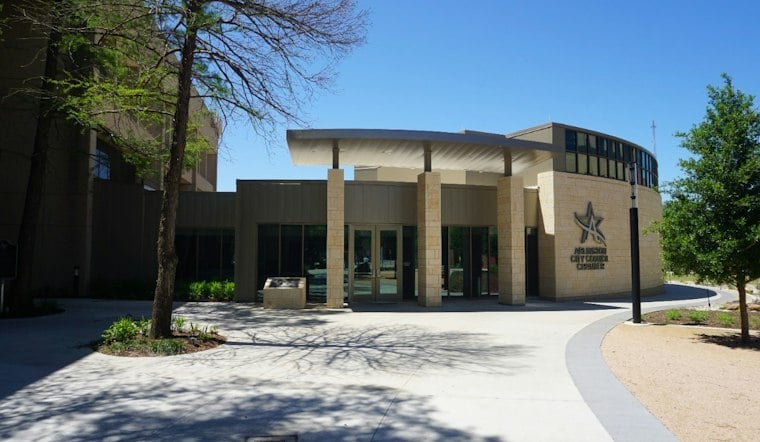
Arlington city leaders spent two public meetings this week defending the police department’s network of 134 Flock license plate reader cameras, a system that scanned 1.5 million unique plates in the 30 days leading up to Wednesday. The sessions, a town hall Monday and a city council work session Tuesday, were called to address mounting public concern over how much of residents’ daily movement the cameras are capturing and who gets to see it.
According to Fort Worth Report, the discussions were meant to directly confront privacy worries that have been building around the Flock system, a brand of automated license plate readers that Police Chief Al Jones said the department has relied on in some form since 2010 without any reported issues. Jones told attendees the questions residents are raising are legitimate, but he said the cameras remain, in his words, invaluable for solving crime in Arlington — pointing to a case where officers located the suspect in a kidnapping within 36 minutes of receiving the initial report in December 2025.
A Murder Case Traced From Dallas-Fort Worth to Houston
Jones also described how Flock cameras helped track the suspect in the December 2023 murder of 56-year-old Tho Tieu, a case in which the suspect had reportedly followed Tieu beginning the night before the killing and changed license plates multiple times during the crime. The cameras helped investigators trace the suspect’s path through Dallas-Fort Worth and all the way to Houston, where he was ultimately arrested, Jones said. He added that the technology has also been used to recover stolen vehicles and to help protect children from sex offenders.
Mayor Jim Ross, who hosted Monday’s town hall, said the city is trying to strike a balance between protecting the community and respecting concerns about surveillance. He compared the current unease over Flock to earlier public resistance when police departments shifted from radar speed detectors to laser detectors, framing it as a familiar pattern of skepticism toward new policing tools. Ross also said Arlington does not sell its Flock data and that the information is not obtainable from any other source, and he committed to working with the incoming Texas Legislature should lawmakers pass new regulations governing how the cameras can be used.
Who Can Actually See the Footage
Arlington modified its system access protocol effective September 1, according to materials presented at Tuesday’s work session, limiting who can search the database to police sergeants, five patrol officers per shift, the criminal investigations division, and the city’s Real Time Crime Center. Anyone running a search must supply a case number, crime type, and a short explanation of why it is necessary, Jones said, and Flock’s own software flags unusual activity, including repeated searches for the same plate by the same user. Jones emphasized that the cameras do not use facial recognition, do not continuously track vehicles, and do not capture personal details such as names or driver information. He also said the department does not use the system for immigration enforcement, calling that a civil matter outside the cameras’ criminal-justice purpose.
Not everyone left convinced. Phil Mynona, who leads the anti-surveillance group Texas Privacy Coalition, acknowledged that automated license plate readers can help police locate a specific vehicle tied to an active investigation. But he questioned whether those individual successes justify recording the movements of everyone else who happens to drive past a camera. Mynona argued that access controls and audit flags do not answer the more basic question of whether collecting and storing the travel patterns of people never suspected of any crime is necessary or proportionate in the first place.
District 8 council member Jason Shelton said the city needs to do a better job explaining how the technology actually helps policing and why it benefits residents, rather than assuming the public will take the benefits on faith.
Arlington’s Debate Fits a Statewide Pattern
The scrutiny in Arlington arrives as scrutiny of Flock systems intensifies across Texas and beyond. Advocacy groups tracking camera locations estimate the state has more than 10,000 Flock cameras, according to The Texas Tribune, which also reported that Austin and Bandera have already terminated their Flock contracts over similar concerns, joining 47 cities nationwide that have done so according to the tracking group DeFlock. The Houston Chronicle has reported that two dozen Texas cities and counties have taken steps to remove license plate readers or end their Flock contracts altogether, a wave of local pushback that stretches from small towns to major metros.
Texas House Bill 763, as described by Click2Houston, would prohibit agencies from sharing captured license plate data with federal agencies, including ICE, and would generally require collected data to be destroyed within 48 hours, with exceptions for evidence in criminal proceedings, warrants, and certain preservation requests. Flock itself has responded to the broader backlash by updating its recommended default data-retention period to seven days, while still letting individual customers choose a longer window, and the company says it will require all law enforcement customers to adopt case codes and its Audit Assistance feature by the end of the year.
Other cities offer a glimpse of how differently the same technology can be governed. TechCrunch reported that Cleveland voted to extend its Flock contract while restricting immigration-related searches and limiting database access to its own police department, while residents of League City, Texas, voted to reject continued use of their department’s Flock cameras, which are now set to be removed. In Oregon, Roseburg’s City Council voted 6-2 this week to continue its two-year, $75,000 Flock contract, with Police Chief Gary Klopfenstein telling OPB that the department shares data only with Oregon agencies and blocks searches tied to immigration or reproductive care. Closer to home, Buda police have told KXAN that their license plate reader data is stored for up to 30 days, with search access limited to supervisors and detectives.





