

























































Nearly a decade after Baltimore officials first authorized a municipal identification card, Mayor Brandon Scott announced Thursday that the program is finally getting off the ground, with a free photo ID for city residents expected in early 2027. The card, known as the 410 Card, is meant to help people who have long struggled to produce the kind of identification that Baltimore requires for everyday services, from library cards to vaccinations.
Scott said the card would be available to all Baltimore City residents at no cost, and that it could prove especially useful for vulnerable populations such as people experiencing homelessness and immigrants who may not have access to a passport or other photo identification, according to The Baltimore Banner. Scott also said residents are often asked to show government ID to access important services, something that is not straightforward for many people, and that all city agencies, including law enforcement, will accept the 410 Card as a valid form of identification.
The mayor attributed part of the long delay to turmoil following the program's creation, including the start of the COVID-19 pandemic in 2020, saying the city needed time to build the program's infrastructure responsibly. Baltimore officials had authorized the municipal ID program roughly a decade before Thursday's announcement, and the City Council approved the underlying legislation in December 2016, per a GovTech report. As of a 2023 report from Governing, the program had never been implemented or funded, despite being written into city code.
Timelines Diverge on When the Card Actually Arrives
Exactly when Baltimoreans will be able to apply remains uncertain. Scott told the Banner the municipal identification program is finally getting off the ground in early 2027. But GovTech's reporting describes a different schedule, saying the program is scheduled to launch a pilot in fall 2027, with full implementation expected no later than the beginning of 2028. The two accounts do not clarify whether they describe separate phases of the same rollout or reflect a changed plan.
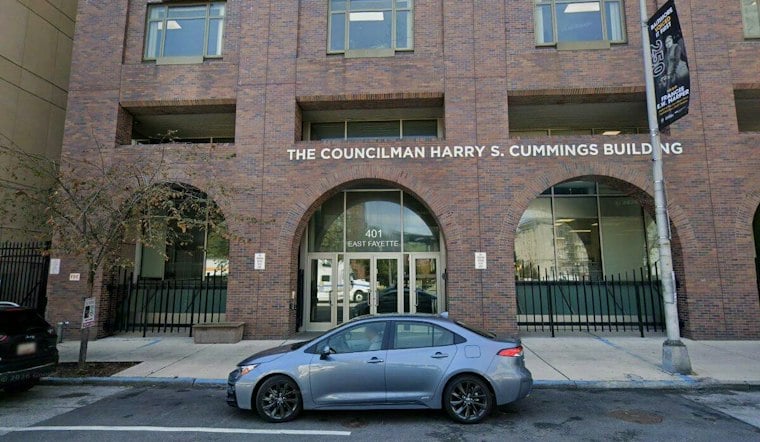
Money has already been set aside for the effort. The city allocated about $1.35 million for the program in its fiscal 2026 budget, GovTech reported. Administration duties are expected to fall to the city's technology office; GovTech reported that the Baltimore City Office of Information Technology will administer the IDs and that all city agencies must accept them, and that the office will not retain cardholders' names, addresses or application documents.
New Bill Signed Thursday Expands Documents and Adds Privacy Rules
Scott signed a bill Thursday that broadens the list of documents residents can use to obtain the card, including school and social services records, while also establishing privacy measures for how the city handles those documents, the Banner reported. GovTech separately reported that applicants could use identity documents such as a passport, state ID or permanent resident card.
City code language reviewed by Hoodline indicates that Baltimore's technology office is tasked with administering the municipal identity card program with cooperation from other city agencies, according to the City of Baltimore Law Library. A related code section states that the office must make a card available to any city resident who meets identity and residency requirements, regardless of citizenship status, housing status and other listed characteristics, per the City of Baltimore Law Library.
The Card Has Real Limits
The 410 Card will not substitute for every form of ID. GovTech reported that it cannot be used as a driver's license, as proof of immigration status or for air travel, and that it will only be valid within the city. The program is intended to help residents facing barriers to traditional government identification, specifically naming immigrants, people experiencing homelessness, transgender people, senior citizens, young people and formerly incarcerated people, according to the same report.
The card also allows people to designate their gender when they apply, the Banner reported. Baltimore City Councilwoman Odette Ramos, who took up the municipal ID issue in 2022, wants every city resident to obtain a 410 Card, saying it should reflect civic pride and be designed for everyone without stigmatizing any particular group.
A National Pattern, and Local Stopgaps in the Meantime
Baltimore's effort fits into a broader pattern of cities issuing their own identification cards. The Banner pointed to New York City's IDNYC program and the now-defunct DC One Card in Washington as examples. Municipal ID programs have also been offered in San Francisco, Philadelphia, New York and Chicago. GovTech reported that Chicago, Philadelphia, New York City and Detroit have had such programs running for roughly a decade already.
In the absence of a city-issued card, other institutions have stepped in. CASA, the immigrant advocacy organization, issues identification cards for its members that are accepted for some local services, and Crisaly de los Santos, the organization's director of operations for Central Maryland and Baltimore, said municipal IDs help people feel like they belong in the city where they live and raise their families. The Archdiocese of Baltimore began a parish ID program in 2018. Separately, immigrants regardless of legal status can obtain a Maryland-issued driver's license or identification card through the Motor Vehicle Administration, though those without legal status must demonstrate Maryland residency and show they have filed state taxes for at least the previous two years to qualify.





