

























































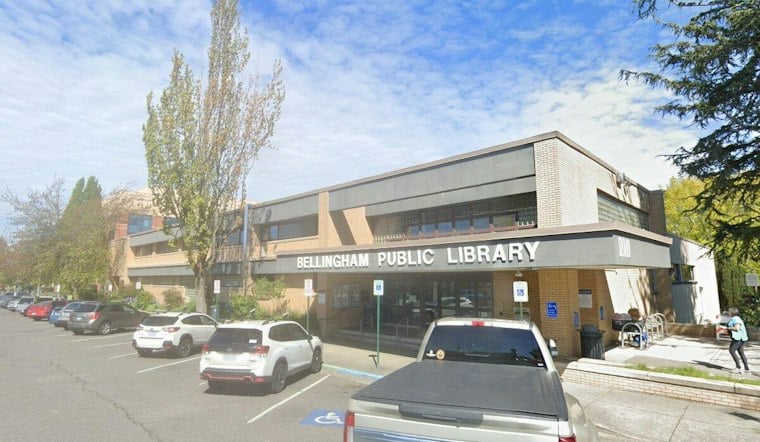
Bellingham's Central Library is heading for its biggest shakeup in decades. The Bellingham City Council voted unanimously on Monday to approve a $5.4 million construction contract for Phase 2 of the library's renovation, setting the stage for the 75-year-old downtown branch to close to the public for as long as a year once work begins.
The library's current working estimate puts the start of construction in early 2027, continuing through late 2027, according to the Bellingham Public Library, which says the branch “could take up to 12 months” to reopen once renovation begins. The City of Bellingham's project page likewise says construction is expected to begin in early 2027 and run through late 2027 at least, though an earlier Bellingham Herald report had pegged completion for summer 2027 and a separate Bellingham Herald report described the closure as slated for late 2026 or early 2027, before an exact date was set. As reported by Cascadia Daily News, the full-year closure is now expected to begin in January 2027.
Why the Whole Building Has to Close
The library says the entire building has to shut down because construction and building-wide utility work will touch all three floors at once, preventing safe public access throughout the renovation. Central Library's heating system is being replaced as part of the project, and the branch will receive air conditioning in certain areas — though accounts of how far that cooling will extend differ. The library's Phase 2 page describes targeted air conditioning in contained areas like the multipurpose room, while an earlier Bellingham Herald report described the project as adding air conditioning to public spaces more broadly.
The renovation itself focuses heavily on the ground floor. Plans call for removing as many walls as possible downstairs to improve sightlines, vibrancy and natural light, moving the teen area down from a corner of the main floor, and giving the children's room aesthetic and ADA upgrades. The project will also remodel the main-floor help desk and overhaul upper-floor staff work areas, per the city's project description. Because the project's cost exceeds $2 million, Bellingham's one percent for art requirement kicks in, and the resulting public art will likely take the form of a large mural in the downstairs foyer, according to Bethany Hoglund.
A Decades-Old Building Getting Its Second Act
Central Library opened in 1951 to serve a Bellingham population of 34,000, according to the library's own account of its history. The city began the first phase of this remodel back in 2018, redesigning the main floor and adding new restrooms and study rooms — work that was ultimately completed in 2021 while the building sat closed to the public under COVID-19 precautions. Skip Williams, reacting to the long-awaited Phase 2 vote, said it's about time this project got moving.
The city awarded the newly approved $5.4 million construction contract to Bellingham-based Summit Construction, a bid that came in under the engineer's $6 million estimate. That contract is a piece of the broader $8.5 million total project budget, which the library's FAQ page says covers furniture, design, temporary relocation costs and green building certification; the library's separate Phase 2 page lists the total slightly differently, at $8.53 million.
Paying for It: Grants, Donations and City Dollars
Funding sources for the project also carry some discrepancies across accounts. The city has received $3 million in state funding, is seeking $3.5 million in private donations — with most of that goal already raised from hundreds of local donors — and will contribute $2 million in city funds to cover the difference. The library's Phase 2 page puts the state contribution more precisely at $3.03 million in Washington State Department of Commerce grants, while a February Cascadia Daily News report described the same funding mix as $3 million in state money, $3.5 million in private donations and $2 million in city funds.
Where to Go During the Closure
Central Library is Bellingham's largest and busiest branch, logging around half a million visits a year — more than 400,000 in 2025 alone, with the library noting its per-capita use ranks among the highest in Washington state. (A separate Bellingham Herald count put visits at 360,000 through September of that year.) During the closure, most adult and children's programming will shift to Bellis Fair Mall, and programming has already started migrating to the Bellis Fair branch's temporary multipurpose room. Bethany Hoglund said it'll be business as usual, as much as it can be.
Library employees will work out of the Bellis Fair, Barkley and Fairharon branches during the closure, and all three will be open for longer hours, with services expanded to help absorb demand. The Bellis Fair branch has already expanded into an adjacent storefront to handle the increased traffic. Book holds can be picked up at Bellis Fair, Barkley, Fairhaven or local colleges' Campus Connections locations, though the library says it cannot offer curbside service because all available staff will be needed to operate the extended hours at those three branches.
Concerns for Patrons Who Rely on the Library
Not every Central Library visit is about checking out a book. Many patrons use the branch to charge devices, get online, wash up, and store carts and belongings — needs that don't easily transfer to a mall storefront or a suburban branch. Library staff have contacted service providers and compiled a list of resources for people who depend on the library in those ways.
Annette Bagley said the library welcomes everyone but lacks the space to meet the demand, adding that a higher-capacity space with dedicated services is needed. She also said additional day services may still appear before the closure begins. That concern isn't new: the city failed earlier in 2026 to find an operator for a proposed day shelter, a gap a February Cascadia Daily News report tied directly to the looming library closure.



