

























































The National Cold War Center’s planned museum still has no settled construction timeline, but 36 original Berlin Wall segments now form a major part of its collection. The center introduced the pieces to the public Saturday night at a gala in Hangar 207, on the grounds of the former Eaker Air Force Base in Blytheville. More than 600 people attended, including former Polish President Lech Walesa, the Arkansas Democrat-Gazette reported. The center says the segments will be part of its collection as it works toward a larger museum campus.
A Collection Unlike Any Other in the Country
The center acquired the 36 segments for its Blytheville campus. The National Cold War Center describes them as the largest publicly viewable Berlin Wall collection outside Berlin. At the gala, Executive Director Christian Ostermann called them “the largest collection of the Berlin Wall in the United States,” the Arkansas Democrat-Gazette reported. Ostermann said the segments are a later design, known as Wall ’75, and were in unusually good condition after being protected from the elements since the Cold War ended.
The newspaper reported that German farmers had repurposed the slabs as walls for grain storage, helping preserve them. The segments were kept in a warehouse roughly two hours north of Berlin before Ostermann and Barry Harrison traveled to Germany earlier this year to select them with Cornelia Thiele. In its account of the shipment, the National Cold War Center said each piece is about 12 feet high and 4 feet wide, weighs 2.6 tons, and arrived in Blytheville on May 13 after about a month in transit by way of Savannah.
What Made the Wall ’75 Design Different?
According to Landesdenkmalamt Berlin, Grenzmauer 75—the last generation of the Berlin Wall—was built from the mid-1970s using L-shaped concrete elements that originated in agricultural silage buildings. The agency describes the elements as about 3.6 metres high and 1.2 metres wide, distinguishing this design by its construction form and agricultural origin.
Walesa and Military Brass Headline the Gala
The center’s seventh annual fundraising event drew political and military figures, according to the Arkansas Democrat-Gazette. Former Arkansas Gov. Asa Hutchinson, a member of the center’s national advisory board, introduced Walesa, 83, a Nobel Peace Prize winner who co-founded the Solidarity trade union and became Poland’s first popularly elected president in 1990. Hutchinson said Walesa changed history. At Cold War Week events the night before, Walesa praised former President Bill Clinton, saying Clinton’s contribution brought Poland into NATO and marked the real end of the Cold War. Thomas F. “Mack” McLarty, Clinton’s first White House chief of staff, called the two men kindred spirits.
Retired Gen. Wesley Clark, who also sits on the center's advisory board, delivered the gala's keynote address and struck a more sobering tone about the present. Clark said the United States is under-strength to protect allies and provide extended deterrence, identifying Russia, China, North Korea and Iran as a convergence of adversaries. Three of those four nations are already nuclear-armed, he said, and the fourth is seeking nuclear weapons.
Fundraising Still Defines the Road Ahead
The gala did not settle when the center’s planned museum will be built. Lockheed Martin, which has facilities in Camden and Fort Smith, has committed $2 million toward the center’s $75 million construction-and-endowment goal. The Arkansas Democrat-Gazette reported that officials now say the timeline depends on fundraising, rather than the late-2027 completion plan announced two years earlier.
Reports have set out differing schedules for the project. KUAF reported in December 2025 that the center planned to break ground on the full museum in 2028 and projected a 2030 opening. The Northwest Arkansas Democrat-Gazette reported that the center was considering a 2027 groundbreaking and hoped to open in 2030 or 2031; it said the center had raised $7.5 million of its $75 million goal as of that December report. The center itself has published a figure of $7 million toward the same initial goal, but it is unclear when that figure was current. Officials did not provide an updated fundraising total from this year’s Cold War Week events. For now, center leaders hope to break ground on an outdoor campus display in early 2027, and Harrison said the gala weekend could help build momentum.
From Nuclear Alert Base to Museum Campus
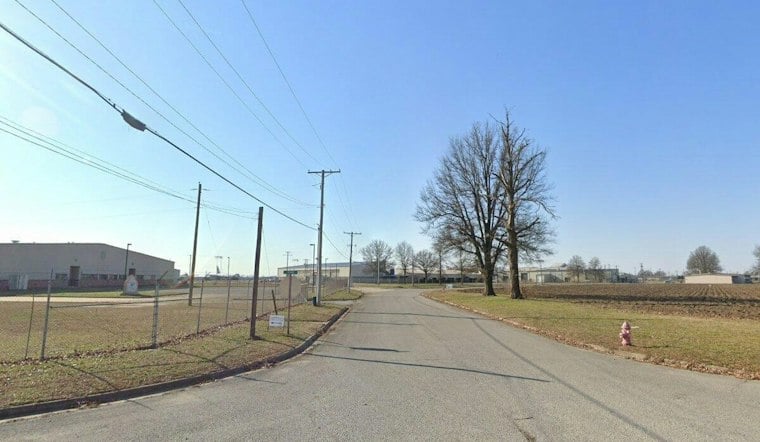
The gala took place at a former Strategic Air Command base where nuclear weapons and aircraft were kept ready for deployment during the Cold War. Eaker Air Force Base closed in 1992. The Arkansas Democrat-Gazette reported that the base’s Strategic Air Command alert and weapons storage areas were listed on the National Register of Historic Places in 2018. Congress designated the Blytheville museum as the official National Cold War Center in 2023, according to the National Cold War Center.
Eaker’s Role in Nuclear Readiness
The Blytheville Air Force Base Alert Center and Alert Apron were part of a broader Strategic Air Command expansion intended to safeguard nuclear deterrence through the SAC Alert program, according to a National Park Service account.
Groundwater Cleanup at the Former Base
Some environmental corrective actions remain underway at the former Eaker Air Force Base. According to the U.S. Environmental Protection Agency, three Solid Waste Management Units and one Area of Concern are undergoing corrective actions for groundwater contamination. The agency’s page does not say whether those areas overlap the planned museum campus, so it does not establish whether the cleanup affects the project’s redevelopment plans.
Mary Gay Shipley, a former Blytheville bookstore owner who chairs the center’s board, said she believes the museum has strong potential. Visitors can already tour the center’s 6,000-square-foot BAFB Exhibition in Building 202 on Idaho Street. It presents artifacts and the base’s history, describes daily life during the Cold War, and includes videos of veterans who served there. The center’s broader collection includes a Soviet fighter jet and a statue of Vladimir Lenin. Officials have also announced plans for a documentary about acquiring the Berlin Wall segments, which they hope will air on Arkansas television in 2027.
The Berlin Wall itself fell in 1989, following nearly three decades in which at least 140 people died attempting to escape East Germany across it. Last year's gala raised about $450,000, according to center officials, underscoring how much ground remains between the event's fundraising totals and the $75 million the center says it ultimately needs.




