

























































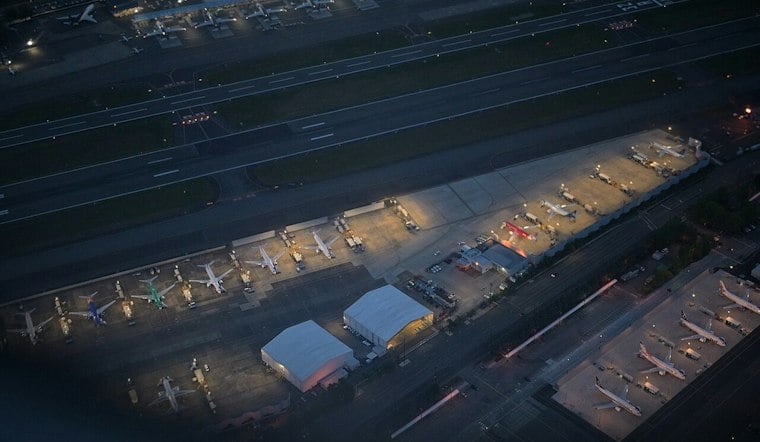
Flights in and out of King County International Airport-Boeing Field are facing about a month of restrictions after a persistent leak forced air traffic controllers out of their regular perch and into a temporary tower with far more limited capabilities. The disruption started Wednesday and is expected to ripple beyond Boeing Field itself, with knock-on effects for arrivals at Seattle-Tacoma International Airport as well.
Air traffic controllers began working from the temporary tower on Nov. 4, according to King County, as reported by KOMO News. The move became necessary because the existing tower cab has to be vacated during construction, since the drainage pipe at the center of the problem runs directly through the cab and repair crews need to open the roof to get at it.
A Leak That Wouldn't Quit
The trouble traces back to a roof leak that controllers first flagged to the airport. Crews patched the roof, but per the same account, water kept finding its way into the tower cab anyway. A closer look afterward revealed that a section of the stormwater drainage system was blocked or damaged, according to King County, which is why a simple patch job has given way to a full repair effort requiring the tower to be emptied out.
Boeing Field’s role extends well beyond private and celebrity travel: King County says the airport handles small commercial airlines, cargo carriers, corporate and private aircraft, helicopters and military flights. It averages about 150,000 takeoffs and landings a year and supports more than 16,000 jobs, making reduced capacity consequential for a broad mix of aviation users. The county also says the airport is home to Boeing operations and the Museum of Flight. King County’s airport overview details that mix of traffic and economic activity.
Crews are now working to repair the air traffic control tower's stormwater drainage system, with the airport coordinating with the Federal Aviation Administration throughout the process. Both the airport and the FAA intend to complete the repairs and restore normal operations as quickly as possible, the station notes, though an exact completion date has not been specified.
The repair also illustrates a split in responsibility: King County owns and maintains the tower, while federal FAA employees staff and operate it. That division puts the physical fix in the county’s hands while requiring coordination with the agency responsible for air traffic control. The county’s maintenance notice describes the arrangement and says the work is intended to provide a long-term solution to the leak while maintaining a safe working environment for controllers.
What Pilots Can Expect in the Meantime
The temporary tower's limited capabilities mean several routine procedures are off the table for the duration of the repairs. Pattern work and VFR transitions through the airspace will not be permitted, and no automatic terminal information service will be available while the restrictions are in place. Pilots should instead expect to use the RNAV approach at Boeing Field.
Clearance-delivery delays are also expected, and the article notes that additional traffic restrictions or delays may be implemented as needed while crews work. The Federal Aviation Administration advises pilots to check notices to airmen for current guidance before flying.
The FAA’s NOTAM system is the operational channel for getting time-sensitive changes like these to pilots; it is not the same thing as a temporary flight restriction, but it can communicate airport and airspace conditions that affect a planned flight. Federal preflight guidance says pilots must review available information, including NOTAMs, before departure. The FAA’s Aeronautical Information Manual explains that requirement, underscoring why crews should check current notices rather than rely on an earlier briefing.
Fewer Arrivals at Two Busy Airports
The practical effect for travelers could be noticeably thinner arrival schedules. Boeing Field arrivals could be reduced to just a few per hour depending on conditions, per King County, a steep drop for an airport described as one of the nation's busiest non-hub airports.
Because King County International Airport and Sea-Tac coordinate and share airspace, the restrictions at Boeing Field are expected to spill over onto Washington's main commercial hub. Arrivals at Seattle-Tacoma International Airport could be reduced to between 32 and 38 per hour as a result of the airspace coordination, the same report states.
Boeing Field sits about four miles south of downtown Seattle and is frequently used by celebrities, dignitaries, and sports teams traveling through the region, according to KOMO News. That higher profile makes the monthlong restriction more than just a technical footnote for pilots - it is a disruption that touches a steady stream of high-traffic flights serving the city.




