

























































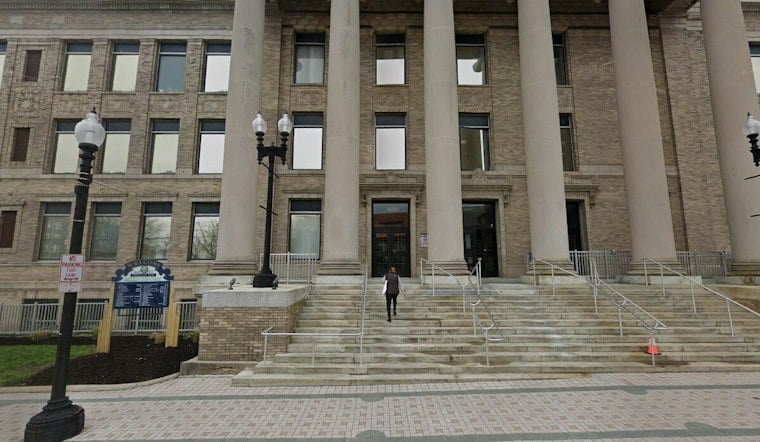
A 43-year-old Bridgeport man was sentenced to 14 months in federal prison this week for his role as the law-abiding “clean face” in a scheme that siphoned millions of dollars from unclaimed property funds held by Connecticut and several other states. Cirt Lindsay's job, according to federal sentencing documents, was to open bank accounts for fictitious businesses, deposit fraudulently obtained checks, and move the money without drawing attention from banks or investigators.
Lindsay was recruited as the respectable front man in a nationwide fraud that targeted unclaimed property held by Connecticut and other state governments, according to CTPost. Assistant U.S. Attorney Dana Hill told the court that Lindsay and two others devised the scheme in 2019, not long after Lindsay picked up a college friend who had just been released from a federal prison in Georgia following a wire-fraud sentence. Lindsay's role, per Hill, was to open accounts, deposit checks, and move money quietly while his co-conspirators handled the paperwork.
How the Scheme Targeted State Funds
From 2019 through 2022, Lindsay's co-conspirators submitted false claims on behalf of businesses they had created out of thin air, while Lindsay opened the accounts and deposited the checks state agencies issued in response, according to Westfair. Prosecutors say Lindsay's co-conspirators submitted false claims on behalf of fictitious corporate entities, and that Lindsay took a share of the proceeds while giving the others access to the rest.
The scheme's first target, per Hill, was $218,537.58 in unclaimed property that New York state held in the name of a man who had died without a will. After the fraudsters submitted a false claim and received a check for the full amount, Lindsay opened a Connecticut account for a fictitious entity called H.B. LLC and deposited it there. He then withdrew $74,800 from those proceeds, using some of it to make two mortgage payments on his home, the same account states.
Spending and Expansion
Lindsay's cut was 20% to 30% of each successful claim, officials said, and he spent the money on mortgage and car payments as well as trips to Atlanta and Trinidad and Tobago with his girlfriend and children, according to Hill. The fraudsters ramped up their efforts in 2020 and into 2022, fraudulently obtaining unclaimed personal and corporate funds from several states as the operation grew.
The FBI estimated that Lindsay participated in 19 fraudulent claims targeting roughly $8.4 million in unclaimed property, with $4.6 million of those claims identified by the conspirators themselves as successful, per Hill's account relayed in the Westfair report. CTPost reports that Lindsay personally obtained $646,875.26 for the role he played, while Westfair reports the FBI's estimate put his take closer to $600,000 over the three years he participated — the two outlets diverging on the exact figure.
The Scheme Unravels
The operation began to fall apart in 2022 after conspirators nearly drained a fraudulent account holding about $467,000 stolen from an individual's unclaimed property in Vermont, according to Hill. In an attempt to cover the shortfall, Lindsay wrote a $25,000 check from one fake business to another, using Connecticut funds to replenish the depleted Vermont account. Banks eventually froze the accounts, triggering an investigation that ended the conspirators' use of Lindsay to funnel checks.
Lindsay was arrested in October 2025. He initially tried to feign ignorance about his role, Hill said, but eventually admitted he was “the clean guy” in the operation. He pleaded guilty to conspiracy to commit mail fraud in July 2026.
Sentencing and Restitution
Chief U.S. District Judge Christina Reiss sentenced Lindsay to 14 months in prison followed by three years of supervised release in federal court in Vermont. Reiss also ordered forfeiture of $467,067.31 and directed Lindsay to pay restitution to state agencies managing unclaimed property in Vermont, New York, Connecticut, Iowa, Georgia, South Dakota, and Minnesota, according to the U.S. Attorney's Office in Vermont. Hill had called for a three-year prison sentence.
Lindsay's assistant public defender, H. Samuel Ansell, argued in a defense sentencing memo that his client was a second-tier accomplice who should receive time served rather than additional prison time. Ansell told the court that Lindsay's family's import-export business fell on hard times in 2018, prompting Lindsay to cut his own salary until his mortgage payment exceeded 45% of his gross monthly income. Ansell noted that Lindsay was also working as a restaurant manager and raising a son and a stepson at the time. Lindsay was born in Trinidad and Tobago, came to the United States at age 10, and became a U.S. citizen at 18, after years working for his family's import-export business.
A spokesperson for the U.S. Attorney's Office in Vermont could not be reached by email or phone Thursday regarding alleged co-conspirators in the case, the Connecticut Post reported. In a separate but similar case, the U.S. Department of Justice's Middle District of Pennsylvania office has said a Connecticut resident and her brother and codefendant together received over $1.2 million in false and fraudulent claims for unclaimed property from state treasuries, an indication that unclaimed-property fraud has drawn federal scrutiny beyond this single Bridgeport case.





