

























































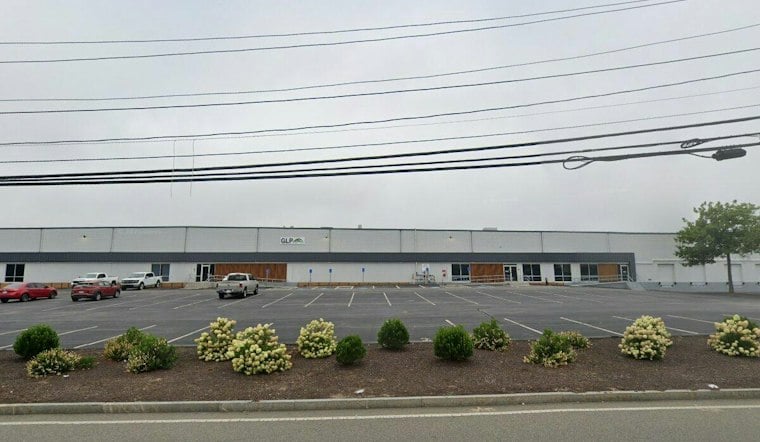
A company that turns leftover wheat and rice straw into wall and ceiling panels is looking at Brockton as the home for its first U.S. factory, with company executives touring a possible site and local officials predicting roughly 100 jobs once production starts. Durra Panel USA LLC is weighing a warehouse at 132 Campanelli Industrial Drive, where the company would become an anchor tenant in a facility exceeding 300,000 square feet.
Executives from Durra Panel USA toured the Campanelli Industrial Drive site on October 26, according to The Enterprise. The company manufactures construction panels from wheat and rice production leftovers, and if the Brockton plant moves forward, it would be a domestic manufacturing operation, with the paper reporting the company expects to employ about 100 people when the factory opens, a figure attributed to Derek Layfield, founder of the Australian company that originally made Durra Panel and an advisor to the U.S. operation. Layfield also said support companies locating near the factory might create another 1,000 jobs.
Maria Giatrelis, identified in the paper's reporting, described the product in blunt terms: Durra Panel essentially replaces drywall. That matches how the material is pitched elsewhere — Passive House Accelerator describes it as a system engineered to replace traditional drywall assemblies, and notes the product is already being supplied into the U.S. market for residential, commercial, institutional and industrial projects even before any domestic factory exists. That same source lists domestic manufacturing as planned for 2027, and Giatrelis told the paper the company aims to open the Brockton factory by the end of 2027.
Why Brockton, and What It Would Take
Layfield said Brockton's labor force and its location off Route 24 attracted the company, and that Durra Panel USA selected Brockton over other Massachusetts cities under consideration. Thumbprint Realty CEO Alex E. Edwards said the company's choice reflects the direction Brockton is heading, describing the project as work here, live here, and beneficial to Brockton residents. The Enterprise reports Brockton actively recruited Durra Panel USA to the city.
Nothing is finalized yet. Chelsea Andre said lease details are still under negotiation, and Durra Panel USA continues negotiating lease terms for the factory space, according to the same Enterprise News report. A listing for the Campanelli Industrial Drive property shows it has been on the market as available industrial space since LoopNet recorded it in March 2026, though that listing does not confirm any agreement with Durra Panel. Once a lease is signed, the company plans to reinforce the factory floor to support a 120-foot-long production machine.
The Material Behind the Pitch
Durra Panel is made from compressed wheat and rice straw, according to the company's own materials, which describe natural lignin binding the fibers together without added resins or formaldehyde. A separate company page frames the U.S. product as manufactured from reclaimed wheat straw specifically, a detail that doesn't fully match the compressed wheat-and-rice-straw description used elsewhere on Durra's site. The company says its process uses heat and pressure with no water, no gas and no toxic binders, as described in its own account of the Durra Panel story — though Australian outlet The Fifth Estate has reported that water-based PVA glue is used for the product's recycled Kraft liner paper, a detail not addressed in Durra's own materials.
The company claims its panels can cut builders' materials and labor costs by up to 32 percent, per the Enterprise News report, and Durra states separately that the panels carry a commercial life of more than 50 years while storing 8.5 kilograms of carbon per square meter, with a verified product-stage Global Warming Potential of negative 19.3 kilograms of carbon-dioxide equivalent per square meter. Layfield told the paper that Durra Panel products in Australia have been in buildings for over half a century, and that independent tests found no mechanical degradation after that span. Durra Panel's materials say the product has been refined, certified and proven across hundreds of projects over more than seven decades.
From Sydney Arenas to a Future Brockton Plant
The brand's Australian track record includes some high-profile stops. Durra Panel supplied more than 5 miles of partitions for the 2000 Summer Olympics in Sydney, and Olympic organizers later composted those partitions after the Games, according to the Enterprise News report. Acoustic panels made by the company are used at Melbourne Park, and The Fifth Estate has reported the material turning up in projects including Sydney's ICC, Margaret Court Arena, Melbourne Convention Centre and Perth Arena. The original Australian manufacturer opened its first factory in Bendigo in 1954, a city that, like Brockton, built its wealth on an old industry — gold mining in Bendigo's case, versus Brockton's 19th-century shoemaking boom, per the Enterprise News report.
City officials have been framing Brockton's pitch to green manufacturers for months. Economic development official Eliza Wilson said Brockton is ready to take advantage of the climate-tech industry, and she joined Mayor Moises Rodrigues and Nelson Fernandes on a visit to a green-tech innovation lab in Somerville in January, according to the Enterprise News report. Separately, the Boston Globe has reported that Powertown is installing battery storage systems in four Brockton businesses, part of a broader clean-energy push the city is leaning into.
A Bigger Shift in Building Materials
Durra Panel's pitch arrives amid a wider industry push to turn farm waste into construction material. The world produces around 150 million tonnes of rice husk annually, and BBC Future reports that rice husk can be used as a durable, moisture-resistant and fire-resilient building material. The outlet identifies Modern Mill as the first U.S.-based company manufacturing construction products from rice husks at scale, having diverted more than nine million kilograms of rice husks from landfill since its 2018 founding, alongside overseas players like Resysta in Germany and Ricehouse in Italy.
Layfield told the Enterprise News that Brockton could eventually produce machinery for new Durra Panel factories built in other U.S. states, positioning the city as more than a single production site. He framed the planned U.S. factory as a way for the company to tap into nationwide efforts to build more housing. For now, the project remains unsettled — the lease is unsigned, the jobs figure is a company estimate, and the 2027 opening target depends on negotiations that Brockton officials and company representatives both describe as still underway.





