

























































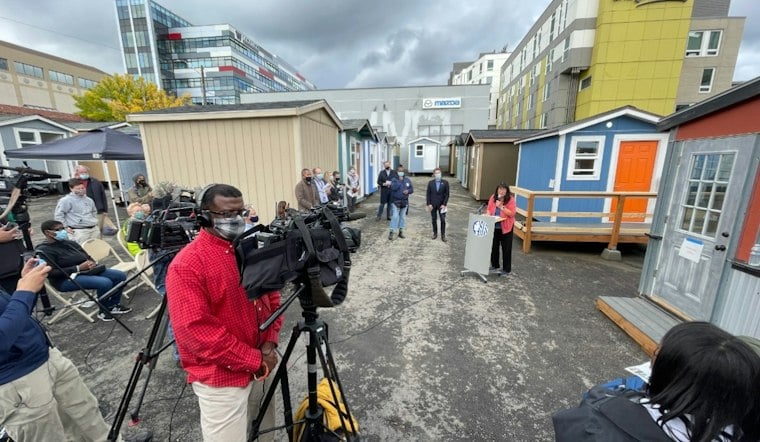
An 80-unit tiny house village is written into King County's proposed budget for a vacant corner of the Judge Patricia H. Clark Children and Family Justice Center campus, at 12th Avenue and East Spruce Street in the Central District.
It is a plan, not an opening. Capitol Hill Seattle reported Tuesday that the council budget proposal appropriates $4 million toward development. Construction and site preparation are slated to begin ahead of an anticipated early-2027 opening if the County Council approves the 2026–2027 budget on Nov. 24.
County Land Beside A $242 Million Campus
The site is the vacant southeast corner of the county-owned campus. The Urbanist described that corner as underused and said Spruce Street would be the Low Income Housing Institute's first tiny home village on King County property.
The youth jail and justice center opened in winter 2020 and cost $242 million. The shelter proposal would put insulated, heated, lockable houses on a corner of that campus rather than add another permanent building.
County and LIHI representatives presented site plans to Central District residents at an October meeting of the Squire Park Community Council.
Families, Singles, And A Staffed Yard
About 30 of the 80 houses would be set aside for families with children. The remaining 50 would serve singles and couples. The shared plan includes a community kitchen, a gathering space, a children's play area, hygiene and laundry buildings, and offices for on-site staff and case managers.
LIHI would partner with the county to build and operate the village, with staffing around the clock. At its villages, case managers help residents with employment, health services, and housing navigation.
Five Million Proposed, Four Million In The Budget
The dollar figure depends on which stage of the budget you are reading. In September, Executive Girmay Zahilay's office committed $5 million toward the village. The Urbanist reported that $5 million was earmarked for the 80-unit project in the executive's proposal, inside an announcement of more than $19.5 million in new housing investments.
The council budget proposal now before members appropriates $4 million toward development, the figure in Tuesday's Capitol Hill Seattle account. Neither number is a finished project cost, and the council has not voted.
That vote is scheduled for Nov. 24. The executive's office has also described a goal of advancing 500 units of shelter and housing in 500 days; a September executive-office page proposed funding to make progress on that target. Spruce Street's construction timetable remains attached to council approval.
What Existing Villages Have Produced
LIHI reported that its villages sheltered 1,663 people in 2025, counting families with children, single adults, and couples. It operated 15 villages that year, 13 of them in King County. Capitol Hill Seattle has separately described LIHI as managing 18 tiny house villages across the region.
Of people who left a village in 2025, 55% secured housing, LIHI said. Among those who moved from a tiny house into housing, 98% still had that housing a year later. Those are organization-wide results, not a projection for Spruce Street.
The nearest recent Seattle comparison is Belmont Village on Capitol Hill. Capitol Hill Seattle reported that LIHI finished 31 shelter homes there in 75 days after a May construction start. Tuesday's account put the cost at $1.1 million. Belmont has round-the-clock staffing, a security pavilion, a community kitchen, hygiene and laundry facilities, and on-site case management and behavioral-health support. The Downtown Emergency Service Center plans a separate 120-unit permanent supportive housing building on that lot.
Operating costs are a different line from setup. The News Tribune reported that LIHI estimated about $400,000 to set up Tacoma's 40-unit village and about $750,000 a year to run it. Tacoma's contract with LIHI covered about $3 million from 2020 to 2025, and the city had spent a little more than $2.5 million in that period. Those are Tacoma figures, not a Spruce Street operating budget.
A Neighborhood That Already Has Villages
Tiny houses are not new to the Central District. Seattle's first officially sanctioned village opened in late 2015 on 22nd Avenue with Lutheran Church of the Good Shepherd. True Hope Village, 33 units on East Yesler Way, opened in 2018 on church property and serves families, couples, and single adults. T.C. Spirit Village, 24 units on 22nd Avenue, opened in 2020 at Christ Spirit Church and focuses on Native American, Alaska Native, and Black residents.
Nickelsville Central District is a resident-governed encampment for singles, couples, and families. Good Shepherd House opened in 2024 as an 86-unit permanent supportive housing building. In March 2020, Capitol Hill Seattle reported a planned Cherry Hill village of 26 tiny houses, with work scheduled to start March 10 and occupancy expected by the end of that month. Spruce Street would be larger than those church-land villages, and it would sit on county property.
One village does not match the count. In its Belmont report, Capitol Hill Seattle cited King County's January point-in-time count: unsheltered homelessness had grown 21% since 2024, by about 2,000 people, to 11,829.
The city is running a separate push. In May, the Seattle City Council approved Mayor Katie Wilson's shelter acceleration plan, raising the legal resident limit at transitional encampments to 150 and allowing one interim-use village for 250 residents. Wilson extended a 1,000-shelter-unit goal through the end of 2027. The administration has scheduled 960 beds, meant to serve an estimated 1,750 people a year, across facilities established in 2026 and eight sites slated for 2027. Interbay Village accounts for 75 of the newer units. Those limits and beds are the city's. Spruce Street still waits on the county vote set for Nov. 24.





