
























































Donald Trump sits down with Xi Jinping this week for trade talks, but the leverage gap between the two countries over critical minerals hasn't closed much at all. China remains the world's top rare earths miner, and despite billions in new American funding commitments, the United States still produces insufficient quantities of the metals, magnets and chemical compounds its own factories depend on, according to six analysts interviewed.
A Trade Truce Hanging On Minerals
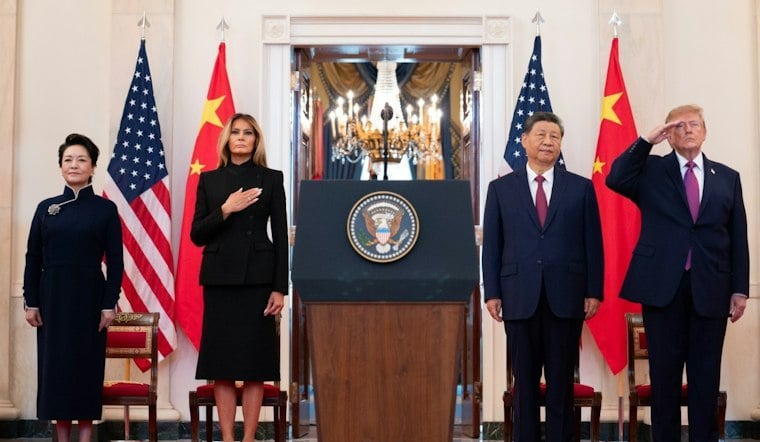
The meeting between Trump and Xi is expected Thursday, as reported by Reuters, and the two leaders may agree to extend their existing trade truce, which is due to expire in January 2027. That truce includes export-control waivers for certain critical minerals, something Washington negotiated last year after China restricted exports of rare earth minerals and magnets in 2025 — restrictions that disrupted work at Ford Motor and other US manufacturers, per the same Reuters report.
China has since said it restricted the minerals to prevent their use in war, while accusing Washington of abusing its own export controls by blocking semiconductor exports to China. Samir Kapadia, head of trade at Washington-based Vogel Group, put the dilemma bluntly in comments to Reuters: US dependence on Chinese minerals limits Trump's ability to press Xi on tariffs and export controls without risking the country's own access to metals, magnets and chemical compounds.
The Numbers Behind China's Grip
The scale of that dependence is stark. China accounted for 60% of global mined production of magnet rare earths and 91% of refined output in 2024, according to the International Energy Agency. Its share of global sintered permanent-magnet production reached 94% that same year, up from roughly 50% in 2005 — a two-decade buildout of processing, refining and manufacturing infrastructure that the US has yet to replicate, the Reuters report notes.
Neodymium-iron-boron magnets, used in electric vehicles and military equipment, show the gap plainly: the International Energy Agency reported that US manufacturing capacity stood at roughly 4,500 metric tons annually in 2025, compared with about 210,000 metric tons in China — nearly 47 times more. Jack Lifton, an analyst with Technology Metals Research, told Reuters the US is in a severely poor position relative to China on critical minerals, and Rich Nolan, head of the National Mining Association trade group, said China uses critical minerals as leverage over the US when it chooses to.
In April 2025, China introduced export controls on seven heavy rare earth elements, related compounds and magnets, and export volumes of those materials fell sharply in April and May, according to the IEA. More recently, China's commerce and customs authorities extended a suspension of specified export-control measures through January 10, 2027, according to Metal.com.
American Projects Still Years Off
The Trump administration has invested billions of dollars in federal funding for US mining projects, but Reuters reports those projects remain years away from production, and Kapadia said US minerals projects have more presentations than permits, with real questions remaining about how many are actually shovel-ready. US mines, refineries and processing facilities require a decade or more to come online, the Reuters report notes — a timeline echoed by The National, which reports that mining and processing projects often take a decade or more to develop.
Some of that funding has started moving. MP Materials began manufacturing neodymium-iron-boron magnets in Texas in December 2025 and is expanding that production under a multibillion-dollar Pentagon partnership, according to Reuters, with the Defence Department separately arranging a $400 million deal for a 15% equity stake in the company, per The National's report. MP Materials is also developing a Mountain Pass heavy rare-earth separation line designed to produce around 200 tonnes of dysprosium and terbium a year, according to ING THINK.
Vulcan Elements has begun making rare earth magnets in North Carolina, though its magnets have not yet been approved by customers for use, Reuters reports. The company received a $620 million conditional loan commitment from the Defence Department and an additional $50 million from the Commerce Department, The National notes. USA Rare Earth, meanwhile, secured a $1.6 billion deal with Commerce in January in exchange for the government taking a 10% equity stake, the outlet reports — part of a broader federal push in which only $8 billion of roughly $30 billion in committed funding had actually begun disbursing.
Lithium, Copper and Antimony Face Their Own Delays
Nevada's Thacker Pass mine, under construction by Lithium Americas and billed as North America's largest lithium source, is expected to begin production in 2028, according to Reuters. But the project's costs are already climbing: Lithium Americas raised its estimated cost for Thacker Pass Phase 1 by 31% to $3.83 billion, citing higher labor, construction and logistics expenses, according to MINING.COM. Phase 1 is still designed to produce 40,000 tonnes of battery-grade lithium carbonate annually at full capacity, the outlet reports.
Other projects sit even further out. A Korea Zinc-backed Tennessee refinery for copper, zinc and other critical minerals, valued at $7.4 billion, is expected to open in 2030, Reuters reports. Rio Tinto and BHP aim to build what would become North America's largest copper mine, though it wouldn't open until next decade, while Trilogy Metals — in which the Trump administration agreed to take an equity stake in 2025 — plans to produce copper in Alaska starting in 2031. Perpetua Resources plans to produce antimony, used to make bullets and armor, in Idaho by 2029.
A Political Clock Is Also Ticking
Democrats won midterm victories and will control Congress next year, and some Democrats have already questioned the administration's investments in private companies, according to Reuters. US Energy Secretary Chris Wright said on November 8 that he is willing to explain the administration's actions. The White House did not respond to Reuters' request for comment on the matter.
Taken together, the picture Reuters paints is of a trade strategy that still lacks a secured homegrown supply of critical minerals to counter Beijing's dominance — even as US manufacturers continue to depend on Chinese materials used in semiconductors, robotics, weapons systems and artificial intelligence. The IEA's broader minerals outlook underscores why that gap is so hard to close: demand for magnet rare earths outside China is projected to rise 50% by 2035, yet existing capacity and planned expansions would meet only about half of projected mining demand, a quarter of refining demand, and less than a fifth of magnet demand.