

























































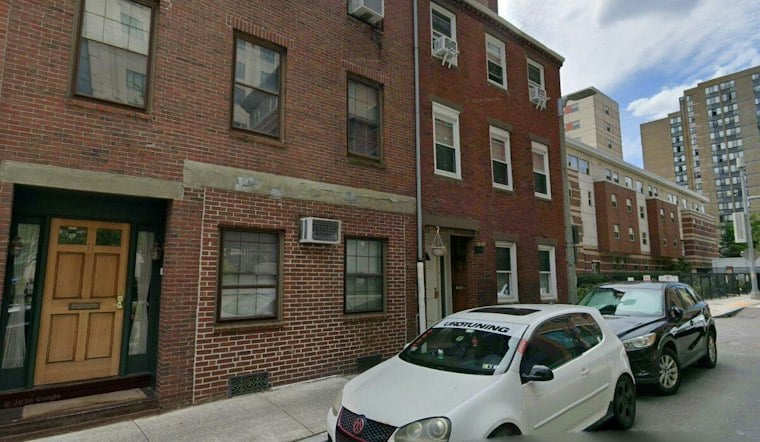
The Chinatown rooming house on Harrison Avenue is on the market.
The Boston Globe reported that the property on Harrison Avenue is for sale.
In response, the Chinese Progressive Association and residents are seeking landmark designation for six parcels that include the 19th-century building, petitioning the city to protect it. Landmark status would likely prevent developers from demolishing the buildings and could encourage owners to maintain affordable housing contracts, the Globe's reporting notes — but it would not prevent the buildings from being sold or remodeled.
A Pattern Beyond One Building
A Pattern Beyond One Building Elsewhere in the neighborhood, the operators of Double Chin and Bao Bao closed after being evicted in January, after the property owner reportedly sought $25,000 a month in rent for both restaurant spaces combined.
Residents of the See Sun were evicted in 2012 because of unfit conditions.
One Tenant's Eight Years
Xiaohua Qiu, 67, moved to the United States from China in 2016 and lived in the rooming house for eight years before she and her husband moved to subsidized senior housing last year. Gloria Chin said modernization risks pricing more Chinese people out of Chinatown, while Melanie Wang said the neighborhood must preserve its existing buildings alongside any new construction — both sentiments captured in the Globe's reporting on the building's fate.
The Numbers Behind the Squeeze
Research offers a more complex picture of displacement: a study covering 2006 to 2019 found that new market-rate housing slightly increased the likelihood that lower-socioeconomic-status residents would move out, while higher-socioeconomic-status residents actually became less likely to leave, according to the Urban Displacement Project. In gentrifying areas specifically, the same research found that new construction didn't substantially change most households' odds of moving out, but it did increase the number of people moving in across every socioeconomic group. The Urban Displacement Project argues that market-rate construction and tenant protections alone will not be enough to address the affordability crisis, pointing instead to preserving unsubsidized affordable housing and expanding social housing.
A survey of 52 Chinatown households experiencing displacement found that more than 80 percent cited affordability as the root of their housing insecurity, according to the Massachusetts Association of Community Development Corporations.
Land Trusts Racing to Buy What They Can
The Chinatown Community Land Trust, formed in 2015 to acquire properties and make some neighborhood housing permanently affordable, had purchased two properties and was pursuing two more in 2023. The trust describes its mission in blunter terms on its own site: it is reclaiming row houses that had been emptied by speculative investors for short-term rentals and returning them to use as homes for working-class families, per the Chinatown Community Land Trust. Community members are also organizing to call for a Row House Protection Area in the zoning code as part of a broader anti-displacement strategy, the trust notes.
One earlier success offers a glimpse of the demand: the land trust scraped together $1.7 million to buy a three-unit row house at 29 Oak Street, and more than 600 people applied to buy the resulting condos, according to WBUR. The resale contract on those units caps price growth at the original value plus up to 4 percent a year, a structure meant to keep the homes affordable for future buyers as well.
These organizations depend on city subsidies, loans, and donations from supporters, and Boston still devotes a limited amount of public funding to community land trusts, according to Boston Neighborhood CLT.
More Housing in the Pipeline
One project is moving through Chinatown's pipeline. A planned six-story building at Tai Tung Village's south parking lot is slated to include 85 affordable housing units and 40 parking spaces, according to Sampan.




