

























































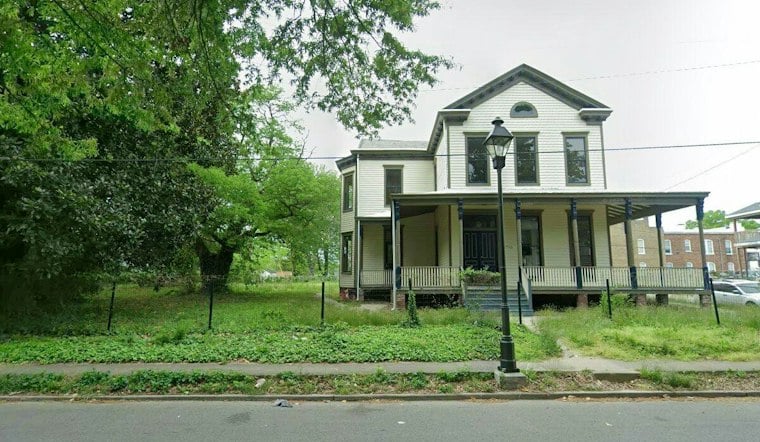
The 1890s-era house at 1716 Monteiro Avenue in Richmond's Barton Heights neighborhood is known as the Dollar House. Clark Glavé is restoring it after acquiring it from Historic Richmond for one dollar as part of a preservation effort.
Glavé, who owns Ark Construction and Development, is restoring the house.
The 1890s-era house sits in Barton Heights.
Barton Heights began as a streetcar suburb in the 1890s, marketed to renters such as managers and clerks who could buy homes on easy terms and ride electric rail into the city. The Virginia Department of Historic Resources says the neighborhood was among the country’s earliest electric-trolley suburbs; Barton Heights became an incorporated town in 1896 and was annexed by Richmond in 1914. Its historic district is especially notable for its collection of late-19th-century frame Queen Anne houses. Virginia’s historic-district account places the Dollar House in a neighborhood shaped by early suburban growth and transit.
A Rebuild From the Roof Down
During the restoration, Glavé salvaged about half of the original slate roof tiles.
The home has an open-concept layout.
Part of a Broader Neighborhood Push
Historic Richmond, project:HOMES, the City of Richmond and the Maggie Walker Community Land Trust worked together on a Southern Barton Heights project to rehabilitate three properties for affordable housing. The project's first phase was completed in 2021.
The earlier Southern Barton Heights partnership paired rehabilitation with a community land trust model designed to keep homes affordable beyond their first sale. The Maggie Walker Community Land Trust retains ownership of the land beneath its homes, while qualified buyers purchase the houses; resale prices are limited using a formula tied to changes in Richmond-area median income. That arrangement is intended to keep the subsidy in the home for future buyers, rather than having affordability end when the original homeowner sells. The trust’s description of its model explains how its work differs from a one-time sale at a below-market price.
Historic Richmond has said the properties selected for that earlier phase were vacant, blighted and tax delinquent, and that no long-term residents were evicted in the process. The organization also notes that while the district carries National Register Historic District status, the neighborhood has no City of Richmond historic or architectural protections.
National Register status recognizes a district’s historic significance, but it does not by itself require private owners to seek local approval for renovations. Virginia’s Department of Historic Resources says local historic-district zoning is what can impose rules on alterations; Richmond likewise says owners in National Register and state-register districts are not subject to historic-review requirements unless local designation applies. The distinction helps explain how Barton Heights can have federal recognition while lacking the city’s local architectural protections. The state’s explanation of historic-register protections distinguishes register listing from local zoning controls.
A Golden Hammer and a Philosophy of Rebuilding
Glavé's work on the Monteiro Avenue house earned him the 2026 Golden Hammer Award in the Best Residential – Single Family category, an honor Historic Richmond oversees to recognize professionals in restoration, adaptive reuse, new construction and historic preservation.
The project lands amid a citywide housing crunch that has made preservation and new affordable construction alike harder to pull off. Richmond was home to 233,655 people and had 117,518 housing units in 2024, according to the Housing Indicator Tool, with the city adding an average of 2,100 residents and 1,400 housing units annually since 2010. Fifty-six percent of Richmond households are renters, and 52 percent of those renters face unaffordable housing costs, per the same data. The city has set goals of adding 2,000 new homeowners earning 50 to 80 percent of area median income and 10,000 new affordable rental units by 2033.





