

























































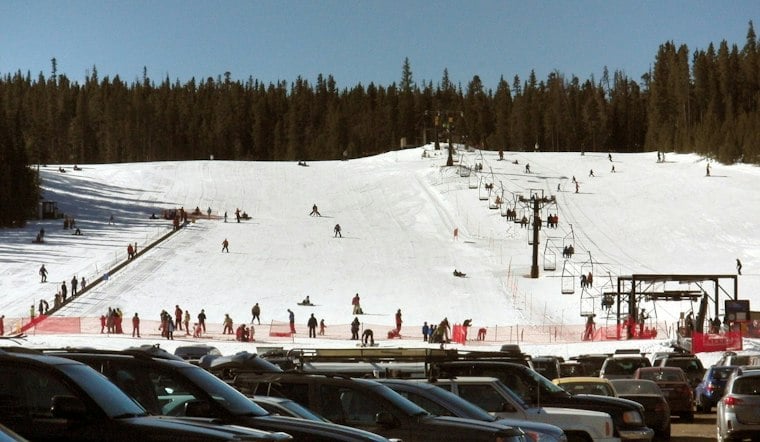
Colorado's mountain economy is under strain, with spending across 18 mountain towns hitting a four-year low in 2025-26 and statewide ski visits falling to their lowest level since 1991-92.
Vail's Alpine-Style Architecture
Vail is known for Alpine-style architecture.
Tim Wolfe, director of the Colorado Tourism Office, told commissioners the festival would likely be scheduled for February, landing after the Sundance Film Festival's run in Boulder and before the spring-break ski crowds arrive in March, per the same Denver Post report. Wolfe said organizers originally eyed a 2028 launch, but ongoing negotiations make 2029 more likely. He described the festival's theme as “Live, Love, Unite” and said an after-event for guests wanting to extend their stay would be called “Symphony of Unity.”
What a Colorado Edition Might Look Like
Wolfe said the festival would run Monday through Thursday, with organizers also planning a series of events in Denver the weekend prior and arrivals greeted inside Denver International Airport's Grand Hall. Transportation, including buses to the host resort, would be coordinated for festivalgoers, the Post reports. Festival organizers reportedly considered resort locations in Utah, California and the Canadian Rockies before settling on Colorado.
The Colorado Office of Economic Development wants any incentive funds, spent over the first two years, tied to the festival remaining in the state for five years, with some funds returned on a pro-rata basis if it leaves early, according to the same report.
Not every commissioner was sold without questions. Walker Stapleton asked whether the new festival would compete with existing mountain events such as Up in the Sky Music, a gathering in Aspen, or the Palm Tree Music Festival, which also draws an EDM crowd, the Post reports. Wolfe pushed back on that framing, telling commissioners, “It isn't competing; you are looking at two different experiences.”
The French Winter Festival Model
Tomorrowland was launched in 2005 by Belgian brothers Michiel and Manu Beers and is held in Boom, Belgium. Tomorrowland events are known for drawing international audiences and selling out rapidly.
A separate U.S. venture, TomorrowWorld, ran from 2013 to 2015 near Atlanta.
Tomorrowland has run a winter festival since 2019 at Alpe d'Huez in the French Alps, distinct from the massive summer gathering in Belgium. The 2027 edition at Alpe d'Huez is scheduled for March 20-27, with nearly 22,000 festival-goers expected across seven stages and performances from nearly 150 international artists. The French event blends music with board sports and activities such as yoga, paragliding and dog sledding, and festival ticket packages, detailed on Tomorrowland's own accommodation page, include a lift and ski pass plus lodging at l'Alpe d'Huez or the Oz 3300 Ski Resort in categories ranging from Wood to Gold. Guests staying at Oz 3300 get a continuously running ski lift at night during the festival, with bus shuttles on standby for bad weather.
A Tough Winter for Colorado's Mountain Economy
The timing of Colorado's pursuit comes against a backdrop of strain in its ski towns. Spending across 18 Colorado mountain towns hit a four-year low in the 2025-26 winter, the second consecutive winter decline, according to The Colorado Sun. Those towns recorded $4.8 billion in spending from November through April, down from $5 billion the prior winter and $5.1 billion in 2023-24, while statewide ski visits fell 24% to 10.5 million — the lowest total since the 1991-92 season. The Colorado Sun reports that many local governments reliant on sales-tax revenue have been cutting budgets as costs rise and spending falls.
Lodging data adds another wrinkle. As of October 31, occupancy across more than 10,000 Colorado units tracked by Inntopia ran 3% below the previous winter for the November-through-April stretch, per KUNC. The average daily lodging rate climbed 2.1% to $712 per night, even as roughly 24,000 fewer room nights were available for rent across Inntopia's resort markets, which span seven states. Summer bookings told a different story, with average seasonal revenue up 3.8% and resort occupancy and daily rates both rising, the station reported.





