

























































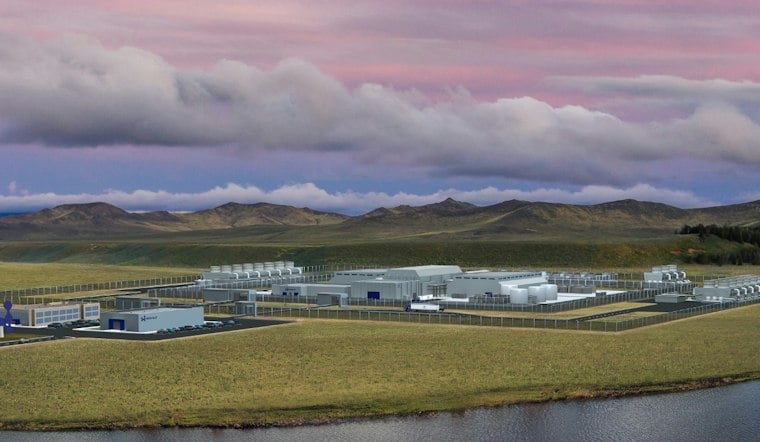
Investors who bought NuScale Power securities earlier this year sued the Corvallis company and four executives on Wednesday, alleging the executives overstated NuScale's financial health and competitive position, failed to disclose stalled projects, and sold shares for more than $3.25 million while the stock price was high. They filed the complaint November 11 in the U.S. District Court of Oregon and alleged violations of federal securities laws. Those claims have not been established in court.
The suit reaches a Corvallis company whose small modular reactor technology was invented and researched at Oregon State University. In 2023 NuScale became the first American firm to receive federal approval for one of its designs. Shareholders say they didn't learn until September that the company's two biggest projects were troubled. Oregon Public Broadcasting reported that they want class-action designation, a jury trial, and a judgment requiring NuScale and the four executives to compensate investors for losses. The company didn't immediately respond to a request for comment.
What the Complaint Alleges
The lawsuit alleges that four executives intentionally overstated NuScale's competitive advantage and financial health in order to inflate the stock price. Investors also allege the executives misled the public about financial solvency and about progress in the nuclear technology. The complaint says they failed to disclose stalled projects while other nuclear companies advanced their reactor designs.
The buyers purchased securities earlier in 2026, and they are not asking to proceed only for themselves. A complaint for violations of the federal securities laws asks the court to designate the action a class action, award compensatory damages to the plaintiff and other class members, and grant a jury trial. Class designation is the mechanism that would let named buyers stand in for others. The request runs against NuScale and against four executives personally.
Compensatory damages are money for alleged losses, not a redo of the reactor program. The share sales are pleaded as the private upside to the public story. According to the lawsuit, executives sold while the price was high, and investors say the trouble at the two biggest projects was not apparent to them until September.
A Design That Started on Campus
NuScale is headquartered in Corvallis. The reactor technology was invented and researched at Oregon State University, and the NuScale Energy Exploration Center is on the campus. What the company wants to sell is a smaller, factory-built reactor that it says would be cheaper to build and safer to operate than a traditional nuclear plant.
Small reactors are pitched as a more climate-friendly alternative to burning fossil fuels for growing electricity demand, particularly at data centers focused on artificial intelligence. The research address is Corvallis. The load growth in that pitch is wherever those computing facilities get their power.
Federal approval in 2023 is the milestone NuScale can already cite: first among American companies to get one of its reactor designs through that review. Approval doesn't switch on a plant. The lawsuit alleges there is no binding agreement with the Tennessee Valley Authority, the public-power system NuScale has explored as a customer. In Romania, where the company is working with Nuclearelectrica, a July 15 release said discussions with the Ministry of Energy had not produced concrete results on the conditions for a final investment decision.
Cash on Hand, and a Smaller Quarter
NuScale's second-quarter results put a large balance and a smaller sales line in the same report. The company ended June 30 with $1.9 billion in cash, cash equivalents, and short- and long-term investments. Revenue for the three months ended that day fell by $8.0 million from the same period in 2025. Cost of sales fell by $6.0 million.
Part of the revenue drop, the company said, followed work that had already finished. Fluor's FEED Phase 2 engineering for the RoPower project was completed in late 2025, with no comparable activity in 2026. A completed phase can still leave a gap where the prior year's revenue used to be. The $1.9 billion is cash and investments on hand. It is not a repeat of that engineering revenue.
September, the month shareholders identify, was also when UBS cut its price target from $10 a share to $6, citing a projected $700 million negative free cash flow, OPB reported. That $700 million is a forecast, and free cash flow is not the revenue figure above. On Thursday, November 12, NuScale shares fell 7.8% and closed at $4.82, under the target UBS had cut to $6.
Romania, Told Two Ways
NuScale is working with Nuclearelectrica to build reactors in Romania. In July, OPB reported, Nuclearelectrica announced that a number of conditions were preventing it from moving forward, and that it was considering alternative designs.
Nuclearelectrica's July 15 release doesn't announce a cancellation. Shareholders rejected a proposal to begin assessing an update to the Doicești project strategy. Nuclearelectrica and RoPower will continue, consistent with a shareholder approval from February 2026, their efforts to reach a commercial consensus with NuScale. Discussions with the Ministry of Energy had not produced concrete results on final-investment-decision conditions.
Considering other designs is not the same decision as keeping a commercial negotiation open, and neither is a final investment decision. OPB's account of the July announcement includes the alternative designs. The release Nuclearelectrica posted keeps the consensus effort with NuScale formally alive and records that the investment-decision conditions were unresolved. On NuScale's books, the RoPower connection already has a figure attached: engineering work that ended in late 2025 and didn't produce comparable revenue in 2026.
Tennessee Is Still a Discussion
NuScale has explored building reactors for the Tennessee Valley Authority, a federally owned electric corporation and the country's largest public power provider. TVA supplies electricity to about 10 million people in seven southern states. In its second-quarter results, NuScale said strategic partner ENTRA1 continued to advance discussions with TVA toward a definitive power purchase agreement.
The November lawsuit alleges there is no binding agreement. A line about discussions advancing toward a definitive contract is a status report on talks. It is not the contract. Design approval in 2023 gave NuScale a regulatory first. A TVA signature would be a customer, and the complaint says that document isn't there.
TVA is pursuing a separate small nuclear reactor project with GE Vernova Hitachi Nuclear Energy. OPB described that project as further into the development process than NuScale's effort with the authority. The lawsuit alleges other companies were moving their designs forward while NuScale's executives failed to disclose stalled projects. The GE Vernova Hitachi work is a named comparison already on TVA's schedule: same utility, another developer, further along in the account OPB published.
Another Filing in the Same Court
This isn't the first time investors have asked the District of Oregon to treat NuScale stock purchases as a securities class action. A separate case, Truedson v. NuScale Power Corporation, et al., covered Class A stock purchased or acquired from May 13 through November 6, 2025. A notice set April 20, 2026, as the deadline to seek lead-plaintiff status. That class period ended in 2025. Wednesday's plaintiffs bought earlier in 2026. The notice and the new complaint are not the same lawsuit.
Shareholders in the new case want a class designation, compensatory damages, and a jury trial. NuScale hadn't immediately commented when asked. On Thursday, the day after the filing, the shares fell 7.8% and closed at $4.82.




