

























































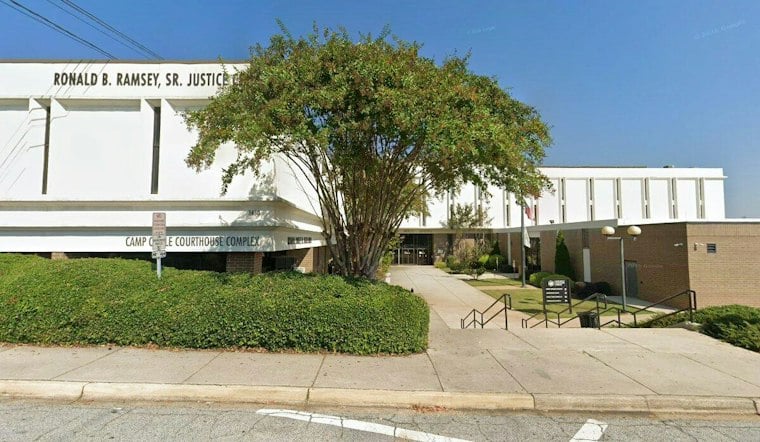
DeKalb County commissioners have decided the county's police surveillance network does not need an outside civilian auditor. On Tuesday in Decatur, the board voted 5-2 to deny Commissioner Ted Terry's resolution for independent oversight of Digital Shield, the system built around Flock automated license-plate readers and other technology police use.
The denial leaves the audits where they already sit: inside the DeKalb County Police Department, which says it reviews Flock use every two weeks and has already sent potential violations involving eight employees into administrative investigations. As Decaturish reported, Terry and Commissioner Michelle Long Spears were the two votes against denying the resolution.
What the Board Turned Down
Terry was not asking the county to take the cameras down. His resolution would have created independent civilian oversight and auditing of Digital Shield, covering system use, data sharing, access protocols, cybersecurity and privacy safeguards, along with annual public reporting, Decaturish reported.
That is a specific job, not a slogan. A plate search is a query against a database of vehicle movements. Data sharing is who else can see the result. Access protocols decide who is allowed to type the query, and the cybersecurity and privacy rules are what are supposed to keep a crime-fighting tool from becoming a personal lookup service. The annual report would have been the part a resident could read without filing a records request and waiting.
None of that structure survived the vote. Supporters of civilian oversight had warned that the technology lacks sufficient privacy guardrails and can be misused, FOX 5 Atlanta reported. Five commissioners denied the resolution anyway, and Digital Shield stayed under the department that operates it.
What the Audits Already Caught
The department's case for keeping the reviews in-house is a schedule. DeKalb police say they conduct comprehensive Flock audits every two weeks. Those reviews identified potential policy violations involving eight employees, which were then reviewed through administrative investigations.
Police Chief Gregory Padrick separated the eight into two kinds of failure. Five employees had searched for vehicles without a legitimate law-enforcement purpose. Three others had legitimate reasons for their searches but failed to follow required procedures or complete required documentation. One group used the system for something that was not police work. The other used it for police work and skipped the paperwork that is supposed to show why.
The log underneath those names is large. Between Jan. 1 and July 24, department personnel conducted 53,276 searches in the Flock system, WSB-TV reported. The eight cases are employees, not a count of bad queries, so the figure does not say how many lookups were clean. It does say how often people inside the department were in the database across less than seven months of 2026.
A Network Bigger Than Plate Readers
Digital Shield did not arrive on Tuesday. On Oct. 1, 2025, CEO Lorraine Cochran Johnson announced it as an $18.9 million countywide initiative to deploy Flock Safety technology and fight crime across DeKalb, after unanimous Board of Commissioners approval, the county said.
County documents cited by Decaturish put the investment in Digital Shield infrastructure at more than $20 million. The launch announcement described an $18.9 million countywide initiative. The documents describe infrastructure spending above $20 million. They are two public figures attached to two different descriptions, not a single price tag restated twice.
Terry said the system has already moved past the plate readers in that original pitch. Digital Shield now extends to drones, privately owned cameras integrated with police systems, and data flowing into real-time crime centers. A private camera piped into a police network is no longer only a homeowner's security device. A drone feed and a real-time crime center pull the same question — who searched, who shared, who watched — into more rooms than a reader on a pole.
The Debate Beyond One Vote
DeKalb's eight employees sit inside a wider Georgia pattern, not in place of it. An Atlanta News First investigation found at least 19 cases in a single year in which Georgia officers faced disciplinary action or criminal charges for improper personal searches of Flock's database. That is not DeKalb's administrative file. It is a separate set of cases, some of them criminal, tied to personal searches rather than the mix of improper purpose and missing documentation Padrick described.
The same investigation reported that more than 250 municipalities across the country have moved to terminate or pause contracts with the surveillance provider. Tuesday's vote was not that kind of decision. Commissioners rejected an oversight board. They did not cancel Digital Shield.
State Sen. John Albers has said he is working with law-enforcement associations on a task force examining automated license-plate reader policies, with recommendations expected ahead of the 2027 legislative session. Those recommendations are not county policy. Until something else changes, DeKalb's operable rule is the one the department already describes: comprehensive Flock audits every two weeks, done internally. Decaturish has also reported that Avondale police conduct weekly internal audits. Both schedules stay inside the agency.
FOX 5 reported that it remains unclear whether usage reports on the Digital Shield network will be shared with the public. The annual public reporting Terry asked for was one of the items the board denied. Residents who wanted a standing public look at who is searching the system did not get one on Tuesday.




