

























































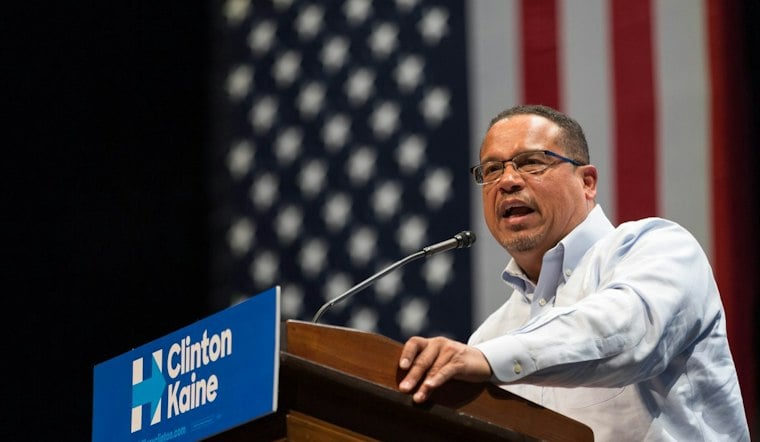
Minnesota Attorney General Keith Ellison filed a lawsuit Thursday to block the Trump administration from forcing the state to enforce new federal Medicaid work requirements, arguing the rules are unconstitutional and could strip health coverage from hundreds of thousands of Minnesota residents. The requirements, tucked into H.R. 1, are set to take effect Jan. 1, 2027, and threaten states with the loss of all federal Medicaid funding if they refuse to comply.
Ellison filed the suit Thursday alongside the attorneys general of Oregon, New Mexico and Washington, according to MPR News. The lawsuit challenges provisions of H.R. 1, also known as the One Big Beautiful Bill Act, which requires states to implement new Medicaid eligibility rules beginning in 2027 or risk losing all federal Medicaid funding. The coalition is asking the court to rule that the federal government cannot withhold existing Medicaid funding from states that decline to carry out the work requirements.
Under the new rules, Minnesotans ages 21 to 64 who apply for Medicaid would have to show they are working, attending school or volunteering at least 80 hours a month to qualify for or keep their coverage, per the same report. Medicaid recipients would have to prove they meet the work requirements or qualify for an exemption in order to maintain coverage.
How Many Minnesotans Are Affected Is Disputed
Roughly 1.2 million Minnesota residents receive health coverage through Medical Assistance, the state's Medicaid program, and MPR News reports that 243,000 residents will be required to meet the new federal work requirements. The Minnesota Budget Project, however, cites a different figure: it reports that the state's own Department of Human Services estimates that 128,000 people will be subject to the work-reporting requirements. The two sources do not reconcile the gap between their estimates.
Ellison did not mince words about the law's impact. He called the legislation a bait-and-switch and unconstitutional, and he criticized it for shifting Medicaid away from simply providing low-income Americans with health coverage and toward using healthcare access to incentivize employment, the station reports. He argued that the legislation could push vulnerable Minnesotans off insurance, worsen health outcomes and increase pressure on hospitals and local governments.
Coercion Argument at the Center of the Case
Ellison and the other attorneys general contend that the funding threat amounts to unconstitutional coercion, because it forces states to overhaul their Medicaid administration or risk losing billions in federal support. They argue the requirements force states to overhaul eligibility systems and monitor recipients' employment status, and that Congress cannot compel states to make those changes simply by threatening to cut off funding they already receive. Medicaid was established in 1965 as a federal-state partnership in which states contribute funding and administration while receiving federal support to cover eligible low-income residents, and the attorneys general argue Minnesota's refusal to implement the new requirements would devastate its Medicaid program and harm the residents who depend on it.
The lawsuit further argues that the new eligibility system threatens to fundamentally transform Medicaid, and claims the work requirement will leave millions of former and prospective Medicaid beneficiaries without access to basic healthcare. It contends that paperwork and administrative hurdles could cause hundreds of thousands of people to lose health insurance, including those who are actually eligible but struggle to complete verification. Depriving people of basic healthcare, the suit claims, would make them less able to work and expose them to financial catastrophe through mounting medical debt. The attorneys general warn that people who lose coverage could face interruptions in treatment for chronic illnesses, reduced preventive care and greater reliance on emergency rooms, and the lawsuit argues the resulting coverage losses would strain Minnesota's healthcare system and increase hospitals' uncompensated care costs.
A spokesperson for the Centers for Medicare & Medicaid Services said the federal agency does not comment on matters involving pending litigation, per the station's report.
Minnesota Has Been Bracing for the Change
This is not Minnesota's first legal fight over the policy. Back in June, Ellison's office joined a coalition that sued over an HHS and CMS interim final rule published June 3, challenging, among other things, the rule's interpretation of who qualifies as medically frail, according to the Minnesota Attorney General's Office. That earlier suit sought to block the challenged provisions and have them struck down.
State health officials have been warning for months that the law would have real consequences. An earlier MPR News report found Minnesota health officials estimated about 140,000 Minnesotans are likely to lose health coverage because of the federal law, and the state's Department of Human Services has said a significant number of people subject to the requirements are expected to lose coverage if they do not qualify or fail to submit the necessary compliance paperwork. Nationally, KFF has noted that states implementing these rules will need to make major policy and operational decisions, upgrade systems, build outreach and education strategies, and hire and train staff to carry it all out.
Arkansas Offers a Cautionary Precedent
Minnesota is not the first state to grapple with Medicaid work requirements, and the track record elsewhere has drawn scrutiny. An analysis from the Urban Institute found that Arkansas's Medicaid work requirement had no statistically significant effect on employment among the affected age group, while being associated with higher uninsurance rates among adults ages 30 to 49 with lower incomes, including a 7.4 percentage-point increase in uninsurance among those below the poverty level.
Figures on coverage losses in Arkansas vary depending on the source. The Commonwealth Fund has reported that Arkansas's own numbers confirmed more than 16,000 people lost Medicaid coverage in 2018 under that state's work experiment, while the Urban Institute has put the figure at more than 18,000 adults disenrolled over four months before a federal court halted further implementation in 2019. A federal court that year vacated HHS approval of the Medicaid work-requirement demonstrations in both Arkansas and Kentucky, with the court concluding, as described by the Commonwealth Fund, that the Trump administration had failed to show how the work requirements fulfilled Medicaid's objective of insuring those eligible for its coverage. The National Council has reported that Arkansas's coverage losses were largely attributed to enrollees struggling to navigate the reporting requirements rather than failing to actually work the required hours.



