

























































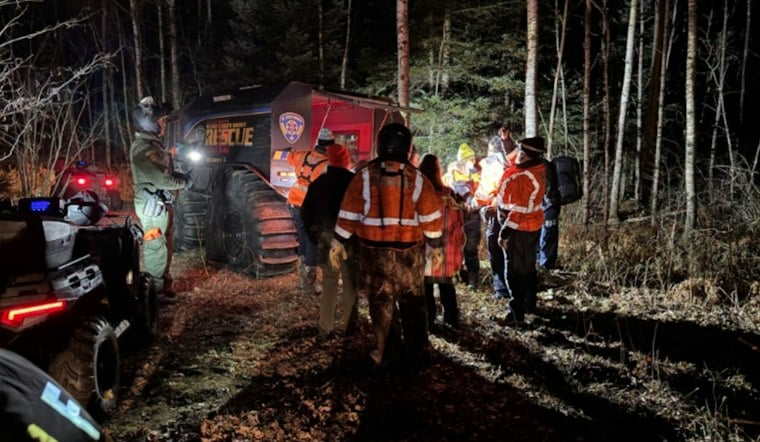
A 74-year-old Eveleth man spent several hours alone on the forest floor near Whiteface Reservoir Road after falling from a tree stand while hunting, until a rescue squad drone spotted him in the dark and guided deputies to his side. He was found semi-conscious, severely hypothermic, and with visible abdominal injuries roughly 0.9 miles from the road, in a stretch of heavily wooded terrain that made the search anything but simple.
The man had headed out to hunt at about 8:30 a.m. but had not checked in with family by late afternoon, according to WDIO. St. Louis County Sheriff's Office deputies responded around 8:08 p.m. on Friday, November 13, 2026, kicking off a search that stretched for nearly two hours before he was located.
A Multi-Agency Push Through the Dark
The St. Louis County Rescue Squad, Minnesota State Patrol, and Minnesota Department of Natural Resources Conservation Officers all joined the search effort, per the same account. It was a rescue squad drone that ultimately made the difference, locating the hunter at about 10:01 p.m. in the heavily wooded area off Whiteface Reservoir Road. A drone operator then guided deputies on foot straight to him.
Once they reached him, authorities learned the man had fallen about 12 feet from his tree stand and had been lying on the ground for several hours before help arrived. Deputies gave him basic first aid and worked to keep him warm while rescue teams, Hoyt Lakes Ambulance, and Lifelink medics made their way to the remote scene.
Flown to Duluth for Treatment
Lifelink air medical ultimately flew the man to Essentia St. Mary's Hospital in Duluth. The St. Louis County Sheriff's Office described the overall effort as an outstanding joint operation involving the sheriff's office, the rescue squad, the Minnesota DNR, the Minnesota State Patrol, Hoyt Lakes Ambulance, and Lifelink Air Medical, the station reported.
A Known Hunting Hazard
Falls like this one remain one of the most persistent dangers hunters face each season. The Minnesota Department of Natural Resources says tree stand accidents are the leading cause of injury among hunters, and that one in three people who hunt from an elevated stand will eventually suffer a serious fall. The agency recommends always wearing a safety harness, or fall arrest system, both while seated in a stand and while climbing into or out of one.
The DNR also advises attaching a safety strap to the tree itself so that any fall is limited to no more than 12 inches, and recommends keeping elevated stands below ten feet off the ground. Those guidelines underscore just how serious a 12-foot fall can be, and why rescuers treated the hours the Eveleth man spent exposed on the forest floor as a race against hypothermia as much as against the terrain itself.





