

























































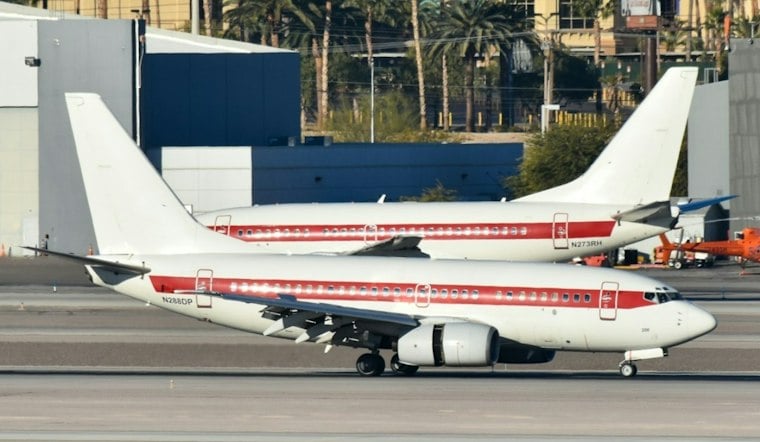
Federal regulators are ordering airlines to repeatedly test the flight controls on roughly 300 U.S.-registered Boeing 737NG jets after identifying a sensor flaw that could let one engine's thrust pull far ahead of the other without the autothrottle catching it, potentially triggering an unexpected roll. The new airworthiness directive targets certain 737-600, -700, -700C, -800 and -900 series aircraft, the generation of 737 that came before the now-infamous 737 MAX.
According to MLQ.ai, the Federal Aviation Administration adopted Airworthiness Directive AD 2026-23-04 for the affected 737NG models, and the order does not name which specific airlines or tail numbers are impacted. The agency identified the core problem as spoiler sensor position data that could be lost without anyone noticing, or recorded incorrectly in the first place.
That matters because the autothrottle's cruise thrust split monitor relies on accurate spoiler-position data to catch large thrust differences between a plane's two engines while cruising, as reported by AeroTime. If that monitor fails to activate because of bad sensor data, the mismatch can grow unchecked, and the autothrottle might not even disengage once a significant throttle split develops.
What a Failed Monitor Could Mean in the Air
A failed thrust split monitor could allow a significant throttle split, asymmetric thrust and an uncommanded roll, per the dossier of findings tied to this directive. The FAA warned that an uncommanded roll not detected and corrected promptly by the flight crew could result in potential loss of control of the airplane — language AeroTime's report frames plainly: pilots who don't respond fast enough could lose control, the FAA said.
To get ahead of that scenario, the agency is requiring operators to run repetitive aileron bite tests of the digital flight control system. The same account notes that operators must address any test failure and repeat the test until the system passes, rather than clearing the aircraft after a single attempt.
A Directive Tied to an Earlier Boeing Advisory
Operators are instructed to follow Boeing Alert Safety Advisory 737-BSA-22-001, dated October 30, 2026, but compliance clocks don't start ticking from that advisory's issue date. Instead, the timelines run from the FAA directive's own effective date, a detail that keeps the regulatory deadline separate from Boeing's earlier guidance to carriers.
The rule was placed on public inspection Thursday and was scheduled for formal publication in the Federal Register on Friday, November 20, taking effect 15 days after that. The FAA skipped its usual notice-and-comment process in adopting the directive, opting instead to accept public comments for 45 days after publication and leaving open the possibility that it could later amend the rule.
Costs Per Test Cycle Add Up Fleetwide
The agency estimated the testing labor at two work-hours per airplane for each test cycle, putting the cost at roughly $170 per airplane per cycle. Multiplied across the estimated U.S. fleet, that works out to about $51,000 per test cycle, though the FAA said it lacked data to estimate what it would cost operators to fix an aircraft that fails a test.
The agency's approach echoes a similar move in October 2022, when it ordered repeated tests on certain 737 Classic -300, -400 and -500 models over what AeroTime describes as a comparable concern. A 2022 Federal Register document tied to that earlier rulemaking indicated the FAA found the risk to the flying public significant enough to bypass notice and comment at the time too, citing a spoiler-sensor failure that could keep the same cruise thrust split monitor from activating — though that older document's text, reviewed via Federal Register, is incomplete and describes a separate, earlier rule rather than this week's directive.
Boeing has not issued a public statement on the new directive, according to MLQ.ai's reporting. The outlet separately reported that Boeing has been cutting about 5% of its commercial airplane workforce as the 737 MAX production ramp slipped, a detail unrelated to the 737NG testing order but noted in the same coverage.
FlightGlobal was first to report on the directive, according to the MLQ.ai account, before other aviation outlets picked up the story. For now, the FAA's directive leaves the recurring testing requirement as the primary safeguard against the roll risk, with airlines required to keep retesting any aircraft that doesn't pass until it does.




