

























































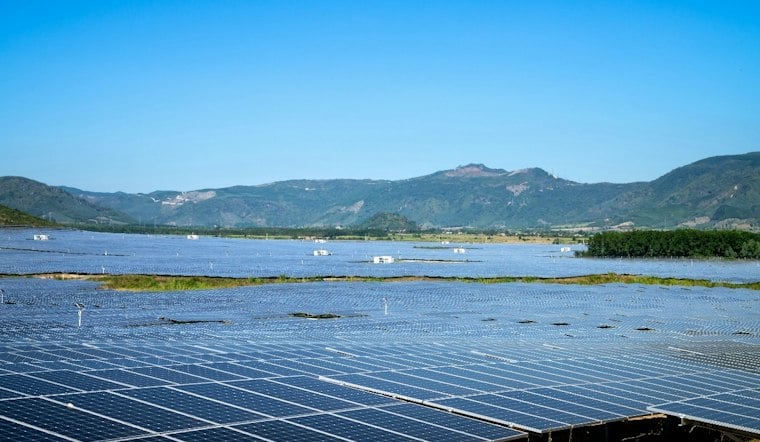
A flooded gravel pit at an active quarry in Cortlandville is about to become the site of North America's largest floating solar complex. Third Pillar Power announced construction of Crown City Solar at Suit-Kote Corporation's Polkville Crushed Stone Facility, placing rows of solar panels directly atop roughly 120 acres of water inside a working sand and gravel mine.
The announcement, made Tuesday, describes Crown City Solar as being built at an active mining operation that's also co-located with an asphalt plant and storage terminal, according to Third Pillar Power. The company says it first identified the roughly 120-acre flooded mine pit as a promising project site in early 2024, and the project reportedly moved from securing site control and applying for interconnection to breaking ground in under two years, as CleanTechnica reported.
Three Phases, One Big Number
Crown City Solar is designed in three 7.5-MW-dc phases that together add up to 22.5 MW-dc, with the full complex expected to be operational in 2027. The first phase, Crown City Solar 1, is expected to begin commercial operation in February 2027, according to the same announcement. Once all three phases are complete, the project is expected to serve approximately 1,500 subscribers through New York's community solar program and to avoid roughly 18,000 metric tons of carbon dioxide emissions each year.
The name nods to nearby Cortland, long known locally as the Crown City, which sits on an elevated plain more than 1,000 feet above sea level, per the same announcement. Third Pillar Power's CEO, Jaimeet Gulati, framed the site choice as part of a broader strategy, saying working quarry and reservoir sites can also power neighboring communities.
Built for Central New York Winters
Floating solar isn't new, but putting the heavy electrical gear on the water is a less common move, and Crown City Solar is designed to float its medium-voltage transformers and switchgear on custom-designed barges rather than keeping that equipment on dry land. The project's backers say floating the electrical equipment reduces agricultural land use, addresses floodplain siting concerns, and improves electrical efficiency.
The system is engineered for central New York winter conditions, including a ground snow load rating of 69 pounds per square foot, which the announcement describes as the highest of any floating solar project in the country. The floating array relies on Alps solar PV modules, Hazelett Marine's mooring systems, and Profloating's floats, with D3Energy serving as the engineering, procurement, and construction contractor. D3Energy managing director Stetson Tchividjian said the firm is proud to contribute its experience to Crown City Solar, a company that the announcement says has more than a decade of experience building floating solar projects nationwide.
A Quarry With a New Owner
The host site's ownership recently changed hands: Suit-Kote was acquired by Colas USA, the U.S. subsidiary of Colas, in October 2026, according to the Third Pillar announcement. That shift places the quarry hosting Crown City Solar under new corporate control just weeks before the solar project's construction was publicly unveiled.
Local reporting on the project's earlier footprint shows some differences from the company's current figures. A 2025 report from WXHC described the proposed fields as having a combined capacity of 14.5 megawatts AC, a figure reported in a different electrical measurement than the 22.5 MW-dc total in this week's construction announcement. The two numbers aren't directly comparable on their face, and available reporting doesn't spell out how the earlier AC-based estimate relates to the newer DC figure.
Local Politics Around New Solar
Cortlandville's relationship with solar development hasn't been without friction. The town board voted unanimously to adopt a resolution implementing a six-month moratorium on accepting and approving new solar project applications, a separate WXHC report noted, with the moratorium set to take effect once filed with the New York Secretary of State. Whether that moratorium has any bearing on Crown City Solar isn't addressed in the available record.
Separately, a notice in the New York State Department of Environmental Conservation's environmental notice bulletin indicates that the Town of Cortlandville Planning Board, acting as lead agency, determined that the proposed Crown City Solar 1, 2 and 3 projects would not have a significant adverse environmental impact. That notice, dated September 10, 2025, comes from a search-result snippet, and the complete filing and any subsequent permitting actions were not independently reviewed here.
Part of a Bigger Floating Solar Push
Cortlandville's project arrives amid a broader national trend of putting solar panels on water that's already spoken for. In Ohio, D3Energy recently energized a 6-MW floating solar array on a village reservoir in Monroeville — a project Solar Power World called the largest floating solar system in the state and among the five largest in the country. That array floats on 12 acres of water the village already owned, and it's Monroeville's second solar project after a 4-MW ground-mounted array that's been running since 2017.
Together with two other D3Energy projects, Ohio now has almost 10 MW of operating floating solar, all sited on water host utilities already owned, the outlet's report noted. That growth has come even as roughly one-third of Ohio's 88 counties have restricted utility-scale solar since a 2021 state law gave local governments that authority — a tension between appetite for floating solar and local land-use pushback that echoes what's playing out around Cortlandville. Florida has seen a similar pattern, with stormwater ponds increasingly becoming floating solar farms as costs fall and demand rises, according to the Associated Press.



