

























































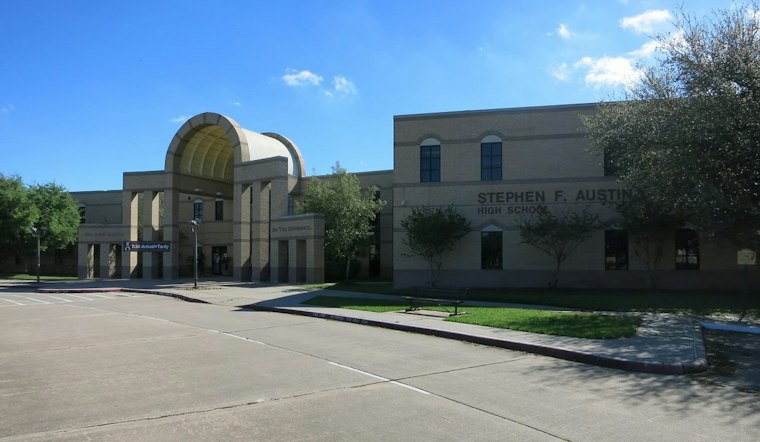
Five seniors at Austin High School in Fort Bend County are spending their free time designing and 3D-printing custom wheelchairs for children in their community, and they've already handed one off to a family who needed it. The students have completed four wheelchairs so far and are now racing to build nine more, with a goal of finishing 13 total by Christmas.
The engineering students — Ishmeet Bhondi, Mason Gay, Jordan Gay, Parth Patel and Sahil Sawant — have partnered with a nonprofit organization to get the chairs directly into families' hands, according to Click2Houston. One of the chairs went to the Salazar family, whose child's mother described it as different, accessible and smooth. The wheelchairs feature adjustable components that move up and down to accommodate growing kids.
A Project Rooted in Personal Experience
Bhondi, who helped spearhead the project, said it carries personal weight for him. He has described experiencing the loss and later recovery of his own ability to use his legs, a history that shaped why the project mattered to him. Patel, another student on the team, said most of the group members are 17 or 18 years old and had never attempted anything like this before.
Sawant acknowledged the scope of the undertaking is unusual for high schoolers, noting that the idea of an entire wheelchair being 3D-printed may seem crazy to outsiders. Still, the team pressed ahead with the support of teacher Mr. Daniel Anderson, who believed in the project's possibility from the start. Patel framed the effort as a reflection of what engineering should be for — serving people, not just solving abstract problems.
Why These Projects Are Popping Up Nationwide
The Fort Bend students are part of a broader, fast-growing movement of DIY makers tackling pediatric mobility devices. A report published earlier this month put the number of people across the country using 3D printers to build pediatric wheelchairs at roughly 1,800, according to the Marshall News Messenger. That same report profiled a Longview man who has printed three free wheelchairs for disabled children ages 1 to 8 through the Make Good platform, with each build taking between 250 and 350 hours and costing between $200 and $500.
Similar projects have surfaced elsewhere in Texas and beyond this fall. In San Antonio, a Texas Military Institute Episcopal student built a Toddler Mobility Trainer with her teacher and the organization TEAMability, per a TPR report. In Gillette, Wyoming, a college makerspace built its first 3D-printed mobility device for a 15-month-old who was too small for any commercially available wheelchair, according to Cowboy State Daily, while in Lehi, Utah, a 13-year-old spent roughly 300 hours designing a custom chair for a 21-month-old girl, ABC4 reported.
A Design Movement With National Recognition
The push toward cheaper, customizable mobility devices has drawn attention well beyond individual builders. New Orleans nonprofit MakeGood won Fast Company's 2026 Innovation by Design award in accessible design for its work on children's mobility trainers, with the outlet noting the devices can be produced locally for a few hundred dollars using consumer-grade 3D printers. MakeGood's platform can match more than 1,000 volunteer makers worldwide with families requesting devices, according to Fast Company.
Engineering firms have also been experimenting with more advanced customization techniques. Design firm Layer has developed a wheelchair that uses a user's own biometric data to create a seat and foot-bay structure tailored to their body, according to the American Society of Mechanical Engineers.
What's Next for the Fort Bend Team
Back in Fort Bend, the Austin High School students still have nine wheelchairs to go before their Christmas target. For Mason Gay, the payoff isn't really about the printing hours or the hardware — he said he's happy with the results because he's helping children, describing the work as something bigger than himself.




