

























































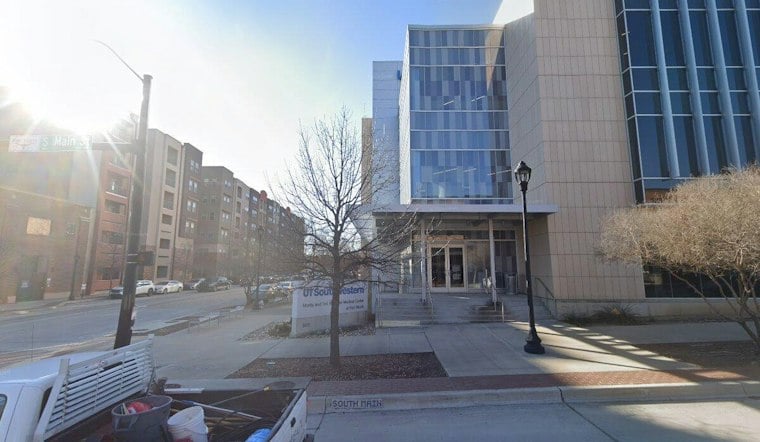
Construction crews hoisted the final beam into place atop UT Southwestern's new Radiation Oncology campus in Fort Worth, a milestone that university officials and city leaders gathered to celebrate on Monday. The topping-out ceremony marks a visible turning point for the $177 million project, which is being built to add radiation treatment to the cancer services UT Southwestern already offers in the city.
UT Southwestern and Fort Worth community leaders marked the placement of the final beam atop the campus on Monday, according to UT Southwestern. Daniel K. Podolsky, president of UT Southwestern, said the milestone brings residents closer to the best possible cancer care through advanced technology and clinical and research expertise, per the same announcement. Fort Worth Councilwoman Elizabeth Beck said the university's investment brings advanced academic medical-center cancer treatment to Fort Worth residents without requiring them to travel outside the city.
What the New Campus Will Offer
The 65,000-square-foot facility is expected to open in 2028 and will become Tarrant County's largest radiation oncology facility once complete, the university said. It will include four linear accelerators, known as LINACs, with space reserved to add two more as demand grows. The campus will also house positron emission tomography imaging equipment and a fully equipped brachytherapy suite for high-dose prostate or gynecologic cancer treatment.
Perhaps most notably for patients, the new campus will offer Fort Worth's first MRI-guided precision radiation treatment, according to UT Southwestern. As many as two-thirds of cancer patients need radiation therapy at some point in their treatment, the university said, underscoring the gap the new campus is meant to fill. UT Southwestern has described radiation treatment as the one major cancer-care component that had been missing from its Fort Worth services before now.
MRI-guided radiation combines detailed soft-tissue imaging with radiation delivery, helping clinicians track a tumor’s position as treatment is given. Imaging can also help the care team adjust treatment when a tumor or nearby organs shift or change shape. The technology is not needed for every radiation plan; the appropriate imaging method depends on the patient’s case. Dartmouth Cancer Center’s explanation of image-guided radiotherapy notes that MRI can be particularly useful for viewing soft tissue, including in the abdomen.
Linking Up With Moncrief Cancer Institute
The Radiation Oncology campus will connect directly to UT Southwestern's Moncrief Cancer Institute in Fort Worth's Medical District. Moncrief has served Fort Worth since 1958 and has been part of UT Southwestern since 1999. Keith Argenbright, director of the Moncrief Cancer Institute and a professor at the Simmons Cancer Center and Peter O'Donnell Jr. School of Public Health, said the campus will bring residents innovative cancer treatments and supports the broader mission of expanding cancer care and preventive screenings across Texas.
Moncrief's reach already extends well beyond Fort Worth's city limits. The institute offers screening, education, and support programs in more than 100 rural and medically underserved counties across North, Central, and East Texas, and it screens approximately 30,000 uninsured and underinsured Texans annually for breast, cervical, colorectal, lung, and prostate cancers.
Part of a Broader Fort Worth Expansion
UT Southwestern first expanded cancer care into Fort Worth in 2015, and its Monty and Tex Moncrief Medical Center opened in the city in 2017, offering specialty clinics, primary care, and imaging and lab services that include 3T MRI, two ultrasound units, CT, and fluoroscopy. The medical center's specialty clinics cover cardiology, dermatology, endocrinology and endocrine surgery, hepatology and liver transplant, neurology and neurosurgery, ophthalmology, otolaryngology, rheumatology, and urology. UT Southwestern has also launched surgical services at Texas Health Hospital Clearfork in southwest Fort Worth and continues adding physicians and specialties across the area.
The Radiation Oncology campus adds to a system that already claims North Texas' largest individual radiation oncology facility, where specialists have pioneered SABR and PULSAR advanced therapies. UT Southwestern's cancer program is ranked among the top 25 of roughly 4,500 U.S. hospitals and No. 1 in Dallas-Fort Worth, and its Simmons Cancer Center is North Texas' only National Cancer Institute-designated comprehensive cancer center, one of just 58 nationwide, the university said.
Simmons Cancer Center’s federal designation places it in a national network, but the designation is not a ranking of individual hospitals or a guarantee of a particular treatment outcome. The National Cancer Institute lists 74 designated cancer centers nationwide, including 58 classified as comprehensive centers, a category that recognizes research breadth as well as clinical and prevention work. The NCI’s overview of its cancer-center program identifies UT Southwestern’s Harold C. Simmons Comprehensive Cancer Center among the designated centers.
The Fort Worth project extends access to a technology UT Southwestern already uses in Dallas: its radiation oncology center lists two MRI-equipped linear accelerators, called Elekta Unity MR linacs, among its treatment systems. That makes the new campus a geographic expansion of the university’s existing capabilities, rather than the first MRI-guided radiation system in its network. UT Southwestern’s Dallas facility inventory also lists other radiation technologies, including CyberKnife and a PET linear accelerator.
UT Southwestern's broader medical staff includes nearly 3,400 full-time faculty practicing in more than 80 specialties, among them 28 members of the National Academy of Sciences, 26 members of the National Academy of Medicine, 14 Howard Hughes Medical Institute investigators, and six Nobel Prize recipients. Across its system, UT Southwestern physicians care for more than 143,000 hospitalized patients, 470,000 emergency room cases, and nearly 5.3 million outpatient visits each year, according to the university's figures.



