

























































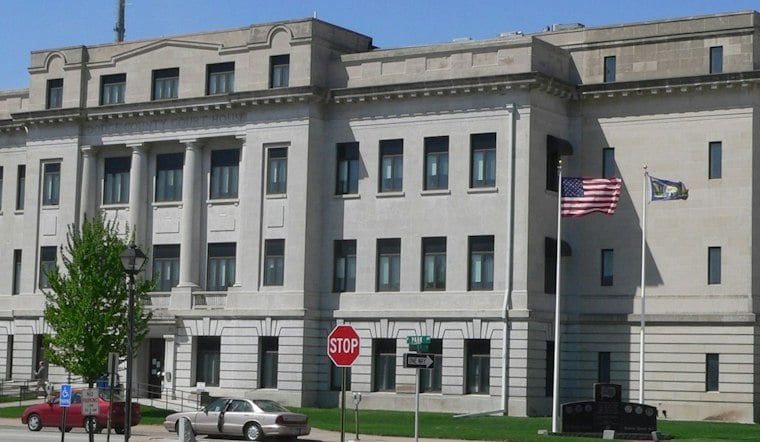
A Fremont County judge has taken the unusual step of filing a formal misconduct complaint against the district attorney who oversees criminal prosecutions in her own courthouse. District Judge Lauren Swan announced in a court filing that she submitted the complaint against District Attorney Jeff Lindsey to Colorado's Office of Attorney Regulation Counsel. The filing itself offered no explanation of what specifically triggered it.
According to the Colorado Springs Gazette, no details were shared in the court filing about the basis of Swan's complaint. Lindsey, who serves as district attorney for Fremont County within Colorado's 11th Judicial District, told the paper he was aware Swan had sent notice of the complaint but said he had not yet received it and could not comment on its contents. He said his office has been working to reform its discovery practices. The 11th Judicial District covers Chaffee, Custer, Fremont and Park counties, and the Office of Attorney Regulation Counsel oversees attorney discipline statewide, investigating complaints about lawyers' professional conduct.
A Judge's Prior Findings of Discovery Violations
Swan's complaint does not come out of nowhere. In July, she found that Lindsey's office had committed discovery violations and removed him and his entire office from a double-homicide and kidnapping case, according to the Gazette's earlier reporting. Colorado's Rule 16 requires prosecutors to disclose evidence to the defense in criminal cases, and a discovery violation is generally defined as evidence in a criminal case that goes undisclosed to the defense or prosecution. Swan has cited a judicial code of conduct that requires judges to report attorneys who may have violated professional rules.
The double-homicide case at the center of the dispute involved allegations that prosecutors failed to disclose that one of three defendants, Anthony Fogle, was working as a confidential informant for the sheriff's office after securing a favorable plea deal in an unrelated matter, according to Colorado Public Radio. In a related case tied to the same pattern of violations, Swan reduced defendant Toni Gurule's first-degree murder charge to second-degree murder; Gurule was ultimately sentenced to 40 years for the murders of Rodolfo Santillan-Reyes and Ryan Roth.
Conflicting Counts of Discovery Failures
Accounts of how widespread the problem has been diverge depending on the outlet. The Gazette reported that Swan found discovery violations across nearly two dozen criminal cases since Lindsey took over the district attorney's office in November 2024. The Wet Mountain Tribune, meanwhile, reported that Swan found more than 23 incidents in which the DA's Office under Lindsey's leadership failed to share evidence with the defense. The two figures are not identical, and the available reporting does not reconcile them into a single confirmed count.
Why Rural Prosecutors Struggle With Discovery
Jessica Dotter, executive director of the Colorado District Attorneys' Council, told the Gazette that rural prosecutors' offices often face difficulty recruiting and retaining staff, along with securing funding for the modern technology needed to track discovery obligations. That systemic strain offers some context for why smaller judicial districts like Fremont County's can struggle to keep pace with disclosure rules, though it does not excuse any specific violation found in court.
The outcome of the newly filed complaint remains unknown, and whether it leads to formal discipline will depend on the office's review.
A District With a History of Disciplinary Trouble
Fremont County's current dispute echoes a prior scandal in the same judicial district. Former 11th Judicial District DA Linda Stanley was disbarred after misconduct involving statements to the media and an improper attempt to remove a judge in the Barry Morphew case, the Gazette noted. The Office of Attorney Regulation Counsel is tasked with investigating and prosecuting allegations that Colorado attorneys violated the Rules of Professional Conduct, and it must prove any charges by clear and convincing evidence, per the Colorado Supreme Court's Office of the Presiding Disciplinary Judge. Possible sanctions in a disciplinary matter range from private admonition to public censure, probation, suspension or disbarment, though the office can also dismiss a complaint or resolve it through an alternative to formal discipline. Notably, the regulation counsel's office does not handle complaints about judges other than magistrates — those go to the Colorado Commission on Judicial Discipline — meaning any scrutiny of Swan's own conduct on the bench would follow a separate track entirely.




