

























































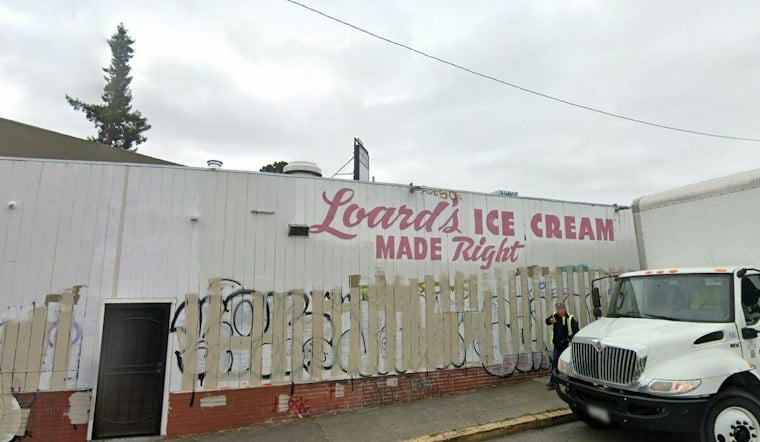
A sprawling new mural is taking shape on the MacArthur Boulevard wall outside Loard's Ice Cream in Oakland's Dimond district, where colorful horses are galloping toward a giant pink diamond. The piece, expected to be completed by January 2027, is the work of Oakland-based muralist and art professor Matthew Adam Floriani, who has been painting on weekends for the past few months.
The project traces back to Lindsey Vontz, a member of the Dimond Improvement Association's economic development committee, who asked Floriani to take on the mural after seeing his work on Skyline Boulevard. According to The Oaklandside, the design is loosely based on the galloping horses in “Pharaoh's Horses,” an 1848 painting by British artist John Frederick Herring Sr. In the mural, horses rendered in pink, purple, red, and blue race across the wall, kicking up golden dust as they head toward the diamond at its center.
A Design Layered With Local References
The mural does more than nod to a 19th-century painting. Shapes evoking blue clouds, or a river dotted with rainbow trout, pay tribute to Sausal Creek, while neon green clouds reference the supernatural light from the 2024 film “Freaky Tales,” which was filmed on location at Loard's Ice Cream. Vontz said the rendering contains Easter eggs throughout, and the piece is also meant to reflect the Dimond district's own history.
The horses’ creek references also fit a longer Dimond tradition of art tied to the local landscape. At Lincoln Avenue and MacArthur Boulevard, the Dimond Gateway mural, installed in 2010 and repainted in 2020, depicts native plants and animals from the Sausal Creek watershed; community volunteers and Oakland students helped paint it. A nearby mosaic by the Dimond Library likewise takes its design from Sausal Creek and the rainbow trout that live there, linking Floriani’s new imagery to earlier neighborhood projects. The Dimond Improvement Association’s public-art inventory documents both works.
That history has nothing to do with gemstones, despite the giant pink diamond at the mural's center. The Oaklandside's reporting notes that the neighborhood is actually named after Hugh Dimond, a Gold Rush settler who purchased the land in 1867. Loard's itself sits in the heart of that district, where the mural will anchor a stretch of MacArthur Boulevard that has not always treated public art kindly.
Funding a Decade in the Making
The mural is being paid for in part through a $15,000 grant from the Julie Johnson Public Art Fund, which the Dimond Improvement Association funds through donations and proceeds from community events like Oaktoberfest. The fund is named for Julie Johnson, a longtime Dimond resident and event organizer who died in a traffic collision in October 2023. The association has also secured an additional $10,000 from the Dimond Merchants Association and is hoping to raise another $10,000 to extend the artwork onto a taller, adjoining MacArthur Boulevard wall.
The association looked into Oakland's own public art program before pursuing a grant of its own, but found that process cumbersome, the report notes. That kind of friction with city funding mirrors a pattern the Dimond Improvement Association has described on its own site: the group has leaned on neighborhood-generated dollars for public art for years, including a $20,000 grant from Peet's in 2008 that funded five separate projects through a competitive process, and a Community Grants Program launched in 2019 that has typically handed out between $250 and $1,500 per project.
Oakland has a municipal public-art system, but its funding structure is distinct from the neighborhood fund backing the Loard’s project. Established by ordinance in 1989, the city program allocates 1.5% of eligible municipal capital-improvement project costs to public art, alongside eligible grants and private contributions. The city says it has commissioned more than 130 public artworks through the program. That framework helps explain why a privately hosted neighborhood mural may require its own fundraising rather than a direct city capital-project commission.
A Yearlong Hunt for a Willing Wall
Finding a location proved just as hard as finding money. Vontz said she spent the better part of a year trying to find a building owner willing to let the association paint a mural, eventually compiling a list of around 25 potential locations throughout the Dimond. Loard's lot owners ultimately agreed to host the piece and said they had no plans to sell the property.
Winnie Tam, co-owner of Loard's, said she was excited to have the mural beside the shop. The grant from the Julie Johnson Public Art Fund will cover painting the mural on Loard's side wall as well as repainting the shop's logo, giving the storefront a refreshed look alongside the new artwork.
Guarding Against Graffiti
Loard's has been down this road before. An earlier mural there, “Greetings from the Dimond District” by artist Pam Consear, was repeatedly tagged and eventually painted over in 2020. Floriani said the current project's funds can cover repainting any sections that get tagged after completion, and he plans to add a graffiti-protective varnish top coat, though an expensive one, that can shield the mural from the elements for a few years.
That protection matters because, per the article, Oakland does not offer financial support for graffiti abatement on public-facing murals, leaving business owners responsible for fixing any vandalism themselves. It is a quiet reminder of why the Dimond Improvement Association has had to build its own funding pipeline rather than wait on the city.
The city’s graffiti system also distinguishes between public and private property: Oakland’s Graffiti Abatement program handles graffiti on public property, while reports involving private property are referred to Building Services for enforcement under the municipal code. That division places the practical cleanup burden on property owners such as Loard’s, even as neighborhood groups raise money to protect commissioned art. Oakland’s OAK 311 guidance lays out the public-property program and the private-property referral process.
More From the Same Muralist
Floriani's work is already familiar to some Dimond and Laurel neighbors. He completed a vibrant harvest-landscape mural at Skyline Community Market, and one of his earlier murals decorates the patio at Dear John in Laurel. His online portfolio also lists the Skyline Community Market project among his completed commissions.
Beyond the mural itself, Vontz's work with the association extends to other efforts to support Dimond's commercial corridor, including plans to maintain a centralized website listing available storefronts and leasing contacts for the neighborhood. For now, though, the focus remains on MacArthur Boulevard, where horses, diamonds, and a bit of Sausal Creek magic are slowly taking over the wall outside Loard's.




