

























































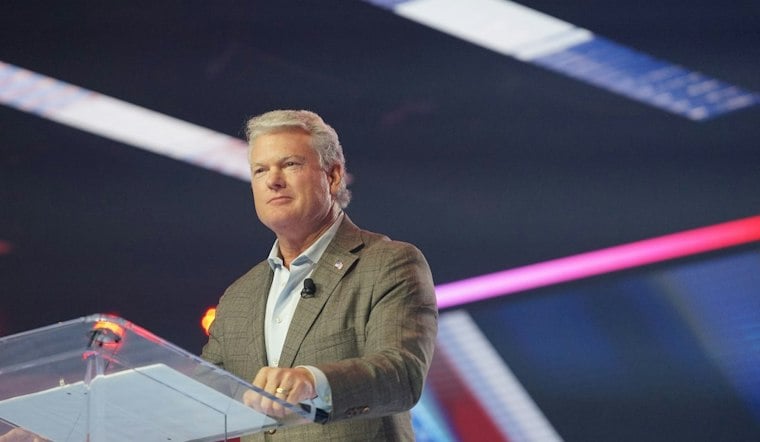
The House Ethics Committee has closed its investigation into Georgia Republican Rep. Mike Collins, finding that his congressional office improperly paid a woman through the House internship program while also accepting months of unpaid communications work from her. The committee resolved the matter by requiring $2,880 to be returned to the U.S. Treasury, according to the committee's findings.
The committee released its report regarding allegations tied to Collins on Nov. 23, 2026, according to a statement from the House Committee on Ethics. As reported by FOX 5 Atlanta, the woman identified in the report as Witness 1 received a total of $10,288.44 as a district intern across two periods — from Nov. 4 through Dec. 31, 2023, and again from Oct. 7 through Dec. 5, 2024. The committee assessed the overpayment at $2,880 rather than the full amount because investigators determined she had performed some legitimate communications work.
Romantic Ties to the Chief of Staff
Witness 1 was romantically involved with Brandon Phillips, Collins's then-chief of staff, per the committee's findings. She told investigators she worked on social media content and materials tied to a House leadership race, and that she created content for Collins's official social media accounts. Investigators said she worked remotely for most of the two paid periods, took part in no educational programming, and held a separate full-time telecommunications job — details that, per the same account, conflict with House rules requiring paid interns to perform services as part of an educational plan and generally barring them from teleworking except under certain exceptions.
An earlier account from the Georgia Recorder described the arrangement more starkly, reporting that Collins “paid an intern who was the girlfriend of his chief of staff but who did not actually perform any duties.” Collins's attorney offered a different characterization to the same outlet, saying Witness 1 “provided valuable assistance to the Office throughout both years regarding communications and other work of the Office.” The committee's final report credited some of that work but still found her pay was not commensurate with her official duties, estimating the overpayment based on the average pay of other paid interns in Collins's office.
Unpaid Volunteer Work Also Flagged
Separately, the committee found that Witness 1 provided about 18 months of unpaid communications services to Collins's office outside the two paid internship periods, work she considered voluntary and for which she did not seek payment. The committee concluded that accepting this unpaid labor violated restrictions on accepting voluntary services for official congressional work, but it explained it has not historically required reimbursement for that type of violation and did not direct repayment tied to the volunteer arrangement.
The Office of Congressional Conduct had earlier stated there was “substantial reason to believe that Rep. Collins used congressional resources for unofficial or otherwise unauthorized purposes,” according to U.S. News & World Report. Collins's counsel told investigators Witness 1 provided valuable digital and social media work and was, “if anything, underpaid,” while Collins himself characterized the matter as one of employment classification and administration rather than a fictitious employment scheme, maintaining that calling the arrangement a “fake internship” was misleading.
Travel Expenses and Oversight Questions
The committee also reviewed Phillips's travel reimbursements drawn from the Members' Representational Allowance, the fund that covers official congressional office expenses. Investigators flagged a $441 hotel stay from Dec. 30, 2023, through Jan. 1, 2024, $4,615.80 in flights to Tallahassee, Florida, and $630.70 in mileage reimbursements for travel between Phillips's home and duty station as potentially improper. The committee said it could not determine whether those expenses served official purposes or calculate the precise impermissible commuting costs, and it found no substantial evidence that Collins's office misused the allowance for Phillips's travel.
Investigators said they could not obtain Phillips's subpoenaed testimony, and the committee voted to refer him to the full House for contempt of Congress proceedings after he repeatedly evaded subpoenas. The report reportedly included Collins's position on the allegations but no substantive response from Phillips to the final findings. The committee found no evidence that Collins was directly involved in hiring Witness 1 or in using her services for official purposes, but it concluded he failed to exercise sufficient oversight of Phillips's expenditures and did not maintain sufficient oversight of his then-chief of staff more broadly.
Collins told the committee he was not personally involved in payroll decisions and relied on senior staff and financial personnel to ensure compliance with House rules. He also said he was not personally involved in submitting, reviewing or approving Phillips's reimbursements and did not knowingly authorize improper expenses, according to the report. The committee said Collins cooperated with its investigation, and it voted to close the matter on Nov. 19. The episode comes after Collins lost a bid to unseat Georgia U.S. Sen. Jon Ossoff.





