

























































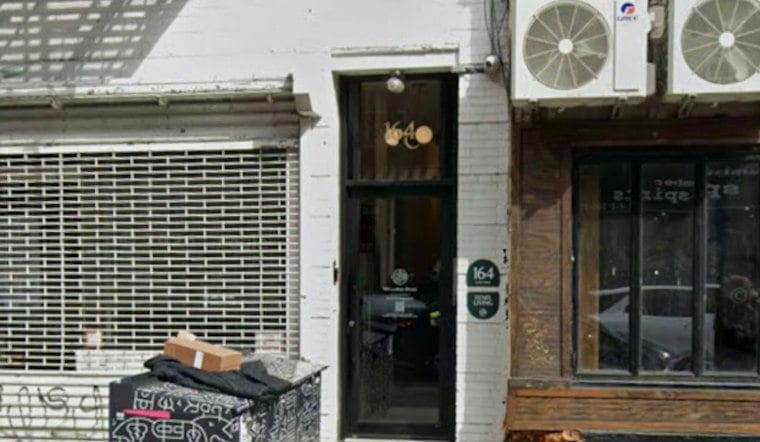
Heytea has opened a store on the Lower East Side that serves nothing but matcha - no coffee, no ube, no other categories at all. The company says Matcha Lab opened Monday at 164 Ludlow Street, giving New Yorkers a spot devoted entirely to the powdered green tea that has become one of the city's most sought-after drinks.
According to a Heytea press release, the Lower East Side location is the first Matcha Lab anywhere in the brand's global network and marks its fourth specialized concept in New York, joining a Heytea Lab in Times Square, a Teabar on the Upper East Side and a Gelato Lab+ in Union Square. The company describes a lab as a playground for exploring what tea can become, with modules that elsewhere include drinks, gelato, cakes and baked goods. At Matcha Lab, that experimentation narrows to a single ingredient: with no coffee, ube or other categories on the menu, the store is dedicated purely to exploring the possibilities of matcha, per the release.
The ceremonial-grade menu centers on single-origin matcha from Jingshan, China, and Shizuoka, Japan, each whisked to order and offered at three intensity levels - M60, M100 and M150 - with higher numbers signaling a stronger brew. Heytea describes the Jingshan matcha as delivering umami up front with subtle toasted notes and a mellow finish, while the Shizuoka version carries a fresh green aroma, a creamy texture and a lingering sweetness. Iced versions come topped with a vivid green cube of matcha ice.
A Hands-On Nod to Matcha's Centuries-Old Roots
Guests who want to get hands-on can grind tencha - the leaf material used to make matcha - themselves, using an antique stone mill from Uji, Japan, that the company says dates to the shogunate era. The release ties the ritual to a longer history: powdered-tea and whisking traditions flourished during the Song Dynasty in China and spread from Jingshan to Japan through Buddhist and cultural exchange, where matcha cultivation, tencha processing and tea-ceremony rituals were later refined.
The drink lineup leans playful alongside the ceremonial pours. The Matcha Dirty swaps out coffee entirely, infusing a house-made extra-rich matcha sauce into a matcha latte, and a pistachio version adds nutty pistachio flavor with a crisp pistachio kataifi topping. There's also a Matcha Latte Float with a scoop of matcha gelato over a matcha latte, a Frozen Yuzu Matcha that pours matcha over yuzu-and-apple sorbet, and matcha gelato served at four intensity levels - M60, M100, M150 and M200.
Sisi Zhang, Heytea's senior brand director, said in the release that mainstream matcha can still carry culinary or cultural edge, and that Matcha Lab takes the brand's curiosity and audacity to another level with a space devoted entirely to playing with matcha. Zhang said the Lower East Side suited the concept because the neighborhood makes room for differences and independent ideas.
Exposed Brick Instead of a Traditional Tearoom
The store itself skips the expected aesthetic. Rather than reproducing a traditional Chinese or Japanese tearoom, the interior pairs exposed original brick and structural elements with a soft beige wall, pale wood furniture and stainless-steel accents, according to the release. Installations throughout the space include matcha tools, the antique stone mill, tencha jars and educational notes, all visible behind a glass façade opening onto Ludlow Street.
Heytea says it now operates more than 3,500 stores across more than 330 cities worldwide, with more than 45 in the U.S. spanning New York, Los Angeles, the San Francisco Bay Area, Houston, Seattle and Boston. Founded in 2012 in Jiangmen, Guangdong, China, the company describes itself as the originator of new-style tea and credits itself with creating the first cup of cheese tea. It says it plans to keep reimagining tea's role in neighborhood and city culture as it expands.
New York's Matcha Boom Isn't Slowing Down
Matcha Lab arrives amid a broader surge in demand for the drink that has strained supply chains and pushed up prices nationwide. The Associated Press reported that U.S. retail sales of matcha are up 86% from three years ago, citing data from NIQ, as poor weather reduced Japan's harvest while labor shortages and high demand drove up prices in China as well. Tea buyer Aaron Vick told the wire service he paid 75% more for the highest-grade 2025 crop of Japanese matcha and expected lower grades to cost 30% to 50% more, and a San Francisco tea-house owner said he raised his matcha latte price by 50 cents after his Japanese matcha costs more than doubled.
The same report quoted a tea analyst who expects the social-media hype around matcha to eventually fade, though she believes the drink will remain on menus for a while. That staying power is visible elsewhere in the country: a November report from Block Club Chicago found the city's matcha wave showing no signs of waning, with one customer waiting three hours to get inside a Friday-only pop-up in late October, and a West Town shop's co-owner saying the location sells more than 1,500 cups a day on weekends.
Heytea's own lab expansion has moved quickly across North America. The company opened its first U.S. Gelato Lab+ at 863 Broadway in Union Square on Oct. 16, which Whatnow described as the brand's fourth lab-format store outside China, following earlier locations in Times Square, Toronto and Bangkok. Heytea has said its first overseas lab debuted in Times Square in early 2025, with its first Canadian lab following at CF Toronto Eaton Centre in February, unveiling eight limited-edition drinks made for international markets.




