

























































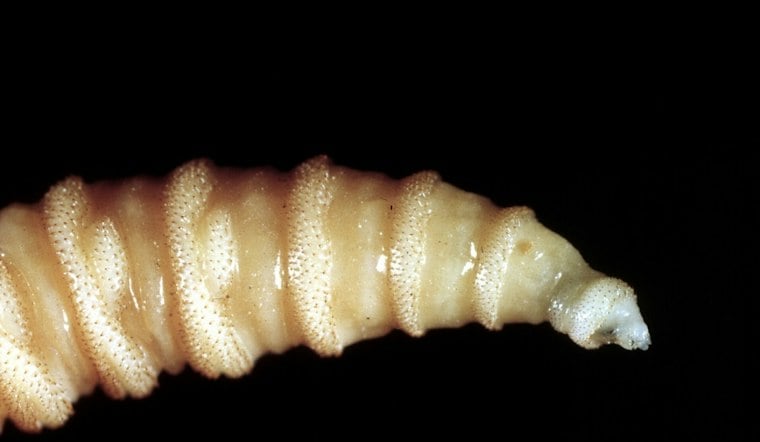
Hidalgo County has its first active case of New World screwworm, after the U.S. Department of Agriculture confirmed the infestation in cattle on Tuesday. The finding pushes the Rio Grande Valley's active-case count to four, as the flesh-eating parasite continues working its way through South Texas livestock.
The Hidalgo County case was detected in cattle, according to ValleyCentral, which first reported the USDA's confirmation. It's the latest marker in a Valley outbreak that began back in July, when the region's first screwworm case turned up in a baby calf — a case that has since been resolved and is now listed as inactive.
Just one county over, the parasite has been spreading faster. The USDA confirmed a screwworm case out of Starr County on Monday, the day before the Hidalgo County case was announced, and earlier in November the agency had already confirmed two additional Starr County cases, one in a dog and one in cattle, per the same ValleyCentral report.
Starr County Ranchers Already Fighting Back
Those earlier Starr County detections have ranchers on edge. After three confirmed cases there, two of them still active, cattle owners have been taking matters into their own hands, as KRGV reports. Rancher Arturo Gonzalez has turned to Vernecrin, a fly repellent for animals that lasts about a month, in an effort to keep his herd protected while the outbreak plays out.
The Valley's troubles fit a broader pattern spreading across the state. Confirmed U.S. animal cases jumped from 79 on November 1 to 139 by November 15, a roughly 76% increase in two weeks, according to Texas Public Radio. Of those 139 nationwide infestations since June, 74 remained active and 65 had turned inactive as of that mid-November count. New detections during that stretch included a horse in Goliad County — the first case there in the current outbreak — along with cattle in Jim Hogg and La Salle counties, sheep in Terrell County, and a horse infestation as far away as Pima County, Arizona.
Cooler Weather Won't Stop the Spread Alone
The Texas Animal Health Commission continues confirming infestations in livestock and wildlife across the state, including areas farther north and west of where the outbreak first took hold, according to the Texas Farm Bureau. The organization notes that cooler temperatures and favorable moisture conditions have actually helped fuel the pest's spread across Texas this fall. TAHC assistant state veterinarian Dr. T.R. Lansford said winter weather could help slow things down, but cautioned that colder temperatures alone will not eliminate the threat.
Federal officials have leaned on an unconventional weapon to fight back: sterile flies. The USDA has released more than 1.7 billion of them through aerial and ground operations, aiming to disrupt the screwworm's ability to reproduce in the wild.
Even when individual cases are resolved, the broader danger zone doesn't necessarily disappear. USDA's Animal and Plant Health Inspection Service has cautioned that an animal case being marked inactive does not mean the surrounding infested zone has been released — additional conditions still have to be met before that happens. Anyone who suspects a New World screwworm case in their animals is urged to call the Texas Animal Health Commission at 1-800-550-8242.





