

























































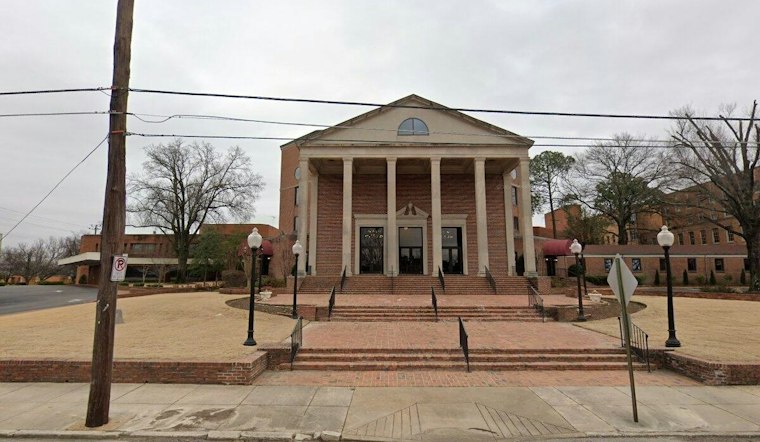
Construction crews knocked down the former Temple Israel building in Midtown on Oct. 30, closing out more than a century for the domed sanctuary at Poplar Avenue and Montgomery Street. The building was later used by Mid-America Baptist Theological Seminary until 1996, then by Memphis Academy of Science and Engineering, and eventually fell into disrepair. Its disappearance from the Memphis skyline is prompting a wave of reflection on what the building meant to generations of worshippers.
From 1916 until 1976, Temple Israel was housed in that grand domed sanctuary, according to the Daily Memphian, which reported that thousands of services, bar mitzvahs and weddings were held there over six decades. The building itself was designed by architects Walk C. Jones Sr. and Max Furbringer, per Synagogues of the South, which also notes the sanctuary opened in 1916.
Rabbi Micah Greenstein has often thought of the Hebrew phrase L’dor Vador, which means “from one generation to the next” and appears in daily Jewish prayers, the Daily Memphian reported. It’s a fitting touch for a building whose congregation is working to ensure its physical demolition doesn’t erase its place in Memphis Jewish history.
A Building Passed From Congregation to Congregation
When Temple Israel left the Poplar Avenue sanctuary in 1976 for its current East Massey Road campus, the congregation didn’t leave everything behind. Members took the ner tamid, or eternal light, along with the Torah ark doors and a Ten Commandments wall decoration, installing them in the new chapel, according to the same account from Synagogues of the South.
The vacated building didn’t stay empty for long. It was later used by Mid-America Baptist Theological Seminary and then by Memphis Academy of Science and Engineering, according to This is Memphis, which also notes that Rabbi James A. Wax served as Temple Israel’s senior rabbi from 1954 to 1978 — spanning the congregation’s move to its current home. Eventually the building fell into disrepair, the Daily Memphian reported, setting the stage for its demolition decades later.
A $310 Million Redevelopment Clears the Lot
The building had passed into the ownership of Mississippi Boulevard Christian Church, which tore it down to make way for a new worship space, part of a broader redevelopment effort. That new sanctuary is expected to complement the church’s $310 million mixed-use development. According to WREG, the structure was torn down to make way for a 73,000-square-foot sanctuary as part of that redevelopment plan.
Not everyone welcomed the wrecking ball without a second thought. WREG reported that Zach Harpole pointed to the Chick-fil-A on Union Avenue as an example of how a historic church building can be reused while its architecture is preserved — a comparison he drew while efforts were underway to save the old synagogue from demolition.
Carrying a Piece of the Past Forward
Temple Israel, for its part, is looking ahead rather than dwelling on the loss. The congregation plans to incorporate a piece of its past into a new project on its East Massey Road campus, the Daily Memphian reported, continuing a pattern established back in 1976 when physical pieces of the old sanctuary were carried into the new one.
B’nai Israel, Memphis’s first Jewish congregation, was founded in 1853. The Goldring/Woldenberg Institute of Southern Jewish Life describes its growth into a full-service congregation with 1,800 families, though it does not specify when that membership was reached.





