

























































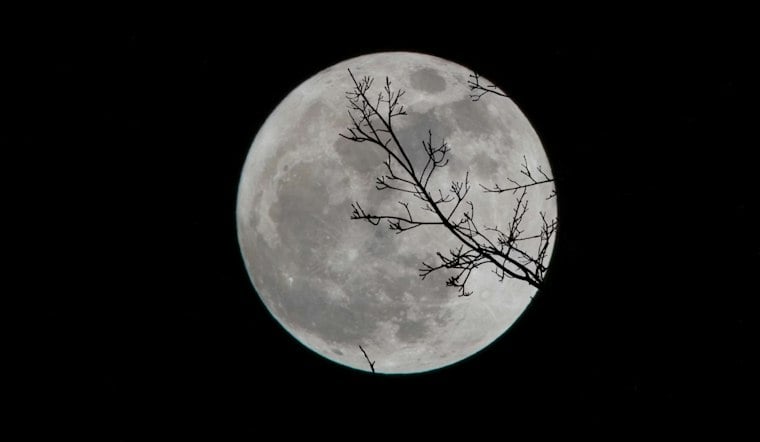
Houston sky watchers have a reason to glance eastward next Tuesday evening: the November full moon officially becomes a supermoon on November 24, 2026. It will be the first in a stretch of three consecutive supermoons expected to light up the region's skies through the winter.
According to CW39 Houston, anyone hoping to catch the moment should look toward the eastern horizon as the moon rises. A supermoon happens when a full moon coincides with the moon's closest approach to Earth in its orbit, and a full moon itself occurs when Earth sits directly between the sun and the moon, illuminating the moon's surface with sunlight. Full moons happen about every 29.5 days, the station notes.
This November's event carries extra significance because of the calendar quirks that led up to it. Per the same report, 2026 began with a full moon at the start of each month, but June's second full moon at the end of that month shifted the pattern, pushing full moons — and now supermoons — toward the last days of the month going forward.
Peak Timing and Best Viewing Window
The Old Farmer's Almanac pegs the Beaver Moon's peak illumination for November 24 at 9:53 a.m. EST, and recommends sky watchers instead look for the nearly full moon on the evenings of November 23 and 24, since the peak itself falls during daylight hours. The Almanac describes November as the first in a series of three consecutive supermoons, with December and January to follow.
As for how much bigger the moon will actually look, two reputable sources frame the comparison differently. The Almanac says the November supermoon may appear up to 8% larger in diameter and 16% brighter than a typical full moon, while EarthSky notes that a supermoon can exceed the disk size of a micromoon — the year's faintest, most distant full moon — by up to 14%, and its brightness by some 30%.
Two More Supermoons on the Way
The December supermoon is set to land on Christmas Eve, December 24, 2026, peaking around 7:28 p.m. in Houston, according to CW39's reporting. EarthSky lists that December 24 full supermoon as sitting roughly 221,667 miles from Earth, closer than November's, and calls it the closest full supermoon of the year.
A third supermoon follows on January 22, 2027, expected to peak around 7 a.m. in Southeast Texas. EarthSky places that one at about 222,229 miles from Earth, compared with November's distance of roughly 224,170 miles. NASA says supermoons happen about three to four times a year and can appear consecutively, which is exactly the pattern playing out this winter.
What to Expect Looking East
Houston's own astronomical calendar backs up the timing. timeanddate.com's November 2026 sky guide for the city lists a supermoon among the month's notable events, alongside Mars and Jupiter appearing close together, a scattering of shooting stars, and a recognizable constellation. For now, the advice from CW39 remains simple: step outside, face east, and watch the Beaver Moon rise a little bigger and a little brighter than usual.



