

























































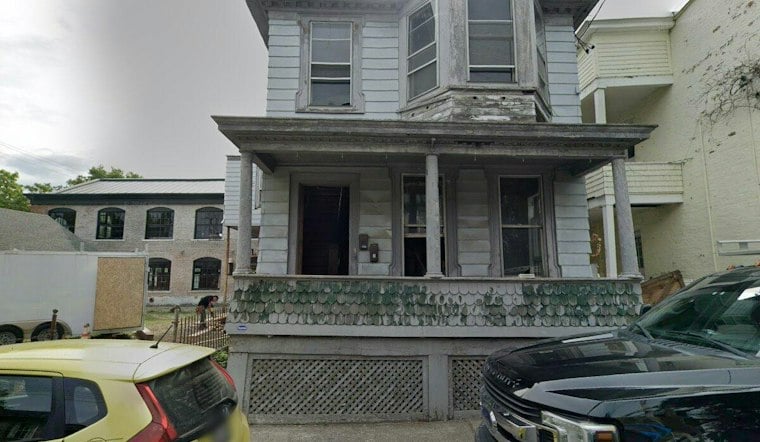
City Code Enforcement Officer Nick Fox said workers grinding paint at 16 North Fourth Street in Hudson sent dust into the air on Thursday, Oct. 29. Fox described the work as a risk to the crew and nearby pedestrians; he also said none of the workers was certified to handle lead paint.
As reported by The Daily Gazette, a paint sample from the site tested positive for lead-based paint. Fox said the workers used N95 masks rather than proper respirators while grinding the paint, which sent dust into the air.
According to The Gossips of Rivertown, none of the workers on site was certified to do lead paint removal, and the grinding method let paint dust become airborne, endangering the workers themselves and creating a threat to public safety. The outlet reports the incident was referred to the federal Environmental Protection Agency, and that Fox has been monitoring the site since. The Daily Gazette separately reported that Fox notified the EPA about the incident and said Galvan had violated lead-based paint regulations.
A Project Already Under a Stop-Work Order
This is not the Hudson Public Hotel project's first run-in with city code enforcement this year. The Gossips of Rivertown's report on the lead paint incident notes that the project had already been subject to a stop-work order since August over violations of the certificate of appropriateness granted by the city's Historic Preservation Commission. Fox found on Aug. 21 that Galvan and Schenectady-based contractor Bishop-Beaudry were not following key conditions the commission had set in the project's March 2023 certificate of appropriateness, according to a separate report from the same outlet.
The Daily Gazette's earlier reporting on that stop-work order detailed specific violations: the project had installed 95 unapproved windows and seven unapproved light fixtures rather than the approved fixtures, among other departures from what the commission had signed off on. The main hotel building's construction has been shut down since that Aug. 21 finding. The Hudson Public Hotel sits at the corner of North Fourth and Warren streets, with the two historic houses at 16 and 14 North Fourth Street, across from Padrona Bar, intended as extensions of the hotel.
Lead Exposure Risks, According to Health Experts
Lead exposure can pose serious health risks. The Mayo Clinic has noted that adults exposed to lead-based paint face increased risks of high blood pressure, hypertension, cardiovascular disease and kidney damage, while children exposed to lead may experience learning difficulties, reduced IQ, developmental delays, shortened attention span and hyperactivity.
The Occupational Safety and Health Administration's lead standard addresses worker exposure and lists power-tool cleaning without dust-collection systems among the tasks covered when lead-containing coatings or paint are present, according to the agency's regulatory text. Separately, the EPA's Renovation, Repair and Painting Program sets certification and training requirements for work within its scope, according to the agency's program guidance.
EPA enforcement actions elsewhere in New York involved different properties and work. The agency said it settled an RRP Rule case against All City Remodeling in Queens in September 2024, with a $103,000 penalty over renovations at three properties. It also reported that Rose Demolition and Carting agreed in September 2024 to comply with lead-paint regulations and pay a $100,000 penalty for RRP Rule violations tied to demolitions at more than 650 New York City residential properties between 2016 and 2019, in a separate case. Both cases are described in the EPA's enforcement announcement.
From Demolition Plans to Renovation — and Back to Scrutiny
The two historic houses at the center of the Oct. 29 incident have had a winding regulatory history of their own. Galvan Foundation initially planned to demolish both structures and build an additional hotel building with more rooms, according to seed reporting on the project. The Historic Preservation Commission confirmed in February that the houses sat within a historic district, and the project's architect, Walter Chatham, paraphrased the commission's message as meaning the houses could not be demolished.
By January, Galvan had reversed course. “We are no longer pursuing demolition and instead plan to renovate and restore the structures,” the foundation said, according to NewsRadio 1450/1370 WKIP. Just how many hotel rooms that renovation would ultimately yield has been reported inconsistently: a Daily Gazette report described the revised plan as containing 12 rooms rather than the 14-room extension originally proposed, while the WKIP report quoted a Galvan representative estimating, “I think we'll end up with about eight rooms.” The current approved room count has not been confirmed in subsequent reporting.
Another Hudson Project Drew Scrutiny
The Hudson Public Hotel project was not alone in drawing scrutiny over the summer — a separate stop-work order was issued at 123 Union Street in August, with Fox reporting on certificate-of-appropriateness violations at both sites, per another Gossips of Rivertown report.
The hotel project is part of Galvan Foundation's broader footprint in Hudson, where the organization has been winding down its holdings. Three properties and the former Helsinki nightclub are among the last Hudson properties managed by Galvan, which donated dozens of its formerly owned Hudson properties to Bard College's endowment in 2025. Galvan employees have said they hope the remaining projects, including the hotel extension, will help create a hospitality hub in the city's 400 block. Fourth Ward Common Council member Henry Haddad represents the district where the project sits.




