

























































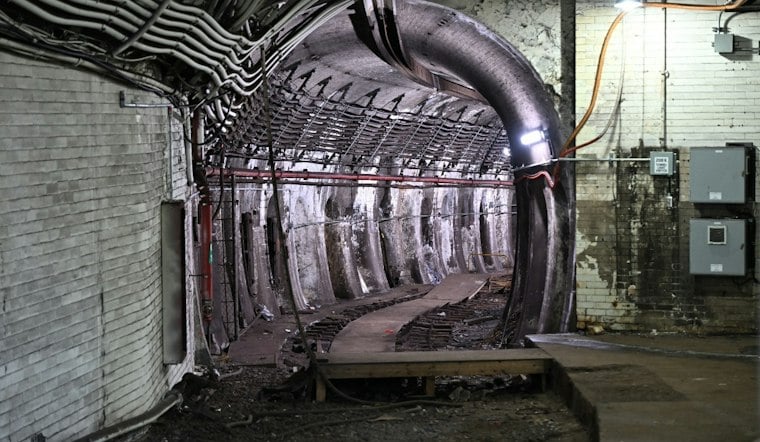
Beneath the streets of Boston sits a tunnel that hasn't carried a passenger since the 1960s, but still holds the rusted tracks, ventilation fans and switch box from when it helped launch the nation's first subway system. NBC10 Boston went inside the forgotten passage, part of the historic Tremont Street Subway, and found it frozen in time, down to stacked civil-defense ration cans left over from the Cold War.
America's First Subway Tunnel, Dug Mostly By Hand
The tunnel dates back to the late 1800s and once formed part of the Tremont Street Subway, which NBC Boston describes as America's first subway system. This particular stretch ran south from Boylston Street Station to the Pleasant Street Incline, and according to transit historian Steven Beaucher, it was the first section in the country to carry revenue passengers underground in a subway car. Beaucher, author of Boston in Transit and co-founder of WardMaps, said the tunnels were mostly dug by hand and were built with a very practical goal: unclogging the chaos of horse-drawn traffic and streetcars crowding Boston's surface streets.
Beaucher likened the scale of the undertaking to a more modern Boston headache, saying it was essentially “the Big Dig of 1897.” He called the Tremont Street Subway's creation the biggest change in transit infrastructure Boston had seen up to that point, a leap that reshaped how the city moved people for decades afterward.
Tracks, Fans and a Forgotten Switch Box
Decades after trains stopped running through it, the tunnel still contains rusted train tracks, old ventilation fans and an original switch box, remnants of a system that quietly outlived its usefulness once cars and buses took over city streets. The tunnels were abandoned in the 1960s, and the rest of the Tremont Street Subway was absorbed into what riders now know as the Green Line, the report notes.
Dennis Varley, the MBTA's chief of stations, told the station that abandoning a tunnel like this one means abandoning a place, not just a piece of infrastructure. He said the tunnels capture the evolution of engineering and infrastructure in a way that's hard to see anywhere else in the city, preserved exactly as crews left it when the last train rolled through.
Cold War Crackers Still Tucked in the Dark
Among the relics are civil-defense cans, which Varley said once held crackers intended to sustain life in the event of a nuclear threat or bombing. The find lines up with a wider Cold War-era effort documented by the Boston Herald, which reported that the Metropolitan Transit Authority stored food, water, sanitation kits and medical supplies in abandoned Boston subway tunnels in 1964. By the end of that year, the newspaper reported, the city's tunnels were stocked with enough provisions for 70,000 people, turning forgotten subway corridors into makeshift fallout shelters for a city bracing for the worst.
This isn't the only piece of the old Tremont Street Subway hidden beneath modern Boston. A separate, now-abandoned stretch beneath City Hall Plaza opened in 1898 as an extension of the line, running from Scollay Square to Adams Square along what used to be Cornhill Street, according to Boston.com. That section was abandoned in the early 1960s during the Government Center redevelopment. In 2018, the Boston Landmark Commission briefly opened it to the public for Preservation Month, and Boston Magazine reported that the limited tour tickets sold out within minutes.
Together, the two buried tunnels tell the story of a transit system that was revolutionary in its day and then quietly left behind as the city moved on to buses, cars and the modern Green Line. For now, the Boylston Street to Pleasant Street Incline stretch remains exactly as Varley described it, a dark, rusted time capsule of 19th-century engineering sitting just beneath the feet of modern-day commuters.




