

























































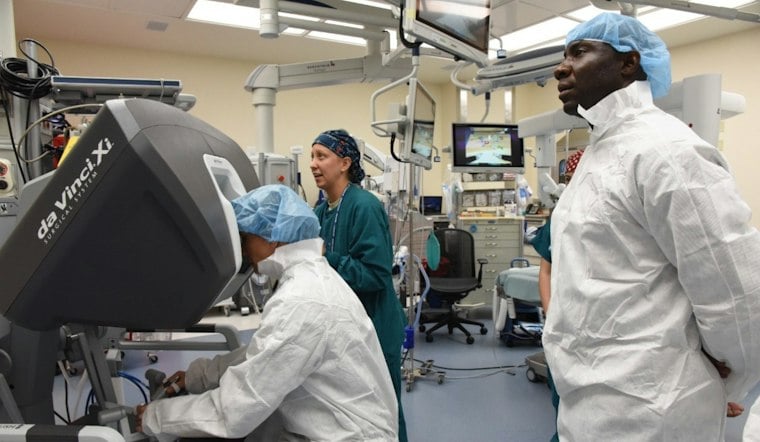
Intuitive Surgical has agreed to pay $450 million to settle a class action brought by hospitals that accused the maker of the da Vinci surgical robot of monopolizing the market for servicing its machines and repairing surgical instruments. The agreement still needs sign-off from a federal judge before any hospital sees a dime.
According to Law360, the settlement is subject to approval by a California federal judge, and Intuitive did not admit liability or wrongdoing in striking the deal. The company reiterated that position in disclosures to Yahoo Finance, which reported the $450 million figure as a charge tied to previously disclosed antitrust litigation over its da Vinci business.
The case traces back to 2021, when hospitals sued under Sections 1 and 2 of the Sherman Act, claiming Intuitive used tying arrangements, exclusive dealing and monopolization to control the markets for da Vinci servicing and EndoWrist repair and replacement. Intuitive disputed the claims throughout, arguing its usage limits reflected engineering and patient-safety concerns rather than anticompetitive intent.
A Long Road Through the Courts
A judge denied Intuitive's motion to dismiss in January 2022, and the case proceeded toward trial. In March 2024, the court ruled at summary judgment that the da Vinci robot and EndoWrist instruments are separate products — a key finding for the hospitals' tying theory — though the company's own regulatory filing later noted the court granted reconsideration that July, vacating portions of that order tied to the EndoWrist repair-and-replacement market and Intuitive's market power within it.
The class was certified on March 31, 2025. No trial date had been set. The case remained unresolved before the proposed settlement.
Per the da Vinci Antitrust Class Action website, the court has not decided whether the plaintiffs or Intuitive are right — the settlement resolves the case without a determination on the merits. Intuitive denies the allegations and maintains its use limits and customer agreement terms promote patient safety and product quality.
Who Gets a Share, and Who Doesn't
The settlement class covers roughly 2,200 hospitals and surgery centers that bought da Vinci service and EndoWrist instruments directly from Intuitive in the United States between May 21, 2017, and December 31, 2021, excluding facilities run by the Departments of Defense and Veterans Affairs. Patients and surgeons are not class members, and the deal has nothing to do with claims that the robots injured anyone during surgery.
Entities that opted out by the April 20, 2026, deadline are excluded from the settlement class. The proposed settlement would resolve the class action over the alleged conduct.
What Changes for Hospitals Going Forward
Beyond the cash payment, Intuitive agreed to five years of structural changes meant to open competition in EndoWrist refurbishment and robot servicing — changes the hospitals' economics expert valued separately at $1.06 billion to $1.93 billion. Under the deal, Intuitive would not void service contracts, cut off U.S. business, or treat customers as in breach for using FDA-cleared third-party remanufactured EndoWrists during that period.
The company also agreed to maintain an authorization process letting original buyers refurbish and reset use counters on eligible EndoWrists, to share technical specifications needed for safety testing, and to stop threatening warranty voidance or halting service and EndoWrist sales simply because a hospital used an authorized or FDA-cleared instrument — except in cases involving damage, malfunction, or patient-safety risk. Intuitive further agreed not to block qualifying third parties from supplying refurbished EndoWrists or prevent hospitals from sending used instruments to them.
One notable commitment: Intuitive agreed to develop and pilot a program allowing trained hospital technicians and independent service organizations to perform preventive maintenance and field repairs on da Vinci X and Xi robots, projected to launch in the first quarter of 2028 and run for 18 to 24 months.
How the Money Would Move if Approved
If approved, the proposed settlement would establish a $450 million fund. Claim forms would be pre-filled using Intuitive's purchase records where possible.
Each claimant's payout would be based on the plaintiffs' expert's damages calculation, with the fund distributed pro rata after fees and expenses are deducted.
Class counsel plan to seek fees, expenses, and service awards, subject to the court's final decision once class members have had a chance to object.
The notice and claims period would begin about 30 days after a preliminary approval order, with a final approval hearing to follow at least 130 days later. Hospitals filed a motion for preliminary approval on November 20, 2026, with a hearing scheduled for April 1, 2027. As of now, claims are not yet open.
The settlement talks unfolded against a backdrop of strong business performance for Intuitive. Worldwide procedures across its da Vinci and Ion platforms rose about 15% in the most recent quarter, with da Vinci procedures up roughly 14% and Ion procedures climbing 31%, the company's report notes. Intuitive also placed 546 da Vinci systems during the period, up from 427 a year earlier, with 315 of those being the newer da Vinci 5 platform, as revenue reached $3.05 billion, a 22% jump from $2.51 billion a year prior.



