

























































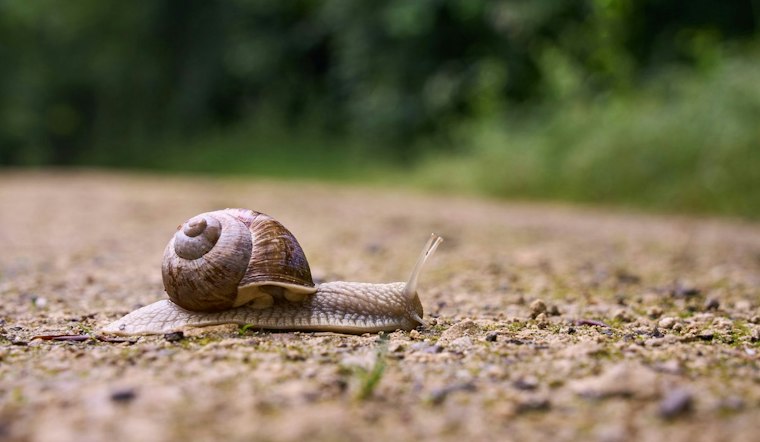
A creek in Kent County has become the newest front line in Michigan's fight against a pinhead-sized invader that can survive being swallowed whole by a fish. Volunteers monitoring water quality discovered invasive New Zealand mudsnails in Bear Creek, a tributary of the Thornapple River, marking the species' first known appearance in the southern Lower Peninsula.
The discovery was made by volunteers with the Coldwater River Watershed Council during routine aquatic macroinvertebrate monitoring, according to Michigan Public, which reported the group discovered the teeny tiny invader in Bear Creek, a tributary of the Thornapple River in Kent County. Aquatic macroinvertebrates like the ones the volunteers were sampling are commonly used to gauge water quality and stream health, which is how the mudsnails first turned up. The watershed council sent photos to the Michigan Department of Environment, Great Lakes, and Energy for identification, and the find was then verified by outside specialists. Experts from Oakland University and Trout Unlimited confirmed the identification, WOODTV reported.
Bear Creek sits roughly 75 miles south of the species' closest previously known Michigan infestation in the Pere Marquette River, according to 99.1 WFMK, which described the find as their first detection in the southern Lower Peninsula, about 75 miles south of the closest known infestation. New Zealand mudsnails were first documented in Michigan in 2015 in the Pere Marquette River near Baldwin, according to a Michigan Department of Natural Resources fisheries report, and since then the species has occupied northern waterways including the Au Sable, Boardman, Grass, Pere Marquette, Pine and upper Manistee rivers before expanding south into Kent County.
A Snail Built to Spread Fast and Survive Almost Anything
These are not imposing creatures to look at. A New Zealand mudsnail measures only about one-eighth of an inch long and is colored brown to black, easy to overlook in a streambed full of gravel and debris. But its biology makes it a formidable invader: the species reproduces by cloning, with all-female populations developing embryos without fertilization, meaning a single snail can establish an entire population on its own. One snail can produce more than 200 offspring each year, per the same WOODTV report.
The snail's defenses are just as striking as its reproduction. Its thick shell and tightly closing operculum make it difficult to digest, and it offers little nutritional value even when a fish does manage to eat one. As a result, the mudsnail can sometimes pass through the digestive system of a fish alive, according to Michigan Public — a trait also confirmed in a Michigan DNR fisheries report, which found New Zealand mudsnails are capable of surviving passage through the digestive tract of rainbow trout. With few natural predators or parasites in North America, the species faces little to check its spread once it arrives, according to Michigan Department of Environment, Great Lakes, and Energy.
What Dense Populations Could Mean for Trout Streams
Where mudsnail populations explode, the ecological ripple effects can be significant. Researchers have documented snails reaching densities of 300,000 per square meter in some western locations, WOODTV reported, while the Michigan DNR fisheries report notes that populations outside the species' native range can exceed 500,000 individuals per square meter. At those densities, food for other stream invertebrate populations can become scarce, and fish that feed on native invertebrates like mayflies and caddisflies may find it more difficult to forage in rivers invaded by the species, according to the Michigan Invasive Species Program.
That matters for the Thornapple River's fish populations because, as mudsnails push out the native food sources trout and other sport fish rely on, it can reduce their growth, condition and abundance. A DNR study of the Pere Marquette River found that native mottled sculpin and sucker species did eat some mudsnails, making up 0.2 percent of sculpin diet and 3.7 percent of sucker diet at infested sites between 2016 and 2017 — but researchers concluded it appears unlikely that these fish exert strong biological control on this invasive species.
No Cure Once the Snails Take Hold
Once established, there is currently no effective treatment to control or eliminate established New Zealand mudsnail populations, 99.1 WFMK reported. That reality is shaping how state biologists respond to the Bear Creek find. Michigan Invasive Species Program biologists are gathering more information about the infestation and plan additional sampling at the site and other Thornapple River tributaries, with biologists planning more sampling in Barry, Kent and Ionia counties, per 99.1 WFMK's report.
Researchers also intend to dig into where exactly these snails came from. Oakland University will conduct genetic testing on the collected samples to identify source populations, and population genetics will be done to try to trace the source of these individuals, Michigan Public reported. The mudsnail is classified as prohibited in Michigan due to the environmental harm it can cause to rivers, streams and lakes, as reported by Michigan Department of Environment, Great Lakes, and Energy. Under Michigan law, a person is not considered to possess a live organism if it was obtained from the environment and is possessed only at the specific location where it was obtained, according to the Michigan Legislature's compiled statutes.
Keeping the Snails From Spreading Further
State staff plan to post informational signs at recreational access points on affected creeks and rivers and will work with the Coldwater River Watershed Council, the Thornapple River Watershed Council and cooperative invasive species management areas to track and respond to the infestation. Part of that effort includes educating recreational users about preventing the snail's spread, since anglers, paddlers and boaters can unknowingly carry the tiny mollusks from one waterway to another.
Recommended precautions include cleaning, draining and drying boats, trailers and equipment before moving to a new destination, and inspecting poles, nets, waders, boots, buckets, kayaks, canoes and flotation devices for plants, mud or debris. The NZMS Collaborative also recommends stomping and inspecting gear immediately upon leaving the water, thoroughly spraying boots and waders with a disinfecting agent, brushing to work disinfectant into gear, rinsing gear after at least 10 minutes, and thoroughly drying waders before their next use whenever possible, as noted by Michigan Department of Environment, Great Lakes, and Energy. As originally detailed by MLive, those simple habits remain the primary defense against a species that, once settled into a creek bed, may be impossible to remove.





