

























































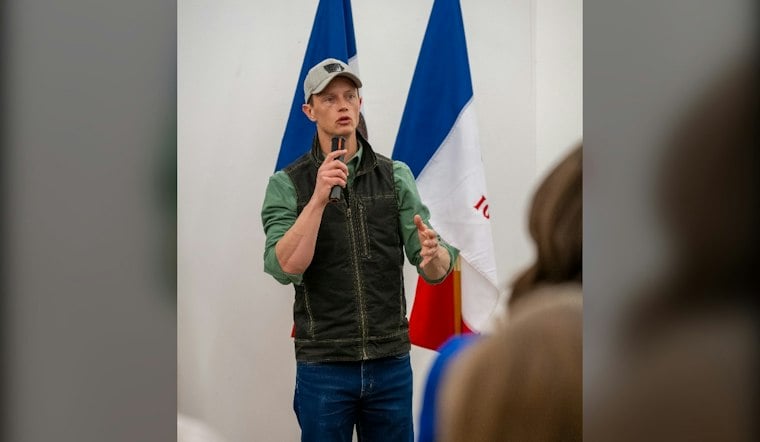
A campaign ad featuring an AI-altered image of Rob Sand has become a flashpoint in Iowa's governor's race. The dispute puts the state's lack of specific rules for AI-generated political ads in focus: Iowa is one of 19 states without such regulation.
No State Law on the Books
According to Axios, Iowa lawmakers considered requiring disclosures on certain AI political ads earlier in 2026, but the proposal failed to become law. The bill would have required ads to disclose when AI was used to create realistic but fake images or videos of people, according to the same report. Nationally, 27 states require some disclosure of AI-generated political ads and four states ban certain AI deepfakes outright, while federal law does not specifically regulate AI-generated political ads, Axios reports. Iowa lawmakers could revisit disclosure requirements when they reconvene in January 2027, per the same account.
Iowa Also Requires Sponsor Identification
Even without AI-specific rules, Iowa requires candidate material expressly advocating a candidate’s nomination, election or defeat—including internet websites and video ads—to carry a “paid for by” attribution identifying its sponsor, according to the Iowa Ethics and Campaign Disclosure Board. That sponsor-identification requirement is separate from a disclosure that an ad contains AI-generated material.
The image was based on a photograph published in an Iowa Capital Dispatch article about a cancer-prevention discussion at the Empire Downtown. Sand wore no face covering in that original photo. AFP Fact Check found that the campaign image had been altered with artificial intelligence. OpenAI's image verification tool detected a SynthID watermark in the altered version, indicating manipulation.
Lahn Defends the Ad, Sand's Camp Cries Foul
Zach Lahn's campaign aired the AI-generated ad depicting Sand in the altered garb, and Lahn has defended it, according to KCCI. The station reports that the ad includes a disclaimer identifying AI-generated content, and that Lahn said its claims about Sand's political positions are accurate. Sand's campaign disputed the ad's accuracy and accused Lahn of using AI to mislead Iowa voters, the station notes.
AI-generated political ads have appeared in contests ranging from U.S. Senate races to gubernatorial campaigns. Experts warn that fabricated scenes can give voters a false impression of a politician's views. Travis Ridout, cited in the Axios report, advises viewers to be cautious when a familiar public figure appears in an unfamiliar situation or in conspicuously stylized, cartoon-like imagery. News reports can also help identify disputed ads when candidates publicly challenge them.
Iowa's Ad Spending Surge
The Wesleyan Media Project tracked six AI-generated ads running in Iowa through Oct. 11, with around $1.5 million spent airing them in the state, according to Ridout's figures cited by Axios. That's a sliver of the broader spending wave: campaigns and PACs nationwide spent around $137 million on 220 AI-generated ads through Oct. 11, per the Wesleyan Media Project. Most of that nationwide spending came from Republicans, the group found.
Fortune, drawing on the same Wesleyan Media Project data, reports that campaigns and political action committees spent more than $137 million on 220 videos made at least partly with AI through Oct. 11, and that more than 70% of those videos carried no disclaimer disclosing AI involvement. Republican campaigns and PACs accounted for 81% of the AI-generated ads and 88% of the spending, according to Fortune. For comparison, the Wesleyan Media Project detected less than $50,000 in spending on AI-generated ads during the entire 2024 campaign cycle, the outlet notes — a sign of how quickly the tactic has scaled up.
Money Is Pouring Into the Iowa Race
The surge in AI ad spending has coincided with a broader cash influx into Iowa's contests. Ad spending in Iowa climbed from $42 million during Sept. 28 through Oct. 11 to $65 million in the following two weeks, according to the Wesleyan Media Project. Spending in the Iowa Senate race alone topped $60 million during that same Oct. 12-25 window, the group reported, part of a pattern Ridout described as the Senate battleground shifting away from Georgia and North Carolina and into redder territory including Iowa.
By early September, the Wesleyan Media Project had identified at least 164 AI-created or AI-enhanced political ads nationwide tied to nearly $80 million in spending, according to The Conversation. That outlet reports that the National Conference of State Legislatures counted 31 states with election deepfake laws as of June, including 28 requiring disclosures — though those laws vary widely. Louisiana's law from that same month requires clear AI warnings on certain ads but excludes federal candidates, while Maryland's law prohibits certain AI-altered depictions even when an AI warning is included, per the same report.
Legal Gray Area Persists
Iowa's Senate File 2166 would have concerned the publication of electioneering communications containing synthetic media and provided penalties for violations, according to bill-tracking records from the Iowa Legislature. A related Ethics and Campaign Disclosure Board proposal would have required political advertising containing synthetic media to include a disclosure, according to legislative documents. At the federal level, the Federal Election Campaign Act prohibits a candidate or a candidate's agent from purporting to speak, write or act for another candidate or political party in a way that damages them, according to the Federal Election Commission — though that doesn't amount to specific regulation of AI-generated ads.
With no state law in place and lawmakers not expected to reconvene until January 2027, the dispute between Sand's and Lahn's campaigns is likely to remain a test case for how Iowa voters sort fact from fabrication heading into the final stretch of the race.



