

























































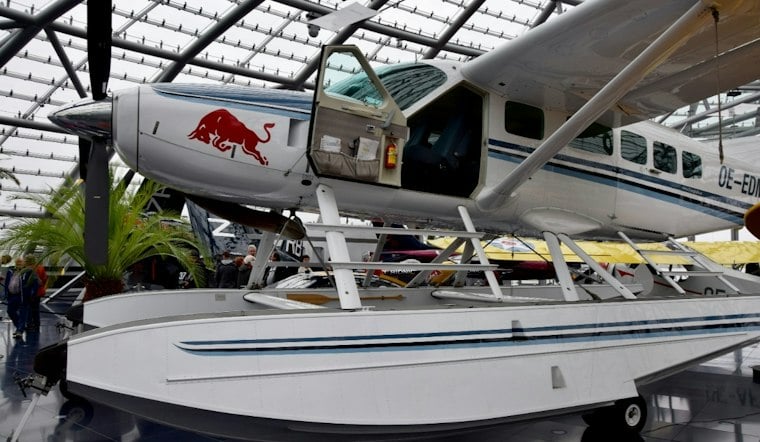
A Cessna Caravan with an onboard safety pilot making no control inputs just flew across the entire United States. The U.S. Air Force has expanded its funding for Joby Aviation, the California-based aviation company better known for its electric air taxi ambitions. Joby says the Air Force's total commitment to its autonomous flight technology has climbed to nearly $37 million, with the ceiling on its operational testing contract now raised to $50 million.
The expanded funding follows what Joby calls a record-setting coast-to-coast tour of its J208 autonomy system, flying a Cessna Caravan from Concord, California, to North Carolina's Outer Banks with zero control inputs from its onboard safety pilot, according to Joby Aviation. The company says the nationwide trip spanned 6,665 miles, with landings in 11 states and integrated flight operations across 24 states total. Along the way, the aircraft demonstrated autonomous taxiing, takeoffs, route navigation and landings, all while under remote supervision from a ground-based operator stationed as far as 2,537 miles from the plane itself.
That ground-based operator can monitor the flight and update routes or communicate with air traffic control in real time, per the company's account. Joby says its autonomy system has now logged more than 400 fully autonomous flights, building a track record the company is positioning as proof its technology can scale beyond a single aircraft type.
Funding Tied to Future Pacific Exercises
AFWERX, described as the innovation arm of the Air Force, awarded the additional funding, which Joby says will support continued autonomy software development and expanded operational testing in the Pacific. The newly awarded contracts will focus specifically on executing follow-on Pacific military exercises, the company says, building on work it has already done in that theater. Joby holds two primary agreement contracts with AFWERX covering software integration and operational testing.
That Pacific work traces back to the REFORPAC military exercises in August 2025, when Joby deployed its autonomous flight technology in the region. During those exercises, an aircraft stationed in Hawaii was operated remotely from Guam, a distance of nearly 4,000 miles, according to the same Joby Aviation account. The Air Force has described those REFORPAC flights as the first autonomous cargo flights tested in the Indo-Pacific, evaluated against what it called real-world challenges including long distances, dynamic routing, diverse weather, and operations with allies and partners, as reported by Defense One.
Defense One also notes the Air Force's broader rationale: autonomous flights using smaller planes, like a Cessna, can reduce the burden on larger cargo aircraft and airmen. The outlet reported separately that the Air Force signed a $17.4 million contract with Reliable Robotics to deploy a pilotless C-208 for logistics operations in the Pacific, a sign that Joby isn't the only company the service is betting on for uncrewed cargo work. Flying magazine has reported that AFWERX also awarded autonomy technology provider Xwing military airworthiness for its self-flying Cessna 208B Grand Caravan in the form of a Military Flight Release, according to Flying.
Speed Gains in Logistics Testing
Joby's own account of a separate test, the Air Force's Agile Flag readiness exercise, states that its autonomous aircraft delivered critical replacement parts 24 hours faster than conventional logistics methods. The company frames these exercises as evidence that its dual-use technology, which integrates advanced sensors, onboard computing and automated flight controls, can serve defense logistics, cargo operations and emergency response beyond the passenger air taxi market Joby is best known for pursuing.
Joby says its aircraft will help establish autonomous routes to move critical cargo, medical supplies, and logistics shipments in participating regions. The company's J208 operations during the cross-country tour were also tied to civilian initiatives, including North Carolina's ELIFT-NC statewide healthcare logistics program and Utah's multi-state UFLY coalition, which is assessing high-altitude and extreme-environment airspace integration for the Federal Aviation Administration. Joby says both threads of testing are part of White House-backed eVTOL integration pilot programs in Utah and North Carolina, and that its operations will generate data to inform the FAA's evolving autonomous-flight regulatory frameworks.
Not a Guaranteed Payout
Despite the headline-grabbing contract ceiling, Joby has cautioned that the figure is not a promise of payment. The company's own disclosures note that Air Force contract ceilings may not result in the maximum amount being paid, citing government funding and appropriations constraints as a standard risk factor in such agreements. In other words, the $50 million represents an upper bound on what the Air Force could spend with Joby under the current contract structure, not a committed check.
Joby executives framed the expansion as validation of a broader strategy. Joby co-founder and CEO JoeBen Bevirt said the company's system was designed to be platform-agnostic, capable of quickly bringing autonomy to varied aircraft types rather than being locked to a single airframe. Bevirt added that the new funding will accelerate sustained uncrewed operations and a software solution aimed at military and cargo logistics needs. AFWERX's Kate Brown said the organization supports autonomous airlift technology development and evaluation as a way to strengthen Air Force logistics resilience.
The autonomy technology at the center of this expansion traces back to Joby's 2024 acquisition of Xwing's autonomy stack. Joby has separately said it plans to acquire Resonant Sciences, a deal expected to close early in 2027 and intended to accelerate the company's defense capabilities. Joby, which trades under the ticker JOBY and also operates Blade, an urban air mobility business providing passenger transportation in the U.S. and Europe, has said it intends to eventually operate air taxi service in cities worldwide and sell aircraft to other operators and partners — a long-term ambition that now runs parallel to its expanding military logistics work.





