

























































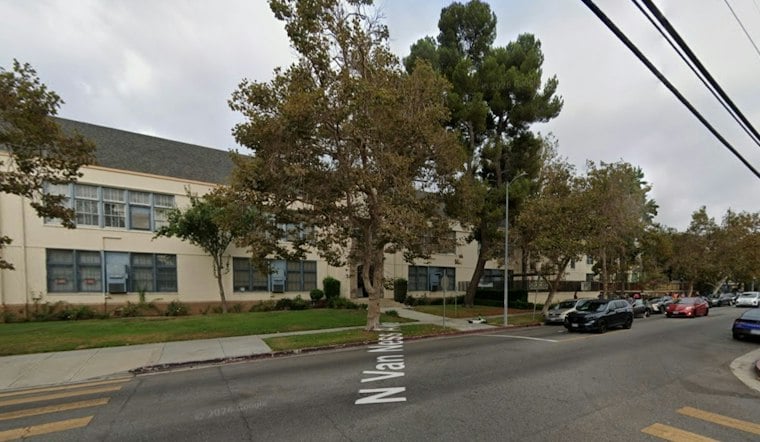
A specialized preschool classroom for blind and visually impaired children at Van Ness Elementary has been shut down after enrollment dropped to a single student, leaving at least one Los Angeles family scrambling for services their son needs. Pablo Noel, who is 4 and completely blind, attended the classroom before his family was notified it would close. When they returned to the school a few days later, he was turned away, and he has not attended the program since.
LAUSD discontinued the preschool program for blind and visually impaired children, according to KTLA, which first reported the closure. Pablo's mother, Adelina Campos, told the station that LAUSD officials informed her family the classroom would close because Pablo was its only enrolled student, and because of budget cuts. LAUSD itself said only that the classroom closed because of declining enrollment, noting that just one student was enrolled at the start of the current school year.
Campos said the district had kept the program open the previous year in hopes that enrollment would increase. Her family lives in San Pedro and used to drive roughly an hour each way to get Pablo to the classroom at Van Ness Elementary, which, according to the school's own website, serves visually impaired students alongside general education and preschool students.
A Child Waiting at Home
Since being turned away, Pablo has been at home, and Campos said he asks daily when he can return to school and see his friends. LAUSD recommended a neighborhood preschool as an alternative, but Campos said it was not equipped to meet her son's needs. She said staff at that school acknowledged they had never previously worked with a blind child.
Campos said a teacher responsible for 25 students would not have the time to teach Pablo in ways the staff did not already know how to use. She also raised safety concerns, saying that without close family supervision, Pablo may walk into a wall or otherwise injure himself.
What the Program Offered
Parents familiar with the classroom said it provided specialized instruction to help blind children develop skills that sighted children often pick up simply by observing the world around them. Diana LeVangie, whose son Eric attended the preschool and is now in first grade, said the program played a critical role in his development. She said Eric now reads braille and books independently, types quickly, and spells many words.
LeVangie said blind children must learn foundational concepts and navigation skills through direct instruction rather than by watching others, since a blind child has to learn basic concepts and how to move through space essentially from scratch. She said two other children were expected to age into the classroom, underscoring that the need for this kind of instruction was not disappearing even as enrollment dipped to one.
Where Families Can Turn Next
Preschool-aged blind or visually impaired children can still receive services through other programs with support from LAUSD's blind and low vision program, according to the seed facts in the case. Separately, Los Angeles Unified School District describes its broader Low Incidence Program as serving eligible students with documented low-incidence disabilities, including visual impairments, from ages 3 to 22, with support individualized and prescribed through each student's Individualized Education Program. The district's materials list orientation and mobility training and braille transcription among the services available under that program.
A federal regulation cited in the Electronic Code of Federal Regulations requires that placement decisions for a child with a disability, including a preschool-aged child, be made by a group that includes the parents and people knowledgeable about the child, evaluation data, and placement options, following least-restrictive-environment rules. That general requirement does not by itself establish whether the Van Ness closure or Pablo's individual placement complied with federal law.
A Pattern With Deep Roots
This is not the first time a specialized classroom for blind students tied to Van Ness Elementary has faced upheaval. In 2013, LAUSD combined Frances Blend, a dedicated school for blind students, with the neighboring Van Ness campus to form what the district called an integrated learning community, according to the Los Angeles Times. A former coordinator of LAUSD's visually impaired program said at the time that the small school was nonetheless a critical option for some visually impaired students. That same year, the Beverly Press reported that LAUSD was seeking to eliminate preschool programs at all of its special-education centers district-wide.
The latest closure also lands amid a broader budget squeeze across LAUSD. The district's enrollment was down 4.3% through the fifth week of the current school year, steeper than the 3.4% decline previously anticipated, the Los Angeles Times reported in September. LAUSD's chief financial officer, Saman Bravo-Karimi, estimated the steeper drop added a $60 million hurdle to this year's budget problems, and the paper reported that in a worst-case scenario, the district's deficit could grow to $3.5 billion by June 30, 2029. The Times also reported that LAUSD did not have a current plan identifying which campuses it would close.
Similar tensions have surfaced elsewhere this fall. In Portland, Oregon, families have said special-education students have been treated as an afterthought amid Portland Public Schools' closure planning, according to OregonLive. That district's superintendent acknowledged that initial closure scenarios, which included options affecting either 14 or 11 schools, had omitted information about students with Individualized Education Plans, calling it a mistake.
Fear of What Comes Next
For LeVangie, the Van Ness closure is about more than one classroom. She said the closure was heartbreaking and made her angry, and that it raises broader concerns for families seeking specialized instruction for blind students. She questioned who might be targeted next if a blind student could lose access to services like these.
For now, Campos is left navigating a system that recommended a neighborhood school her son's advocates say is not equipped for him, while Pablo waits at home asking when he can go back to class and see his friends again.



