

























































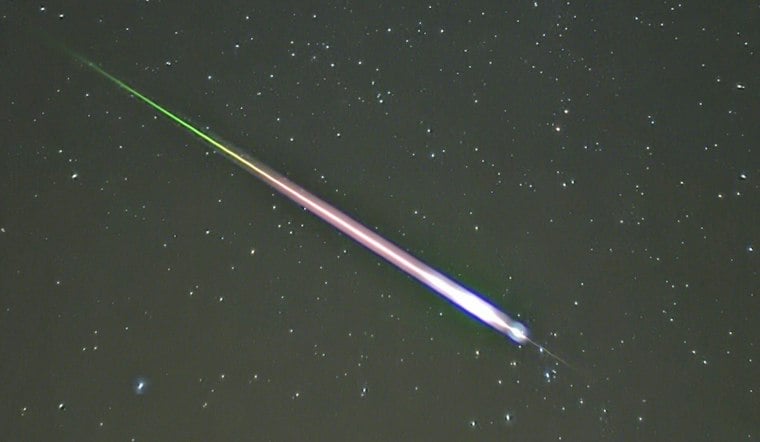
Skywatchers across North Texas have a chance to catch shooting stars overnight this week, as the annual Leonid meteor shower reaches its peak. The shower, active since Nov. 6, is expected to put on its best show in the early morning hours of Nov. 17 and 18, with some meteors bright enough to rival Venus.
The exact peak moment is a matter of some debate among forecasters. As reported by The Dallas Morning News, the shower peaks in the early morning hours of Nov. 17 and 18, 2026. The International Meteor Organization calendar lists the maximum at 23:45 UT on Nov. 17 with a zenithal hourly rate of about 15, while EarthSky predicts the peak will land at 0 UTC on Nov. 18, and Universe Today forecasts it for 3 a.m. UT on Nov. 17. EarthSky recommends watching late into the night on Nov. 17 until dawn on Nov. 18, adding that the morning of Nov. 17 could be worthwhile too.
The Leonids get their name from the constellation Leo, since the meteors appear to radiate from that part of the sky. Nilakshi Veerabathina, a physics professor at the University of Texas at Arlington, explained that the meteors are debris shed by a large comet burning up as it enters Earth's atmosphere, according to the Morning News. Those particles travel at roughly 44 miles per second, and some are classified as fireballs — explosions of light brighter than Venus — or as earth-grazers that streak near the horizon with long, colorful tails.
When and Where to Look
NASA says stargazers get the best view from about midnight until dawn local time, while Veerabathina told the Morning News the best viewing window is early dawn, usually between 3 a.m. and 6 a.m. During that stretch, the Leo constellation will be pretty much overhead, according to the Morning News' reporting. The Planetary Society notes that Leo rises in the east in the hours after midnight during November, and that the first-quarter Moon is expected to set around midnight, leaving darker skies for the pre-dawn hours.
Light pollution from city or street lights makes meteor viewing difficult, so the Morning News suggests heading to rural areas outside Dallas, which have less light pollution and can be good places to watch. One option highlighted in the area is Lakewood Village, an officially recognized International Dark Sky Community in Denton County. DarkSky International's page for the town notes it as a place to find good conditions for viewing the night sky, listing its coordinates as 33.1441, -96.9719. The Planetary Society similarly stresses that the most important factor for any meteor shower is getting to a dark location away from light pollution. Stargazers should arrive a little before their intended viewing time to let their eyes adjust to the darkness, per the Morning News.
How Many Meteors to Expect
Rate predictions vary depending on the source. NASA says Leonid showers typically produce fewer than three to 15 meteors per hour under ideal conditions, a figure echoed by the Planetary Society, which also expects about 15 meteors per hour at a dark site this year. Universe Today, meanwhile, projects a peak of about 20 meteors per hour in 2026. The IMO calendar adds that model calculations predict several low-density trail encounters between Nov. 17 and Nov. 19.
Veerabathina offered a personal benchmark for what a strong night can look like. She watched the meteor shower from the Himalayas with friends in 1999 and said they observed a few hundred meteors per hour, describing the show to the Morning News as beautiful. That kind of display is far beyond a typical year, but it illustrates how dramatically Leonid activity can swing.
The Rare Chance of a Meteor Storm
Every so often, the Leonids escalate into something far more dramatic than an ordinary shower. A Leonid meteor storm — defined by the Planetary Society as at least 1,000 meteors per hour — occurs roughly every 33 years, and EarthSky notes that these storms sometimes recur in cycles of 33 to 34 years. The last Leonid meteor storm occurred in 2002, according to the Morning News' reporting, with such storms capable of producing hundreds to thousands of meteors per hour.
The most extreme Leonid display on record came on the morning of Nov. 17, 1966, when EarthSky reports rates reached thousands of meteors per minute during a 15-minute span. Accounts of that storm's peak intensity differ: Space.com reports the 1966 shower produced 144,000 meteors per hour, while Universe Today put observed rates over the southwestern United States at an estimated 160,000 per hour. Space.com also notes that both the 1833 and 1966 Leonid storms produced meteor rates in the tens of thousands per hour.
Nothing on that scale is expected this year. Universe Today reports that current models don't predict major Leonid storms during the comet's 2031 or 2064 passes, identifying 2099 as the next great storm year. For now, North Texans with clear skies and a bit of patience can still catch a steady trickle of shooting stars this week — just don't expect the sky to light up like it did in 1966.



