

























































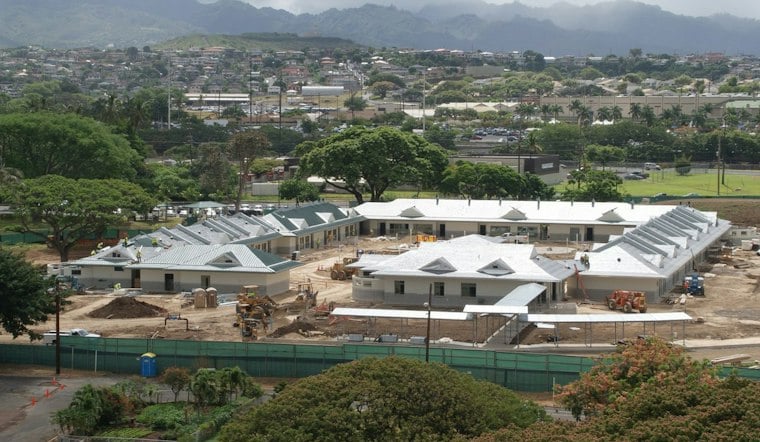
Navy leaders and construction partners gathered at Joint Expeditionary Base Little Creek-Fort Story last month to sign and hoist one of the final wooden beams on the base's new child development center, a milestone known in construction circles as topping out. The $52 million facility, once finished, is designed to serve up to 300 children from infancy through age five.
The beam-signing and topping-out ceremony took place Oct. 29, according to einpresswire.com, with project leaders signing one of the last wooden beams for the facility's north building before it was hoisted into place. An evergreen tree and an American flag were secured to the beam as it was set, a nod to a tradition builders have used for generations to mark a structure reaching its full height.
At the time of the ceremony, the project was reported as roughly 17 percent complete and on schedule for completion in June 2027, per the same report. That timeline differs from what was reported at the project's Jan. 6, 2026 groundbreaking, when the center was described as scheduled for completion in 2028, according to dvidshub.net. Neither account explains what changed between the two estimates.
A Commanding Officer's Case for Child Care
Capt. Katie Jacobson, JEB Little Creek's commanding officer, said military families deserve world-class support for their sacrifices. She has argued that accessible child care supports military-connected parents and strengthens the workforce and community by helping retain talent, according to The Virginian-Pilot.
The project's next construction phase is expected to include installation of the roof and exterior walls in late November, the same report notes. Once complete, the facility will measure 41,000 square feet and include 25 activity rooms, administrative spaces, a kitchen and age-appropriate playgrounds, the paper reported.
A separate accounting from DVIDS described the same future building as supporting up to 300 children across 41,000 square feet, with 25 activity rooms and five age-appropriate playgrounds. Notably, the project's own architect, RRMM, lists different numbers altogether, describing a 36,101-square-foot design-build project with 26 activity rooms for up to 305 children — a discrepancy the available reporting doesn't reconcile.
Built Through a Pentagon Pilot Program
The center broke ground in January 2026 and was selected as a pilot effort for the use of Other Transactional Authority through the Defense Innovation Unit, which awarded the project agreement on Aug. 14, 2024, per DVIDS. A NAVFAC Mid-Atlantic project management director described it as the first Navy military construction project delivered through an OTA approach, according to the einpresswire.com report.
The project also incorporates prefabricated, industrialized construction techniques intended to reduce timelines and improve quality, DVIDS reported. RRMM says the facility and its site features were designed and constructed to meet at least LEED Silver certification.
Part of a Broader Push on Military Child Care
The Little Creek project fits into a wider Navy effort to expand child care capacity across its installations. A Navy Installations Command report cited in earlier local coverage found that child development and school-age-care waitlists worldwide had fallen by half, from 5,000 to about 2,500, according to a Jan. 12, 2026 pilotonline.com article that described the Little Creek center as part of a $52 million undertaking to expand facilities and grow services.
Little Creek's current child development center, which opened in 2012 at a cost of $10 million, was built to serve 306 children across 36,000 square feet with 26 classrooms, according to a 2012 Virginian-Pilot report. That center's opening, combined with renovations and reopenings of two smaller centers, was expected at the time to cut the base's waitlist from about 380 children to about 90.



