

























































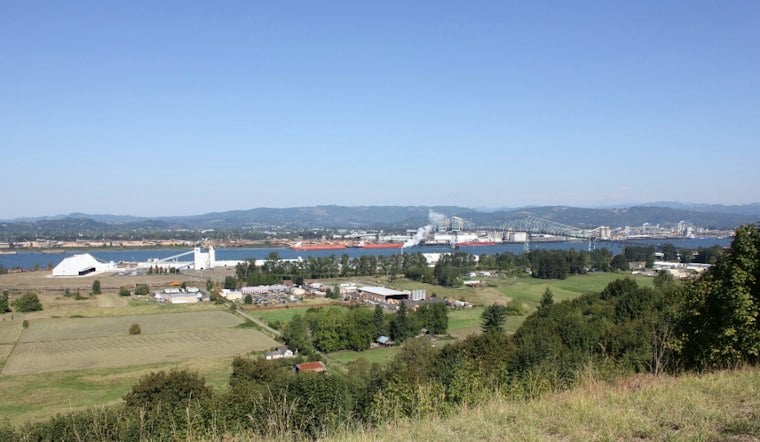
A stretch of Port of Longview waterfront that has sat empty since 1989 could soon see development of a potash export terminal. The Port of Longview and fertilizer giant Nutrien have outlined tentative agreements to build a potash export terminal at Berth 4, a deal that could bring between $500 million and $1 billion in private investment to the Cowlitz County waterfront.
A Long-Vacant Berth Gets New Life
Berth 4 has sat without a tenant since the Continental Grain terminal shut down there in 1989, according to André Stepankowsky. Under the newly outlined terms, the port would lease up to 105 acres of its property to Nutrien for the project, with the lease running 50 years and including three 10-year renewal options, port's director of planning and environmental services Lisa Hendricksen said. The proposed terminal itself would be built to store 200,000 metric tons of potash, according to The Seattle Times, which first reported the tentative deal.
The agreement is still described as a non-binding, procedural step, as reported by The Globe and Mail, with Nutrien's final investment decision not expected until 2028. Port staff and Nutrien still have further design, engineering, regulatory and permitting work ahead of them before anything is finalized, per a report from KLOG.
What the Port and Nutrien Stand to Gain
The financial structure of the deal is detailed and layered. The proposed lease sets base rent at roughly $2.3 million per year, with additional maintenance, rail and wharfage fees on top, according to the Seattle Times report. Nutrien has also committed to minimum wharfage payments starting at $1 million in year one and escalating to $4 million by year four, with the port projected to receive roughly $4 million for every 2 million metric tons of potash shipped, and roughly $10 million for every 5 million metric tons.
On the port's side of the ledger, a site preparation agreement worth roughly $110 million would cover the buildout — $30.7 million for acquiring neighboring properties and relocating other tenants, and $33.7 million for constructing Nutrien's dock. The port and Nutrien are weighing public-private partnerships to fund that dock, with upfront costs potentially recouped through future port revenues or state funding, the same report notes. The Globe and Mail separately reports the port's $110 million berth-development spend could be partly repaid to Nutrien through credits on future cargo fees.
Jobs, Timeline and a Looming Vote
The proposal now heads to a Port of Longview hearing scheduled for the evening of November 16, where commissioners are expected to vote on the agreements, per the port's own reporting cited by Stepankowsky. Hendricksen cautioned that the revenue estimates rely on many assumptions, while CEO Ken Anderton said the project would involve a lengthy process — one that requires businesses to move, buildings to be demolished, and years of construction and permitting before anything ships. Reports diverge on where Nutrien's own corporate approval stands: one account says the agreements are still awaiting Nutrien board sign-off, while another, citing port officials, says that board has already approved them.
If built, the terminal would have annual export capacity of 5 million to 8 million metric tons of potash, with construction potentially beginning around 2032 and continuing into 2033. Trains carrying shipments from Saskatchewan mines would arrive at the site every one to two days, with vessels departing every two to three days to carry the fertilizer additive around the world by river and rail. The potash exported from Longview would ship to fast-growing agricultural markets in the Indo-Pacific, including China, India and Japan, according to the Globe and Mail.
Competing Job Estimates and Economic Stakes
Two separate economic analyses have tried to size up the project's local impact, though their scopes differ and the figures should not be treated as directly comparable. A port-commissioned analysis estimates 432 direct jobs and a total of 1,082 indirect and induced jobs in the county, per the Globe and Mail. A separate analysis cited by Stepankowsky projects 660 construction jobs across Washington and Oregon between 2027 and 2032, plus 315 permanent jobs statewide by 2032, including about 190 in Cowlitz County. The Port of Longview proposal is also expected to create hundreds of construction jobs on its own, according to the Seattle Times.
Anderton said the project aligns with Nutrien's motto and that the port appreciates being part of it, adding that port staff are ready to proceed if the proposal is approved and are excited to work with the company. Nutrien is the world's largest potash producer, according to Anderton, with operations spanning all facets of potash manufacturing, sales and distribution. The company has a presence in 40 countries, is listed on both the New York Stock Exchange and Toronto Stock Exchange, and operates more than 30 locations in Washington state selling agricultural products. Potash itself is an alkaline potassium compound used in fertilizer to improve crop yields, strengthen roots and improve drought resistance.
Why Longview Over a Canadian Port
Nutrien identified Longview as its preferred site after assessing potential expansion locations in earlier reports. The choice has drawn attention north of the border: a report from the Chamber of Shipping's Shipping Matters outlet said Nutrien's preference for Longview over Canadian ports has raised concerns about Canada's ability to attract major export infrastructure investments. The Globe and Mail has also reported that Vancouver and Prince Rupert were among the Canadian ports Nutrien considered.





