

























































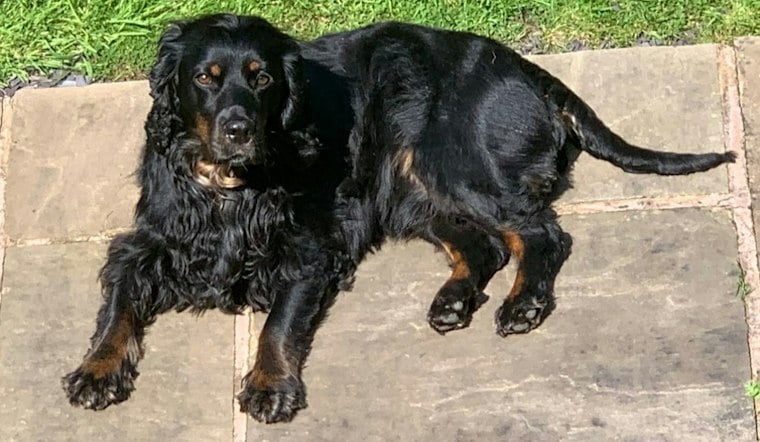
Corduroy the Cocker Spaniel disappeared in Los Angeles back in 2019, right as his family was packing up to move to San Diego. Seven years later, he turned up at a city shelter, and this time his microchip did what it was designed to do: it brought him home.
Corduroy arrived at LA Animal Services’ North Central Shelter last month, according to Yahoo. Per LA Animal Services, Corduroy had vanished while his family was in the middle of relocating from Los Angeles to San Diego in 2019, and his disappearance was especially hard on one family member's young daughter. Staff scanned him for a microchip, as the agency does with every animal that comes through its doors.
A Years-Long Mystery Solved by a Scan
Thanks to that microchip, Corduroy's family was found, and they reunited with their cherished pooch, as reported by KTLA. The family, who still lives in San Diego, made the drive up to the North Central Shelter to bring Corduroy home, closing out a seven-year gap with a single scan of a chip implanted long before he ever went missing. LA Animal Services shared before-and-after photos showing a young girl with Corduroy, taken seven years apart, as a visual marker of just how long the dog had been gone.
The reunion is also a case study in why shelters keep pushing microchipping as a baseline safety net. LA Animal Services notes that all animals admitted to its shelters are scanned for a microchip, which is precisely the step that connected Corduroy back to his people. The agency also advises owners to update their address with the microchip company whenever they move, a detail with obvious relevance to a dog whose family disappeared mid-move in the first place.
The Numbers Behind the Reunions
LA Animal Services says it reunited 3,347 pets with their families in 2025 alone, underscoring that Corduroy's case, while striking for its seven-year timeline, fits into a much larger pattern the agency handles routinely. The city's six LA Animal Services centers offer microchipping for $15 with no appointment necessary, making it one of the more accessible preventive steps available to local pet owners.
Outside research backs up why shelters lean so heavily on the technology. A Human Animal Support Services analysis of 17 government-funded shelters found that, on average, pets with a microchip were over three times more likely to be reunified with their families than those without one. The same analysis found that only about 18 percent of stray pets, roughly one in six, had a microchip at intake, and that from 2019 to 2021 in HASS pilot shelters, 57 percent of chipped dogs made it home compared with 22 percent of chipped cats.
Why Registration Details Matter as Much as the Chip
The American Veterinary Medical Association has found that lost dogs with microchips are returned to their owners at more than twice the rate of those without, a statistic LA Animal Services cites on its own site. A separate fact sheet from the Ohio State University Indoor Pet Initiative reports that median shelter return-to-owner rates were 2.4 times higher for microchipped dogs and 21.4 times higher for microchipped cats compared with strays overall, figures that make the gap in outcomes hard to ignore.
Still, researchers caution that the chip itself is only part of the equation. A microchip is only as good as the information it links to, according to the same Human Animal Support Services analysis, which is why keeping registration details current after a move or change of contact information remains essential. For Corduroy's family, that underlying system, built on scanning, registration, and a bit of luck, finally closed a gap that had stretched for seven years.





