

























































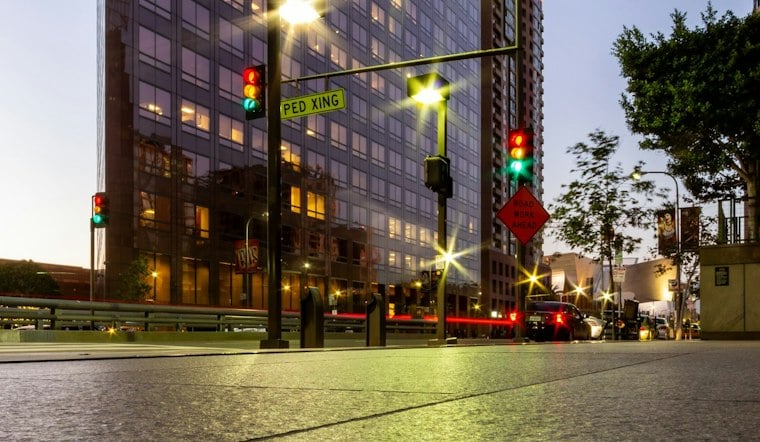
Los Angeles has started replacing wired street lights with self-contained solar fixtures, and it is using poles that are already standing. More than 1,000 are up. The conversion began in October.
First Light Technologies, based in Victoria, Canada, announced the installation Monday. A sponsored account on Smart Cities Dive says Los Angeles Public Works employees retrofitted the company's SCL3 luminaires onto existing mast arms and horizontal tenons, replacing wired lights with fixtures set at a fixed 4,000-lumen output.
Same Arm, Different Lamp
FLT says the SCL3 replaces a standard wired cobra-head fixture while preserving the light origin at the end of the mast arm. The beam still starts where the old one did. The pole stays put.
A mast arm is the pipe that reaches out over the street. A horizontal tenon is the end fitting the fixture mounts on. Leave those in place, and a crew is changing the lamp rather than rebuilding the pole line.
The company says the unit can retrofit previously wired poles regardless of power wires, trees, or buildings. Panel, battery, and lamp come as one piece, so the swap does not depend on trenching a new electrical run to that arm.
In FLT's account, wired lighting is prone to power outages, copper-wire theft, and the cost of that trenching. A self-contained solar head is the product built to step around all three: no copper feed on that pole to cut, and no new ditch to reach it.
Under a 60,000-Light Ceiling
The sponsored account places the installation inside a wider city effort. In March, Mayor Karen Bass launched an initiative to repair or replace up to 60,000 street lights over two years using solar lighting.
More than 1,000 SCL3 fixtures is a real installation. Set next to an initiative capped at 60,000 repairs or replacements, it is an early reported piece of a much larger ceiling, not the ceiling itself.
That conversion started in October, seven months after the mayor's launch. Measured from March, a two-year push runs into 2028. The method described for these lights is plain: city crews, existing mast arms, a solar luminaire, and a fixed 4,000 lumens.
Panels, Batteries, and a Remote Login
FLT says its Active Cell solar panels and ChargeLogic MPPT technology let cities harness, store, and use solar energy so streets stay lit night after night. On its own site, the company draws a sharp comparison on batteries. Conventional solar-lighting batteries, First Light Technologies says, can fail in as few as 400 cycles. Its LiFePO4 batteries are engineered for more than 2,000.
A cycle, in that comparison, is one charge and discharge. FLT is setting an engineered service life against the early-failure figure it cites for conventional solar-lighting batteries, and selling that margin as the reason a city would not be back up the pole as often.
Link is the remote layer. FLT says the system gives worldwide access to fixtures through LPWA cellular connectivity, with time-based or duration-based lighting profiles, astronomical timing for dusk and dawn thresholds, motion sensing, and performance statistics. Those statistics include battery state of charge and output power. Astronomical timing, as FLT lists it, follows dusk and dawn rather than one clock setting.
From Victoria to a Los Angeles Arm
FLT says it has operated as a commercial-grade solar lighting manufacturer for 17 years and has manufactured 60,000 solar lights installed in 33 countries. Against that lifetime figure, the Los Angeles announcement is more than 1,000 lights: a city-scale job on the company's books, and a small share of what FLT says it has built.
Scott Douglas, vice president of sales and marketing, said, "FLT is proud to illuminate the streets of Los Angeles with technologically advanced, reliable and efficient solar lights." The fixture retrofits, in the project account, were handled by Los Angeles Public Works employees.
FLT also says technicians and residents were satisfied with the installation and the first night the lights came on. The hardware is already specific: a solar head at the end of the mast arm, where the wired cobra head used to sit. The two-year window Bass opened in March still runs into 2028.



