

























































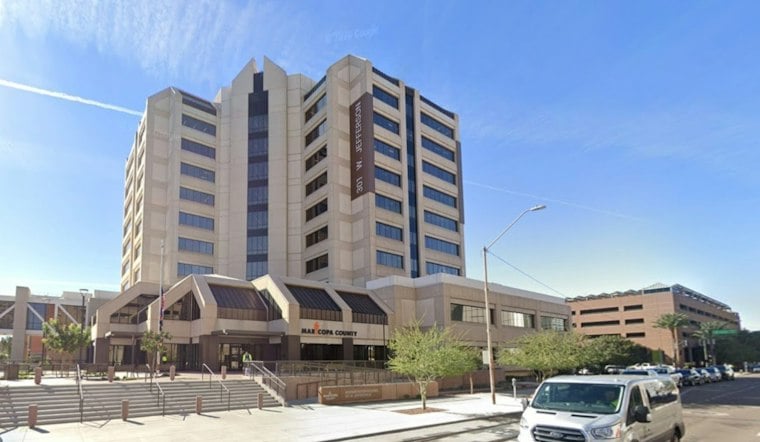
Maricopa County just got federal approval for a new way to earn emissions-reduction credits by cleaning up old vehicles on the road, but an environmental advocate is warning that the fine print could let heavy industrial polluters off the hook instead of tightening the screws on them. The U.S. Environmental Protection Agency approved the county's Rule 205, which lets owners of vehicle fleets earn credits by replacing or upgrading high-emitting on-road vehicles, and had also proposed approval of a companion measure, Rule 204, covering non-road vehicles like construction equipment and locomotives.
Sandy Bahr, director of the Grand Canyon Chapter of the Sierra Club, laid out her concerns in an interview with KJZZ. She explained that Rule 204 is a voluntary program, and its real consequence is that it allows emissions credits earned from cleaning up non-road engines to offset pollution from an entirely different category of polluter. “It's a voluntary program to provide for that. And the thing that it does is allow for emissions credits for stationary sources,” Bahr said, naming power plants, chip manufacturers and data centers as the kinds of stationary sources that could benefit.
A Voluntary Fix for a Mandatory Problem
Bahr's core objection is that trading credits between vehicle categories and permanent industrial facilities does not actually speed up progress toward cleaner air. “This is not a path to clean air faster. I see this as more of status quo or potential for backsliding,” she said, according to the same KJZZ interview. She argued that mandatory requirements are more enforceable than voluntary programs, and said she would rather see binding upgrades, emissions reductions and phaseouts imposed directly on heavily polluting vehicles and engines, alongside real reductions from stationary sources themselves.
Bahr also pointed to a regulatory decision she sees as softening the pressure on the county: the EPA kept Maricopa County's ozone classification at moderate rather than bumping it to serious, which she said would have triggered more stringent requirements. Her worry is less about what the rule explicitly permits than about what it quietly enables, since offsetting pollution from a stationary source should not, in her view, translate into more pollution allowed in the same area.
A Glendale Gas Plant in the Mix
Among the facilities Bahr says could be facilitated by the new credit program is a gas-fired power plant proposed in Glendale, which she described as a 700-megawatt facility. AZCentral reported that Project Baccara, a natural-gas power plant planned alongside the Project Eagle data center, is a 744-megawatt facility. AZCentral also reported that the county's air quality department had not made a final decision on whether to treat the power plant and data center as a single emissions source, noting the projects could be evaluated separately if they can show they are not dependent on one another or under common control.
Bahr said her bottom-line concern is simply that the program will not improve air quality, and acknowledged there is a legal backstop built into federal law. She cited the Clean Air Act's no-backsliding provision, saying that if the program were demonstrated to worsen air quality, “it would not be able to be implemented.”
County Leadership Frames It as Balance
Not everyone sees the new rules as a step backward. Maricopa County Board of Supervisors Chair Kate Brophy McGee has said Rule 204 could support economic development while preserving quality of life in the county, framing the credit system as a way to “maintain the quality of life, maintain what we value here in Maricopa County and support and drive the robust economic development,” according to an earlier KJZZ report on the county's push for federal approval.
That same report noted the county was seeking EPA sign-off for both Rules 204 and 205 as mechanisms that provide credits when vehicle owners upgrade or replace high-emission vehicles. For now, Rule 205 has cleared the EPA, while Rule 204 remains at the proposed-approval stage, leaving Bahr's warning about stationary-source offsets as an open question for whichever facilities, including the Glendale plant or projects like Project Baccara and Project Eagle, eventually seek to use the credits.





